Seven new luminescent mushroom species discovered
October 5, 2009
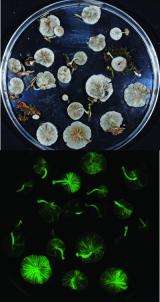
A new luminescent fungus, Mycena silvaelucens, discovered by San Francisco State University Professor Dennis Desjardin and former SF State graduate student Brian Perry has been reported in the journal Mycologia. The species was collected in the grounds of an Orangutan Rehabilitation Center in Borneo, Malaysia and was found on the bark of a standing tree. The mushrooms are tiny with each cap measuring less than 18 millimeters in diameter. Credit: Brian Perry, University of Hawaii
Seven new glow-in-the-dark mushroom species have been discovered, increasing the number of known luminescent fungi species from 64 to 71. Reported today in the journal Mycologia, the new finds include two new species named after movements in Mozart's Requiem. The discoveries also shed light on the evolution of luminescence, adding to the number of known lineages in the fungi 'family tree' where luminescence has been reported.
San Francisco State University Biology Professor Dennis Desjardin and colleagues discovered the fungi in Belize, Brazil, Dominican Republic, Jamaica, Japan, Malaysia and Puerto Rico. The discoveries include four species new to science and three new reports of luminescence in known species. Three quarters of glowing mushrooms, including the species described in the study, belong to the Mycena genus, a group of mushrooms that feed off and decompose organic matter as a source of nutrients to sustain their growth.
"What interests us is that within Mycena, the luminescent species come from 16 different lineages, which suggests that luminescence evolved at a single point and some species later lost the ability to glow," said Desjardin, lead author of the study. He believes that some fungi glow in order to attract nocturnal animals that aid in the dispersal of the mushroom's spores which are similar to seeds and are capable of growing into new organisms.
"It's pretty unusual to find this many luminescent species, typically only two to five percent of the species we collect in the field glow," Desjardin said. "I'm certain there are more out there."
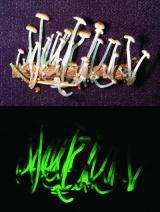
A new luminescent fungus, Mycena luxaeterna discovered by San Francisco State University Professor Dennis Desjardin and Professor Cassius V. Stevani from the University of Sao Paulo has been reported in the journal Mycologia. The species was collected in Sao Paulo, Brazil and was found on sticks in an Atlantic forest habitat. These mushrooms are tiny with each cap measuring less than 8 millimeters in diameter and their stems have a jelly-like texture. The species' name was inspired by Mozart's Requiem. Credit: Cassius V. Stevani, Chemistry Institute, University of Sao Paulo
The newly discovered fungi glow constantly, emitting a bright, yellowish-green light, and are tiny, with caps smaller than one centimeter across.Desjardin has named two of the new species Mycena luxaeterna (eternal light) and Mycena luxperpetua (perpetual light), names inspired by Mozart's Requiem and the fact that these mushrooms glow 24 hours a day. To date, Desjardin has discovered more than 200 new fungi species and together with these latest findings, has discovered nearly a quarter of all known luminescent fungi.
More information: "Luminescent Mycena: new and noteworthy species" was published online in the journal Mycologia on Oct. 5 and will appear in the March/April 2010 print issue.
-
International experts collect alpine fungi in Beartooth Mountains of Montana
Sep 08, 2008 |
not rated yet |
0
-
Long-term co-evolution stability studied
Jun 27, 2006 |
not rated yet |
0
-
Tree-killing fungus officially named by scientists
Jun 30, 2008 |
not rated yet |
0
-
The Evolution of Our Fungi Relatives
Oct 19, 2006 |
not rated yet |
0
-
New light shed on marine luminescence
Feb 23, 2009 |
not rated yet |
0
-
Engineers build first sub-10-nm carbon nanotube transistor
Feb 01, 2012 |
4.9 / 5 (30) |
30
-
Something old, something new: Evolution and the structural divergence of duplicate genes
Jan 31, 2012 |
4.6 / 5 (7) |
1
-
The hidden nanoworld of ice crystals: Revealing the dynamic behavior of quasi-liquid layers
Jan 30, 2012 |
5 / 5 (3) |
1
-
Stock market network reveals investor clustering
Jan 27, 2012 |
3.9 / 5 (23) |
8
-
Of microchemistry and molecules: Electronic microfluidic device synthesizes biocompatible probes
Jan 26, 2012 |
5 / 5 (1) |
0
-
Any books/articles for evolutionary stable strategy models in humans?
4 hours ago
-
Science behind the bore feeling?
11 hours ago
-
Homo Sapien vs. Chimpanzee - Divergence Timeline
15 hours ago
-
a single mRNA strand is attached to sevaral ribosomes?
Feb 08, 2012
-
Oestrogen and FSH
Feb 07, 2012
-
Linear Blood Vessel Network Examples in Animals or Plants
Feb 07, 2012
- More from Physics Forums - Biology
More news stories
Ultraviolet protection molecule in plants yields its secrets
Lying around in the sun all day is hazardous not just for humans but also for plants, which have no means of escape. Ultraviolet (UV) radiation from the sun can damage proteins and DNA inside cells, leading ...
1 hour ago |
5 / 5 (1) |
0
|
Deciding to go left or right: Researchers use device to determine that lower animals can navigate too
For decades, scientists have associated binary decision making opting to go left or right with higher-ranking animals, including humans. A team of Harvard researchers, however, is rewriting that ...
7 hours ago |
not rated yet |
2
|
New Zealand team finds early plant arrivers dominated landscape
(PhysOrg.com) -- It seems intuitive that not all plant species could have taken a foothold on land at the same time all those millions of years ago as conditions on Earth evolved to the point where they could survive; some ...
Why are there so few fish in the Earth's oceans?
(PhysOrg.com) -- A Stony Brook University researcher has found that, contrary to popular belief, there are not plenty of fish in the sea.
23 hours ago |
4.3 / 5 (12) |
25
|
Ocean warming causes elephant seals to dive deeper
Global warming is having an effect on the dive behaviour and search for food of southern elephant seals. Researchers from the Alfred Wegener Institute for Polar and Marine Research in the Helmholtz Association cooperating ...
5 hours ago |
not rated yet |
0
Deconstructing a mystery: What caused Snowmaggedon?
In the quiet after the storms, streets and cars had all but disappeared under piles of snow. The U.S. Postal Service suspended service for the first time in 30 years. Snow plows struggled to push the evidence ...
Flexible paper robots
(PhysOrg.com) -- These inexpensive robots can stretch, bend and twist under control, and lift objects up to 120 times their own weight. Being soft, they can apply gentle and even pressure, and adapt to varied ...
Materials that shrink when heated
One common reason that people with fillings experience toothache is that their fillings expand at a different rate to the original tooth when, for example, drinking a hot drink. Contrary to intuition, however, ...
Hydrogen from acidic water: Researchers develop potential low cost alternative to platinum for splitting water
A technique for creating a new molecule that structurally and chemically replicates the active part of the widely used industrial catalyst molybdenite has been developed by researchers with the Lawrence Berkeley ...
Researchers weigh in on ethics of H5N1 research
(Medical Xpress) -- In a commentary on the biosecurity controversy surrounding publication of bird flu research details, a bioethicist and a vaccine expert at Johns Hopkins reaffirm that "all scientists have an affirmativ ...
FDA-approved drug rapidly clears amyloid from the brain, reverses Alzheimer's symptoms in mice
Neuroscientists at Case Western Reserve University School of Medicine have made a dramatic breakthrough in their efforts to find a cure for Alzheimer's disease. The researchers' findings, published in the journal Science, show t ...
