Bizarre new horned tyrannosaur from Asia described
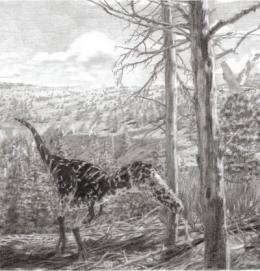
Now, just a few weeks after tiny, early Raptorex kriegsteini was unveiled, a new wrench has been thrown into the family tree of the tyrannosaurs. The new Alioramus altai—a horned, long-snouted, gracile cousin of Tyrannosaurus rex—shared the same environment with larger, predatory relatives. A paper published this week in the Proceedings of the National Academy of Sciences describes this exceptionally well-preserved fossil, shedding light on a previously poorly understood genus of tyrannosaurs and describing a new suite of adaptations for meat eating.
"This spectacular fossil tells us that there is a lot more anatomical and ecological variety in tyrannosaurs than we previously thought," says Stephen Brusatte, a graduate student affiliated with the American Museum of Natural History. "Not all tyrannosaurs were megapredators adapted for stalking and dismembering large prey. Some tyrannosaurs were small and slender. Compared to Tyrannosaurus, this new animal is like a ballerina."
Mark Norell, Chair of the Division of Paleontology at the Museum, agrees. "We now have evidence of two very different tyrannosaurs that lived in Asia at the same time and place—just like today, where lions and cheetahs live in the same area but look dissimilar and exploit their environment differently."
Tyrannosaurs are bipedal predators that lived at the end of the Cretaceous (from 85 million years to approximately 65 million years ago) is currently known from several groups of fossils. One subfamily from North America includes Albertosaurus and Gorgosaurus, while the other subfamily bridges Asia and North America and includes Tyranosaurus, Tarbosaurus, and Alioramus. Both T. rex and Tarbosaurus are remarkably similar, even though they lived on different continents; both were predators with massive jaws and thick teeth that could crunch through bones. In fact, bite marks have been found on some fossils that were prey. Until now, Alioramus was known only from fragmentary fossils that were briefly described decades ago by a Russian paleontologist, and it has long been debated whether Alioramus was a proper tyrannosaur, a more primitive cousin, or perhaps a juvenile Tarbosaurus.
The new specimen and species, A. altai, was found on a 2001 Museum expedition to the Gobi Desert of Mongolia led by Norell and Michael Novacek. In fact, it was found at the same site as a Tarbosaurus fossil. But although its skeleton is anatomically similar to this larger relative, A. altai is half the size; the reconstructed size is about 369 kilograms, or 810 pounds. It is the skull that is dramatically different from close relatives. Although this dinosaur was carnivorous, the teeth are slender, the skull has small and weak muscle attachments, and the skull has a long snout with eight horns that were probably about five inches in length, features never seen in a tyrannosaur before.
Analysis of the braincase, though, ties the new species closely to tyrannosaurs. CT scans of the brain by co-author Gabe Bever, also of the Museum, show the large air sacks, huge olfactory bulbs, and the small inner ear expected for a tyrannosaur. Another co-author, Gregory Erickson, of Florida State University, analyzed the microstructure of the bone to determine that this animal died as a nine year old, essentially a teenager at 85% of its adult size.
"This fossil reveals an entirely new body type among tyrannosaurs, a group we thought we understood pretty well," says Norell. "The different body forms probably allowed Alioramus and Tarbosaurus to coexist."
Brusatte agrees, "A. altai probably fed differently from its larger cousin, going for smaller prey because it could not crunch through bone like its larger relatives."
Source: American Museum of Natural History


