Italian group claims to debunk Shroud of Turin (Update)
October 5, 2009 Italian group claims to debunk Shroud of Turin (AP)

Enlarge

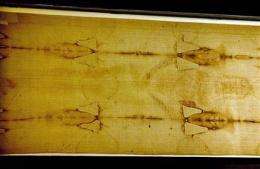
FILE - In this Aug. 12, 2000 file photo, The Holy Shroud, a 14 foot-long linen revered by some as the burial cloth of Jesus, is shown at the Cathedral of Turin, Italy. A group of Italian debunkers is claiming it has proved that the Shroud of Turin - revered as the cloth that covered Jesus in the tomb - was man-made. The shroud bears the image of a crucified man. Believers say Christ's image was recorded on the fibers at the time of his resurrection. The Italian Committee for Checking Claims on the Paranormal said Monday Oct 5, 2009 that scientists have reproduced the shroud using materials and methods that were available in the 14th century. (AP Photo/Antonio Calanni, file)

(AP) -- Scientists have reproduced the Shroud of Turin - revered as the cloth that covered Jesus in the tomb - and say the experiment proves the relic was man-made, a group of Italian debunkers claimed Monday.

The shroud bears the figure of a crucified man, complete with blood seeping out of nailed hands and feet, and believers say Christ's image was recorded on the linen fibers at the time of his resurrection.

Scientists have reproduced the shroud using materials and methods that were available in the 14th century, the Italian Committee for Checking Claims on the Paranormal said.

The group said in a statement this is further evidence the shroud is a medieval forgery. In 1988, scientists used radiocarbon dating to determine it was made in the 13th or 14th century.

But the dispute continued because experts couldn't explain how the faint brown discoloration was produced, imprinting on the cloth a negative image centuries before the invention of photography.

Many still believe that the shroud "has unexplainable characteristics that cannot be reproduced by human means," lead scientist Luigi Garlaschelli said in the statement. "The result obtained clearly indicates that this could be done with the use of inexpensive materials and with a quite simple procedure."

The research was funded by the debunking group and by an Italian organization of atheists and agnostics, he said.

Garlaschelli, a professor of chemistry at the University of Pavia, said in an interview with La Repubblica daily that his team used a linen woven with the same technique as the shroud and artificially aged by heating it in an oven and washing it with water.

The cloth was then placed on a student, who wore a mask to reproduce the face, and rubbed with red ochre, a well known pigment at the time. The entire process took a week, Repubblica said.

The shroud is first recorded in history around 1360 in the hands of a French knight - a late appearance that is one of the reasons why some scientists are skeptical of its authenticity.

Measuring 13 feet (4 meters) long and three feet (one meter) wide, it has suffered severe damage during the centuries, including from fires.

Owned by the Vatican, it is kept locked in a special protective chamber in Turin's cathedral and is rarely shown. The last public display was in 2000, when more than 1 million people turned up to see it, and the next is scheduled for 2010.

The Catholic Church makes no claims about the relic's authenticity, but says it is a powerful symbol of Christ's suffering.

The shroud has been strongly debated within the scientific community. Some researchers claim that patches used in the Middle Ages to repair the cloth after a fire altered the carbon-dating results.

Another study, by the Hebrew University, concluded that pollen and plant images on the shroud showed it originated in the area around Jerusalem sometime before the eighth century.

Garlaschelli told Repubblica he didn't think his research would convince those who have faith in the shroud's authenticity.

"They won't give up," he said. "Those who believe in it will continue to believe."

--

On the Net:

The debunking group (in Italian): http://www.cicap.org/

Shroud Web site of the Turin diocese: http://www.sindone.org/

©2009 The Associated Press. All rights reserved. This material may not be published, broadcast, rewritten or redistributed.


print this article email this article download pdf blog this article bookmark this article     Stumble it Digg this share on Facebook retweet share on Reddit add to delicious
Rate this story - 4.8 /5 (12 votes)


October 5, 2009 all stories

Comments: 0

4.8 /5 (12 votes)
  • Stumble this up

  • Digg this

  • share this

  • hide
  • Related Stories

  • Age test of Shroud of Turin planned
    created Feb 25, 2008 | popularity not rated yet | comments 0
  • Turin Shroud confirmed as a fake
    created Jun 21, 2005 | popularity not rated yet | comments 0
  • Italy dig unearths female 'vampire' in Venice
    created Mar 14, 2009 | popularity not rated yet | comments 0
  • Experts split on supposed Jesus tomb
    created Jan 18, 2008 | popularity not rated yet | comments 0
  • Medieval ruins found near Stockholm castle
    created Oct 26, 2007 | popularity not rated yet | comments 0


  • hide
  • Relevant PhysicsForums posts

  • Is there a gay gene?
    created 13 hours ago
  • Super quick question about Starling forces?
    created Nov 22, 2009
  • Questions about diffusion
    created Nov 22, 2009
  • Human Leukocyte Antigen (HLA) typing
    created Nov 21, 2009
  • More from Physics Forums - Biology

Other News

As robots become more common, Stanford experts consider the legal challenges

Other Sciences / Social Sciences

created 4 hours ago | popularity 4 / 5 (1) | comments 0

(PhysOrg.com) -- They already detect and defuse bombs, control traffic patterns and do some basic household chores. And scientists predict that pretty soon, robots will be using artificial intelligence to play a larger role ...


Climate change could boost incidence of civil war in Africa

Other Sciences / Social Sciences

created 6 hours ago | popularity 1.6 / 5 (7) | comments 4

Climate change could increase the likelihood of civil war in sub-Saharan Africa by over 50 percent within the next two decades, according to a new study led by a team of researchers at University of California, Berkeley, ...


The cause behind the characteristic shape of a long leaf revealed

The cause behind the characteristic shape of a long leaf revealed

Other Sciences / Mathematics

created 6 hours ago | popularity 5 / 5 (1) | comments 0

Applied mathematicians dissected the morphology of the plantain lily (Hosta lancifolia), a characteristic long leaf with a saddle-like arc midsection and closely packed ripples along the edges. The simple ...


Do kids benefit from homework?

Do kids benefit from homework?

Other Sciences / Social Sciences

created 2 hours ago | popularity not rated yet | comments 0

(PhysOrg.com) -- Homework is as old as school itself. Yet the practice is controversial as people debate the benefits or consider the shortcomings and hassles. Research into the topic is often contradictory ...


5-day delivery no sure cure for postal woes, economist says

Other Sciences / Economics

created 3 hours ago | popularity not rated yet | comments 0

Scaling back mail delivery from six days a week to five may be the best bet to stem mounting U.S. Postal Service losses, but could still be a gamble, says a University of Illinois economist who has studied the agency's persistent ...