NIU will use robotic submarine to explore melting occurring below Antarctic ice
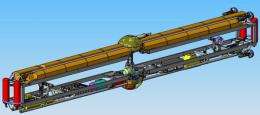
(PhysOrg.com) -- Northern Illinois University geologists are helping to lead a multi-million-dollar, five-year investigation of melting near the base of the West Antarctic Ice Sheet (WAIS) using a 24-foot-long robotic submarine that will be lowered through more than a half mile of ice into ocean water.
The National Science Foundation has already awarded $10 million in support of scientists at nine U.S. institutions involved in the research. A key project component is the robotic submarine, which is being built for NIU and is nearly completed.
While the device is the length of a ski boat, the robotic submarine will collapse to a width of only two feet, allowing it to be threaded down a drill hole melted through the ice. The submarine will be equipped with five cameras, a robotic arm with “fingers” for gathering samples and more bells and whistles than a Mercedes-Benz.
The unique technology will allow scientists for the first time ever to observe melting and other conditions at the interface between seawater and the base of the glacial ice. Scientists also will use the submarine to investigate the sea floor and layers of sediment beneath.
The information that will be gathered is critical to climate modelers trying to project potential future rises in global sea levels due to global warming. Substantial melting at the base of the ice shelf and ice sheet would lead to a more rapid sea-level rise.
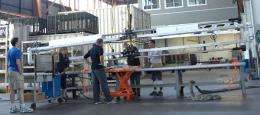
NSF awarded a grant of $2.5 million to NIU’s Ross Powell, a Distinguished Research Professor of Geology and Environmental Geosciences, for his lead role in the project. Powell and colleagues at NIU also received federal funding in 2004 for design and construction of the robotic submarine.
“We’ll be investigating some of the last unexplored aquatic environments on the planet,” Powell said. “One of our major objectives is to get to the bottom of the Ross Ice Shelf and West Antarctic Ice Sheet and see what’s going on. We know the ice is melting there, but we don’t know how fast.”
Glacial ice flows like a river to the sea, albeit at a much slower pace. Ice sheets are grounded on land, while ice shelves are floating on seawater.
Roughly the size of Alaska, the WAIS is the world’s only “marine ice sheet,” meaning that it sits atop bedrock that is below sea level. Its margins are surrounded by floating ice shelves. They include the massive Ross Ice Shelf, which is about one third the size of the ice sheet (or the size of Texas).
“Scientists don’t know for sure what's happening at the grounding line between the ice sheet and ice shelf, where the ice starts to float,” Powell said. “If the bottom of the ice sheet is resting on hard rock, the ice would flow more slowly into the sea. But a film of water or muddy sediment beneath the ice sheet would provide a lubricating layer, and the ice would slide or flow much faster, speeding up any rise in sea levels.”
NIU joins the University of California at Santa Cruz and Montana State University as lead institutions on the five-year program, known as WISSARD, for Whillans Ice Stream Subglacial Access Research Drilling. The project also will include a drilling investigation of Subglacial Lake Whillans. The interior lake is hidden beneath a thick layer of relatively fast moving grounded WAIS ice and may host a complex community of microbial life.
NIU’s Reed Scherer, a Presidential Research Professor of Geology and Environmental Geosciences, also is a key member of the research team. Both Powell and Scherer are well known internationally for their Antarctic geologic research related to global warming. NIU research scientist Stefan Vogel will be a major project contributor as well, and NIU undergraduates and graduate students are expected to participate in each of three research field seasons in the Antarctic.
Scherer during the 1990s led a team of scientists who confirmed the WAIS has been unstable and might have collapsed several times within the last 1 million years, raising sea levels by 18 feet. ANDRILL, an international geological drilling program co-led by Powell, recently corroborated the notion that the WAIS has collapsed many times over the past 2.5 million years due to warmer climates heating the ocean under the Ross Ice Shelf, which also collapsed.
“This is absolutely the first project of its kind,” Scherer said. “Ross came up with the idea of using a robotic submarine, and we first proposed a project like this nearly 10 years ago. It has tremendous potential. Up to now, all we know about conditions at the base of the ice is from theory and remote data from surface instruments. The submarine will provide scientists with images of the environment and physical, chemical and biological measurements of the ice, water and sediment conditions.
“There is a network of lakes, rivers, and streams trapped beneath the ice sheet, well below sea level,” Scherer added. “The water flows to the grounding line and empties into the ocean cavity beneath the ice shelf, like a river flowing into the ocean at a normal coastline. At times, inland lakes beneath the ice, such as Subglacial Lake Whillans, fill up with water and then drain catastrophically. We want to find out what happens to that water, and the sediments and microbes it carries, and how these events influence ice sheet dynamics.”
The expedition will not be without adventure. Using sleds and tractors, teams will haul the robotic submarine and drilling equipment hundreds of miles across the Ross Ice Shelf before arriving at the drilling destinations. A drill that converts snow to hot water will be used to melt through nearly 3,000 feet of ice, creating a 3-foot-wide entry for the submarine and other instruments.
Drilling to reach the ice sheet grounding line will begin in late 2012, although a dry run will be performed in the Antarctic toward the end of the previous field season. Drilling through the WAIS and into Subglacial Lake Whillans will be conducted in late 2011.
Deep Ocean Exploration and Research (DOER) Marine of Alameda, Calif. was contracted to build the robotic submarine. It will be equipped with lights, sonar and instrumentation for recovery of ice and sediment borings and seawater samples. During explorations, the submarine will be tethered by fiber optic cables to equipment on the surface allowing it to transmit real-time images from beneath the ice shelf.
“It’s quite complex,” Powell said. “We expect to collect a huge amount of data.”
Provided by Northern Illinois University


