Two NASA satellites capture monster Super Typhoon Melor
October 5, 2009
Two NASA satellites capture monster Super Typhoon Melor

Enlarge

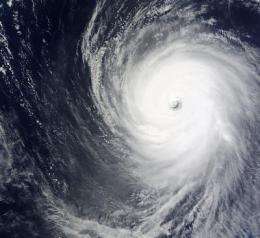
The Moderate Imaging Spectroradiometer (MODIS) instrument on NASA's Terra satellite captured an image of Super Typhoon Melor in the Western Pacific Ocean during the early morning hours of Oct. 5, 2009. Melor has intensified to Super Typhoon strength and is currently a category 5 typhoon (with maximum sustained winds near 161 mph) on the Saffir Simpson scale. Credit: NASA MODIS Rapid Response Team

NASA's Terra and Aqua satellites flew over Super Typhoon Melor early today, October 5 and captured some impressive images of the storm's clouds on a track toward Japan. The Western Pacific Ocean has the edge on super typhoons, and Melor's maximum sustained winds near 161 mph are more proof.

Typhoon Melor tracked through the channel between Saipan and Agrihan on Saturday night, and became a Super Typhoon on Sunday. Melor's winds dropped to 130 mph just before it passed near the island of Saipan this weekend and it was far enough away to not cause any major damage, according to local news reports. Downed trees and heavy rain were experienced Saturday afternoon and overnight into Sunday (local time), but no major flooding was reported.

On October 5 at 5 a.m. EDT (0900 UTC), Super Typhoon Melor's winds were up to 161 mph, and it was located approximately 585 nautical miles southeast of Okinawa, near 19.6 North and 134.3 East. Melor is moving west-northwestward at 19 mph.

NASA's Terra satellite flew over Melor during the early morning hours on October 5. The Moderate Imaging Spectroradiometer (MODIS) instrument on Terra provided a dramatic image of Melor at Category 5 strength on the Saffir-Simpson scale with maximum sustained winds near 161 mph!
Two NASA satellites capture monster Super Typhoon Melor
Enlarge

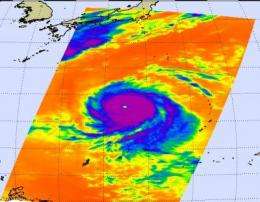
Aqua's Atmospheric Infrared Sounder (AIRS) instrument captured Melor's high thunderstorm cloud temperatures (in purple) that were colder than minus 63 Fahrenheit. This image from Oct. 4 at 12:29 EDT clearly shows Melor's eye. Credit: NASA JPL, Ed Olsen

NASA's Aqua satellite flew over Super Typhoon Melor mid-day on October 4 and captured an of the monster typhoon. Aqua's Atmospheric Infrared Sounder (AIRS) instrument and Moderate Imaging Spectroradiometer (MODIS) analyzed temperatures in Melor's . AIRS revealed the cold high cloud temperatures were colder than minus 63 Fahrenheit indicating a very strong tropical cyclone.

Forecasters at the U.S. Navy's Joint Typhoon Warning Center have amended the forecast track for Melor, and take the super typhoon on a path resembling the letter "C" in the Western Pacific Ocean. The storm is forecast to swing just east of Kadena island Japan, then turn northeast (because westerly winds will push it northeast) and its center is now expected to brush Tokyo before it swings northeast back into the open Western Pacific.

There's good news about the storm's strength however. Melor will slowly weaken as a because of increased vertical shear (winds blowing sometimes at different directions, at different levels of the atmosphere that can tear a storm apart) and cooler waters. When Melor is south of Tokyo, it's expected to interact with a baroclinic boundary (i.e. a front) and become extratropical.

Source: NASA/Goddard Space Flight Center

3.7 /5 (6 votes)  

Filter


Move the slider to adjust rank threshold, so that you can hide some of the comments.


Display comments: newest first

omatumr
Oct 05, 2009

Rank: 3 / 5 (2)
Congratulations!

It is gratifying to see that NASA is starting to pay attention to planet Earth.

To understand Earth's climate, I hope that the new NASA Administrator will also ask NASA to go back and re-examine NASA's past attitude toward experimental data that suggested Earth's heat source is not a ball of Hydrogen, but a plasma diffuser that selectively moves lightweight isotopes and elements to its surface.

Isotope data from the first analysis on lunar soils would be a good place to start [LSPET (The Lunar Sample Preliminary Examination Team): 1969, “Preliminary examination of lunar samples from Apollo 11”, Science 165, 1211-1227].

With kind regards,
Oliver K. Manuel
Former NASA PI for Apollo
Rank 3.7 /5 (6 votes)
Related Stories
Relevant PhysicsForums posts
  • Do some geologists actually act a lot like Randy Marsh?
    createdFeb 11, 2012
  • Discrepancy between oxygen and carbon-dioxide levels
    createdFeb 09, 2012
  • where gems are found in the world
    createdFeb 09, 2012
  • Wind Waves in Reservoir ~ Wind run-up and Wind set-up
    createdFeb 08, 2012
  • Balance of oxygen in the atmosphere
    createdFeb 01, 2012
  • The case for a methanol-based economy
    createdJan 30, 2012
  • More from Physics Forums - Earth

More news stories

Latin America mining boom clashes with conservation

Latin America is experiencing a mining boom as prices rise fuelled by a hike in global demand, but the region is also being hit by a wave of violent protests, strikes and rallies by environmentalists.

Space & Earth / Environment

created 6 hours ago | popularity not rated yet | comments 0

Political leaders play key role in how worried Americans are by climate change: study

More than extreme weather events and the work of scientists, it is national political leaders who influence how much Americans worry about the threat of climate change, new research finds.

Space & Earth / Environment

created Feb 06, 2012 | popularity 5 / 5 (6) | comments 72

NASA budget will axe Mars deal with Europe: scientists

US President Barack Obama's budget proposal to be submitted next week for 2013 will cut NASA's budget by 20 percent and eliminate a major partnership with Europe on Mars exploration, scientists said Thursday.

Space & Earth / Space Exploration

created Feb 10, 2012 | popularity 5 / 5 (3) | comments 55

Humans may have helped the decline of African rainforests 3000 years ago

(PhysOrg.com) -- Large areas of rainforests in Central Africa mysteriously disappeared over three thousand years ago, to be replaced by savannas. The prevailing theory has been that the cause was a change ...

Space & Earth / Environment

created Feb 10, 2012 | popularity 4.1 / 5 (14) | comments 20 | with audio podcast report

Study shows global glaciers, ice caps, shedding billions of tons of mass annually

Earth's glaciers and ice caps outside of the regions of Greenland and Antarctica are shedding roughly 150 billion tons of ice annually, according to a new study led by the University of Colorado Boulder.

Space & Earth / Earth Sciences

created Feb 08, 2012 | popularity 4.4 / 5 (9) | comments 14 | with audio podcast


Google might launch Drive for cloud storage soon

(PhysOrg.com) -- Google's next big move, according to the Wall Street Journal, is a cloud storage service called Drive. Hardly first to the plate, Google is simply catching up to introducing its cloud reposi ...

Love a click away in Indonesia's Twitter Republic

He was a geeky kid from Yogyakarta, she a glamorous city girl in Jakarta. In a country with one of the world's most vibrant social networking scenes they fell in love on Twitter.

Europeans protest controversial Internet pact

Tens of thousands of people marched in protests in more than a dozen European cities Saturday against a controversial anti-online piracy pact that critics say could curtail Internet freedom.

Walney offshore wind farm is world's biggest (for now)

(PhysOrg.com) -- The Walney wind farm on the Irish Sea--characterized by high tides, waves and windy weather--officially opened this week. The farm is treated in the press as a very big deal as the Walney ...

Navy to begin tests on electromagnetic railgun prototype launcher

The Office of Naval Research (ONR)'s Electromagnetic (EM) Railgun program will take an important step forward in the coming weeks when the first industry railgun prototype launcher is tested at a facility ...

Explained: Sigma

It's a question that arises with virtually every major new finding in science or medicine: What makes a result reliable enough to be taken seriously? The answer has to do with statistical significance -- but ...