A misplaced dinosaur tooth may have been cannibalism
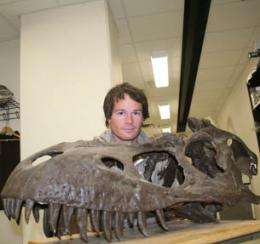
(PhysOrg.com) -- You don't have to be a paleontologist to suppose that way back when dinosaurs roamed the Earth chances were good meat eaters would dined on one of their own. Short of a time-machine trip back 70 million years, however, supposing dinosaur cannibalism and proving it are two different stories.
That might be about to change thanks to evidence from a southern Alberta dig site and some paleontological detective work by University of Alberta researcher Phil Bell.
"Evidence of dinosaur cannibalism is rare," said Bell, a paleontology PhD candidate. "The only proven case of one meat-eater eating another of the same species was found in Madagascar in 2007."
The evidence Bell has to work with comes from Dinosaur Provincial Park in southern Alberta. The jawbone of what appears to be a Gorgosaurus was found in 1996. A technician at the nearby Royal Tyrell Museum found something unusual embedded in the jaw.
It was the tip of a tooth from another meat-eating dinosaur.
Bell says that tooth definitely shows that a fight had taken place. "The wound showed no signs of healing so we know the dinosaur died soon after it was inflicted." Bell says that leaves two possible storylines. "Either the attacker fought and killed this dinosaur or it was already dead, and dinosaurs are not known for passing up a free meal."
With only part of the victim's jaw and just the tip of the attacker's tooth, Bell couldn't identify what species were involved, but given the time period-late Cretaceous-and the location, he knows two likely suspects-the Gorgosaurus and Daspletosaurus, both 10-metre long cousins of the bigger and more famous Tyrannosaurus rex.
"To feed or fight, both these dinosaurs led with their heads. They had similar serrated teeth, meant for crushing bones," said Bell.
Analysis of the wound and jaw bone showed researchers that the bite was applied with the same force as a two-tonne great white shark says Bell. "Sharks are a good analogy as their teeth frequently break off in an attack and become lodged in the victim."
The fossil record for area shows there were more Gorgosaurus than Daspletosaurus in the area at that time, which leads Bell to believe it's likely the attacker and the victim were both Gorgosaurus.
Gorgosaurus-on-Gorgosaurus dining would make this a case of prehistoric cannibalism.
"Cannibalism is pretty widespread in today's ecosystems," said Bell. "Birds do it, crocodiles do it-it's not as uncommon as we think it is."
Bell and co-author, U of A biologist Phil Currie, published a paper on the research and the cannibalism theory. It comes out next month in the academic journal Lethaia.
Bell says he's not married to the idea of cannibalism as the story behind this find. The wound could have come during a fight about territory or competition, or simply post-mortem feeding. Bell says it's a matter of examining all plausible scenarios.
"We're always looking for evidence of how these animals behaved and that can only come from extraordinary fossils. This is one of those."
Provided by University of Alberta (news : web)


