Breaking Down the Barrier for Smaller, Faster Electronic Devices
October 5, 2009 by Kendra Snyder
Breaking Down the Barrier for Smaller, Faster Electronic Devices

Enlarge

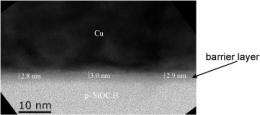
Cross-sectional transmission electron microscopy image of a barrier layer on a low-k dielectric that was formed by annealing a Cu-Mn alloy for 1 hour at 420C.

(PhysOrg.com) -- A team of international researchers is the first to uncover the chemical composition and structure of a microelectronics element that is vital to producing ever smaller - and, thus, cheaper and faster - devices.

"The number of electronic devices that can be placed within an integrated circuit has followed almost perfectly an exponential increase in the past 40 years," said James Ablett, a researcher at Synchrotron SOLEIL in France. "However, to maintain this rate, a major change in the fabrication process is required."

One of these changes involves the production of "diffusion barriers," which are needed to separate the copper metallic lines that connect the various components in an electronic device from the silicon-based insulating material. Silicon and copper are highly reactive and the mixture of the two will ultimately lead to circuit failure. However, current fabrication processes are unable to deliver diffusion barrier films that are conformal (have the same thickness across the entire interface) and thin enough - on the order of one nanometer - to support the next generation of electronic devices.

That's why Ablett, along with researchers from the NSLS, the National Institute of Standards and Technology (NIST), IMEC, and Intel, are studying one potential fabrication method that uses copper-manganese alloys. In these systems, the atoms diffuse out of the alloy film upon annealing and form a thin and conformal barrier layer at the silicon interface before copper diffusion can begin.

At NSLS beamlines X27A and X23A2, the researchers used grazing incidence x-ray fluorescence spectroscopy to study these self-forming barrier layers. They grew the diffusion barrier on two different materials: thermal (SiO2) and one with a lower dielectric constant.

The researchers discovered that the diffusion layer is principally made up of two different components (MnSiO3 and MnO) and is relatively easy to form on the low-k material but substantially more difficult to form on SiO2. These results are promising as low-k dielectrics, which have a low capacitance - ability to hold charge - than SiO2, will eventually be used in future microelectronic technology, enabling faster and more efficient devices. This is because insulators with a smaller dielectric constant can charge faster, allowing electrical signals to propagate faster through the circuit.

The researchers also discovered that the low-k material forms an effective diffusion barrier because its porosity helps it absorb moisture that efficiently produces the barrier's oxide layers.

Their results were published in the January 26, 2009 edition of Applied Physics Letters.

"Not only have these measurements allowed us to study the effect of the self-forming diffusion barrier process on both SiO2 and low-k dielectrics, as a function of alloy thickness, anneal temperature, and time, we also have been able to identify the major phases in the diffusion barrier layer, which will allow us to better understand how these barriers behave and to assess their ultimate feasibility for future integration into wide-scale semiconductor manufacturing," Ablett said.

More information: J.M. Ablett, J.C. Woicik, Zs. Tokei, S. List, and E. Dimasi, "Phase Identification of Self-Forming Cu-Mn Based Diffusion Barriers on p-SiOC :H and SiO2 Dielectrics Using X-Ray Absorption Fine Structure," Applied Physics Letters, 94, 042112 (2009).

Provided by National Synchrotron Light Source

4.2 /5 (5 votes)  

Rank 4.2 /5 (5 votes)
Relevant PhysicsForums posts
  • Doubts about surface plasmons
    createdFeb 11, 2012
  • excited U-236 decay time in the U235 fission chain
    createdFeb 09, 2012
  • Polar catastrophe?
    createdFeb 09, 2012
  • Large scale field sonication
    createdFeb 09, 2012
  • states and energy of paired electrons in BCS
    createdFeb 08, 2012
  • difference between longitudinal and transverse refractive indices
    createdFeb 08, 2012
  • More from Physics Forums - Atomic, Solid State, Comp. Physics

More news stories

Explained: Sigma

It's a question that arises with virtually every major new finding in science or medicine: What makes a result reliable enough to be taken seriously? The answer has to do with statistical significance -- but ...

Physics / General Physics

created Feb 09, 2012 | popularity 5 / 5 (19) | comments 72

Quantum physicist explains $100K offer for proof scaled-up quantum computing is impossible

(PhysOrg.com) -- MIT researcher Scott Aaronson has certainly riled the physics community with his offer this past Friday, of $100,000 to anyone who can prove that scaled-up quantum computing is impossible. ...

Physics / Quantum Physics

created Feb 08, 2012 | popularity 4.2 / 5 (13) | comments 35 | with audio podcast weblog

Diamond light, brighter than the sun

It’s the size of five football pitches and generates light 10 billion times brighter than the sun. As the Diamond Light Source celebrates its tenth anniversary this year, Penny Bailey visits one of the ...

Physics / General Physics

created Feb 07, 2012 | popularity 4.3 / 5 (7) | comments 18 | with audio podcast

Physicists 'record' magnetic breakthrough

An international team of scientists has demonstrated a revolutionary new way of magnetic recording which will allow information to be processed hundreds of times faster than by current hard drive technology.

Physics / General Physics

created Feb 07, 2012 | popularity 4.5 / 5 (41) | comments 14 | with audio podcast

Hints of the Higgs - papers are submitted

Back in December 2011, the ATLAS and CMS experiments at CERN presented some exciting results that provided tantalising hints of the Higgs boson.

Physics / General Physics

created Feb 08, 2012 | popularity 4.1 / 5 (7) | comments 10


Google might launch Drive for cloud storage soon

(PhysOrg.com) -- Google's next big move, according to the Wall Street Journal, is a cloud storage service called Drive. Hardly first to the plate, Google is simply catching up to introducing its cloud reposi ...

Latin America mining boom clashes with conservation

Latin America is experiencing a mining boom as prices rise fuelled by a hike in global demand, but the region is also being hit by a wave of violent protests, strikes and rallies by environmentalists.

Walney offshore wind farm is world's biggest (for now)

(PhysOrg.com) -- The Walney wind farm on the Irish Sea--characterized by high tides, waves and windy weather--officially opened this week. The farm is treated in the press as a very big deal as the Walney ...

Love a click away in Indonesia's Twitter Republic

He was a geeky kid from Yogyakarta, she a glamorous city girl in Jakarta. In a country with one of the world's most vibrant social networking scenes they fell in love on Twitter.

GPS court ruling leaves US phone tracking unclear

A US Supreme Court decision requiring a warrant to place a GPS device on the car of a criminal suspect leaves unresolved the bigger issue of police tracking using mobile phones, legal experts say.

Europeans protest controversial Internet pact

Tens of thousands of people marched in protests in more than a dozen European cities Saturday against a controversial anti-online piracy pact that critics say could curtail Internet freedom.