'Blue Stonehenge' discovered
October 6, 2009 'Blue Stonehenge' discovered

Enlarge

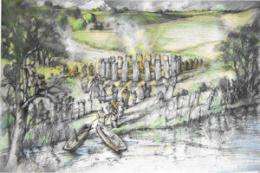
The artist's impression. Credit Peter Dunn.

(PhysOrg.com) -- Archaeologists have released an artist’s impression of what a second stone circle found a mile from Stonehenge might have looked like.

The drawing shows the sensational discovery of “Blue Stonehenge” by a team led by archaeologists from Manchester, Sheffield and Bristol Universities on the West bank of the River Avon last month.

Professor Julian Thomas, from The University of Manchester and a co-director of the Stonehenge Riverside Project, said the monument was a circle of bluestones, dragged from the Welsh Preseli mountains, 150 miles away around 5,000 years ago.

However, the stones, he said, had since been since removed, leaving behind nine uncovered holes. The team believe they were probably part of a circle of 25 standing stones.

The new stone circle is 10m (33 ft) in diameter and was surrounded by a henge - a ditch with an external bank.

The standing stones marked the end of the Avenue that leads from the River Avon to Stonehenge, a 1¾-mile long (2.8km) processional route constructed at the end of the Stone Age - or the Neolithic period.

The outer henge around the stones was built around 2400 BC, but arrowheads found in the stone circle indicate that the stones were put up as much as 500 years earlier.

When the newly discovered circle’s stones were removed by Neolithic tribes, they may, according to the team, have been dragged to Stonehenge, to be incorporated within its major rebuilding around 2500 BC.

know that after this date, Stonehenge consisted of about 80 Welsh stones and 83 local, sarsen stones. Some of the bluestones that once stood at the riverside probably now stand within the centre of Stonehenge.

The discovery may confirm of the Stonehenge Riverside Project’s theory that the River Avon linked a ‘domain of the living’ - marked by timber circles and houses upstream at the Neolithic village of Durrington Walls (discovered by the Project in 2005) - with a ‘domain of the dead’ marked by Stonehenge and this new stone circle.

The team hope to radiocarbon date antler picks found on the site - used by the stone circle builders as pickaxes - to provide more precise dates.

The dates will reveal if the circle was built when another 56 Welsh bluestones were erected at Stonehenge itself - in the decades after 3000 BC.

Sheffield University’s Professor Mike Parker Pearson, Director of the project, said: “It could be that Blue Stonehenge was where the dead began their final journey to Stonehenge.

“Not many people know that Stonehenge was Britain’s largest burial ground at that time. Maybe the bluestone circle is where people were cremated before their ashes were buried at Stonehenge itself.”

The University of Manchester’s Professor Julian Thomas, co-director, said: “The implications of this discovery are immense.

“It is compelling evidence that this stretch of the River Avon was central to the religious lives of the people who built Stonehenge.

“Old theories about Stonehenge that do not explain the evident significance of the river will have to be re-thought.”

He added: ”There is no evidence that the circle had a particular orientation or even an entrance.

Soil that fell into the holes when the stones were removed was full of charcoal, showing that plenty of wood was burned here.

“Yet this was not a place where anyone lived: the pottery, animal bones, food residues and flint tools used in domestic life during the Stone Age were absent.”

The University of Bristol’s Dr Josh Pollard, co-director, explained: “This is an incredible discovery.

“The newly discovered circle and henge should be considered an integral part of Stonehenge rather than a separate monument, and it offers tremendous insight into the history of its famous neighbour.

“Its landscape location demonstrates once again the importance of the River Avon in Neolithic funerary rites and ceremonies.”

Provided by University of Manchester (news : web)


Rate this story - 4.5 /5 (19 votes)

Rank Filter

Move the slider to adjust rank threshold, so that you can hide some of the comments.


Display comments: newest first

  • alexxx - Oct 07, 2009
    • Rank: 1 / 5 (2)
    Stonehenge is britain's most disappointing attraction:
    http://www.travel...7327.htm
  • frajo - Oct 07, 2009
    • Rank: 5 / 5 (2)
    Stonehenge is britain's most disappointing attraction


    Fine. That's how it should be.
    All those man-made artefacts are here to inform us about the development of mankind and to enlighten our understanding of our own species.
    They are not here to be profitable in a commercial sense.

October 6, 2009 all stories

Comments: 2

4.5 /5 (19 votes)

  • hide
  • Related Stories

  • Burials held at Stonehenge for hundreds of years: research
    created May 29, 2008 | popularity not rated yet | comments 0
  • Prehistoric site found near UK's Stonehenge
    created Oct 03, 2009 | popularity not rated yet | comments 0
  • 'Cursus' is older than Stonehenge
    created Jun 10, 2008 | popularity not rated yet | comments 0
  • Stonehenge 'No Place for the Dead', Says Expert
    created Nov 16, 2006 | popularity not rated yet | comments 0
  • Megalithic rock art discovered in Anglesey
    created May 10, 2006 | popularity not rated yet | comments 0


  • hide
  • Relevant PhysicsForums posts

  • Sleeping habits and the risk of cancer
    created Feb 08, 2010
  • Pressure in chambers of the heart
    created Feb 07, 2010
  • Primordial soup canned?
    created Feb 07, 2010
  • Where on the r/K selection theory scale do social insects like ants and bees fall?
    created Feb 06, 2010
  • Testosterone levels and Fighting
    created Feb 05, 2010
  • Evolution Simulator
    created Feb 04, 2010
  • More from Physics Forums - Biology

Other News

Women on board: Does forced diversity hurt firm performance?

Other Sciences / Social Sciences

created 59 minutes ago | popularity not rated yet | comments 0

(PhysOrg.com) -- New SEC rules will require public firms to disclose what role, if any, diversity plays in appointing members to their corporate boards, but University of Michigan researchers say any forced restructuring ...


Baseball teams with more international players draw more fans, profits

Other Sciences / Social Sciences

created 14 minutes ago | popularity not rated yet | comments 0

(PhysOrg.com) -- Ticket revenue increases by roughly half of a million dollars for each international player added to a Major League Baseball team, showing a sharp swing in fan favoritism for internationally diverse teams, ...


Office romance? Not a problem most of time: study

Office romance? Not a problem most of time: study

Other Sciences / Social Sciences

created 1hour ago | popularity not rated yet | comments 1

(PhysOrg.com) -- Pam and Jim on The Office. Meredith and McDreamy on Grey's Anatomy. Television shows depict many workplace romances, but in the real world how do co-workers view love on the job? According ...


'Counterfactual' thinkers are more motivated and analytical, study suggests

Other Sciences / Social Sciences

created 3 hours ago | popularity 4.5 / 5 (2) | comments 1 | with audio podcast

(PhysOrg.com) -- "If only I had..." Almost everyone has said those four words at some time. Rather than intensifying regret, '"what if" reflection about pivotal moments in the past helps people to weave a coherent life story, ...


Has the mystery of the Portrait of Maud Abrantes been solved?

Has the mystery of the Portrait of Maud Abrantes been solved?

Other Sciences / Other

created 6 hours ago | popularity not rated yet | comments 0

A century after Amedeo Modigliani painted the Portrait of Maud Abrantes, the mystery behind the painting might be solved. Ofra Rimon, Director and Curator of the Hecht Museum at the University of Haifa, discovered ...