IBM Research Aims to Build Nanoscale DNA Sequencer (w/ Video)
October 6, 2009 IBM Research Aims to Build Nanoscale DNA Sequencer (w/ Video)

Enlarge

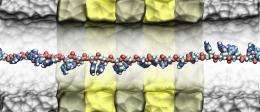
A cross section of IBM's DNA Transistor simulated on Blue Gene supercomputer showing a single stranded DNA moving in the midst of (invisible) water molecules through the nanopore. The DNA molecule, at the center of the pore, contain the bases A, C, G and T, that code of biological information necessary for life.

(PhysOrg.com) -- In an effort to build a nanoscale DNA sequencer, IBM scientists are drilling nano-sized holes in computer-like chips and passing DNA strands through them in order to read the information contained within their genetic code.

This advanced research effort to demonstrate a silicon-based “DNA Transistor” could help pave the way to read human DNA easily and quickly, generating advancements in health condition diagnosis and treatment. The challenge in the effort is to slow and control the motion of the DNA through the hole so the reader can accurately decode what is in the DNA. If successful, the project could improve throughput and reduce cost to achieve the vision of personalized genome analysis at a cost of $100 to $1,000. In comparison, the first sequencing ever done by the (HGP) cost $3 billion.

Having access to an individual’s personal genetic code could advance by using genomic and molecular data to facilitate the discovery and clinical testing of new products, and help determine a person's predisposition to a particular disease or condition.

A team of IBM scientists from four fields - nanofabrication, microelectronics, physics and biology -- are converging to master the technique that threads a long DNA molecule through a three nanometer wide hole, known as a nanopore, in a silicon chip. A nanometer is one one-billionth of a meter or about 100,000 times smaller than the width of a human hair. As the molecule is passed through the nanopore, it is ratcheted one unit of DNA at a time, as an electrical sensor “reads” the DNA. This sensor that identifies the is the subject of intense ongoing research. The information gathered from the reader could be used to gain a better understanding of an individual’s medical makeup to help further the pursuit of personalized healthcare.

“The technologies that make reading DNA fast, cheap and widely available have the potential to revolutionize bio-medical research and herald an era of personalized medicine,” said IBM Research Scientist Gustavo Stolovitzky. “Ultimately, it could improve the quality of medical care by identifying patients who will gain the greatest benefit from a particular medicine and those who are most at risk of adverse reaction.”

IBM Research Aims to Build Nanoscale DNA Sequencer (w/ Video)
Enlarge

A membrane containing the nanopore, funtionalized with metal contacts (orange) separated by dielectric materials (lime), devides a reservoir into a top part containing an ionic solution with a high concentration of single stranded DNA, and a bottom part, where the DNA will be translocated to. The DNA on the top reservoir is induced to go to the bottom reservoir by the action of a biasing voltage. In the absence of anything else, the DNA would translocate through the pore at a speed of several million bases per second. To control the passage of DNA trhough the nano-hole, voltages of appropriate polarity (not shown) are applied to the metal contacts inside the pore, which create an internal electric field that trap the DNA. By alternating the trapping voltages applied to the metal contacts, the DNA can be made ratchet from the top to the bottom reservoirs in a controlled way.

IBM Research is working to optimize a process for controlling the rate at which a DNA strand moves through a nano-scale aperture on a thin membrane during analysis for DNA sequencing. While scientists around the world have been working on using nanopore technology to read DNA, nobody has been able to figure out how to have complete control of a DNA strand as it travels through the nanopore. Slowing the speed is critical to being able to read the . IBM scientists believe they have a unique approach that could tackle this challenge.

To control the speed at which the DNA flows through the microprocessor nanopore, IBM researchers have developed a device consisting of a multilayer metal/dielectric nano-structure that contains the nanopore. Voltage biases between the electrically addressable metal layers will modulate the electric field inside the nanopore. This device utilizes the interaction of discrete charges along the backbone of a DNA molecule with the modulated electric field to trap DNA in the nanopore. By cyclically turning on and off these gate voltages, scientists showed theoretically and computationally, and expect to be able prove experimentally, the plausibility of moving DNA through the nanopore at a rate of one nucleotide per cycle - a rate that IBM scientists believe would make DNA readable.

A human genome sequencing capability affordable for individuals is the ultimate goal of the sequencing and is commonly referred to as “$1,000 genome.”

In the Fall of 2005, IBM revised its corporate privacy and equal opportunity policies to reflect the corporation's intention to handle information about an employee's genetics with a high regard for its privacy, and also to refrain from using genetic test information to discriminate against a person in the employment context. At that time, IBM was arguably the first company in the world to restrict genetic data from being used to make employment-related decisions.

On May 21, 2008, the United States signed into law the Genetic Information Nondiscrimination Act (GINA) that protects Americans against discrimination based on their genetic information when it comes to health insurance and employment. The bill passed the Senate unanimously and the House by a vote of 414 to 1. The long-awaited measure, which has been debated in Congress for 13 years, is helping to pave the way for people to take full advantage of the promise of personalized medicine without fear of discrimination.

Provided by IBM


print this article email this article download pdf blog this article bookmark this article     Stumble it Digg this share on Facebook retweet share on Reddit add to delicious
Rate this story - 4.2 /5 (11 votes)

Rank Filter

Move the slider to adjust rank threshold, so that you can hide some of the comments.


Display comments: newest first

  • finitesolutions - Oct 06, 2009
    • Rank: not rated yet
    Read my DNA: IBM is a dead end company. IBM is were researchers go to die.
  • kerry - Oct 06, 2009
    • Rank: not rated yet
    Are you retarded? IBM is one of the last companies to conduct basic research. Few companies today have the courage, the foresight, and the resources to do so, and I have no doubt that such fundamental research will pay off for them in the future. Plus, IBM puts their research to good use like making the world's most energy efficient servers; this also makes IBM one of the greenest high-tech companies out there.

    PS I am not employed (student) and therefore do not get paid by IBM to support them.
  • zevkirsh - Oct 06, 2009
    • Rank: not rated yet
    i think maybe he has a point. ....why are there 'information' videos in this article. the music in the video is proof they spent alot of money on it as an advertisment, what are they advertising? since when do major respected top research centers NEED to advertise themselves. word of mouth/prestige is usually how it goes, advertising prestige is an admission of weakness. you don't see jpl or general atomics advertising their research like this.. it looks like they are selling their research before they have any results, which is the kind of behavior you expect from a company with little confidence. why not just come out with a final product as fast as possible and let it speak for itself? why all the blustering?
  • rincewind - Oct 06, 2009
    • Rank: not rated yet
    You guys seem surprised that a corporation would think it prudent to market itself?

    Aside from that... how many other companies support & encourage fundamental research like this with the breadth and competence that IBM has? They should be applauded instead, not forum-trolled! Just think how many paradigm-shifting innovations have come about as a result of basic research - the recent telerome Nobel prize should serve as a good example of this.

October 6, 2009 all stories

Comments: 4

4.2 /5 (11 votes)
  • Stumble this up

  • Digg this

  • share this

  • hide
  • Related Stories


  • hide
  • Relevant PhysicsForums posts

  • Questions about diffusion
    created 1hour ago
  • Human Leukocyte Antigen (HLA) typing
    created 7 hours ago
  • Breeding program
    created Nov 20, 2009
  • How does a concentration gradient provide energy?
    created Nov 20, 2009
  • Eyesight and Neural Damage from Electronics
    created Nov 19, 2009
  • Quick question about the Golgi Apparatus?
    created Nov 19, 2009
  • More from Physics Forums - Biology

Other News

Nanoparticles used in common household items caused genetic damage in mice

Nanotechnology / Bio & Medicine

created Nov 16, 2009 | popularity 4.7 / 5 (22) | comments 11

Titanium dioxide (TiO2) nanoparticles, found in everything from cosmetics to sunscreen to paint to vitamins, caused systemic genetic damage in mice, according to a comprehensive study conducted by researchers at UCLA's Jonsson ...


Using superconducting probes to get a picture of what it's like inside CNTs

Nanotechnology / Nanophysics

created Nov 20, 2009 | popularity 4.9 / 5 (7) | comments 0

(PhysOrg.com) -- "Carbon nanotubes are exciting for fundamental physics, and for potential technological applications," Nadya Mason tells PhysOrg.com. "However, we are generally limited in the way that we can study them. ...


Nanotube defects equal better energy and storage systems

Nanotube defects equal better energy and storage systems

Nanotechnology / Nanomaterials

created Nov 19, 2009 | popularity 4.4 / 5 (9) | comments 2

(PhysOrg.com) -- Most people would like to be able to charge their cell phones and other personal electronics quickly and not too often. A recent discovery made by UC San Diego engineers could lead to carbon ...


When It Comes to Drug Delivery, Size Matters

Nanotechnology / Bio & Medicine

created Nov 20, 2009 | popularity 5 / 5 (1) | comments 0

(PhysOrg.com) -- One of the great promises of nanotechnologies lies in its ability to create drug-containing nanoparticles decorated with targeting molecules that recognize and bind to cancer cells, providing drug delivery ...


New study confirms exotic electric properties of graphene

New study confirms exotic electric properties of graphene

Nanotechnology / Nanomaterials

created Nov 17, 2009 | popularity 4.8 / 5 (23) | comments 1

(PhysOrg.com) -- First, it was the soccer-ball-shaped molecules dubbed buckyballs. Then it was the cylindrically shaped nanotubes. Now, the hottest new material in physics and nanotechnology is graphene: ...