Arctic sea ice recovers slightly in 2009, remains on downward trend (w/ Video)
October 6, 2009
Arctic sea ice recovers slightly in 2009, remains on downward trend, says U. of Colorado report

Enlarge

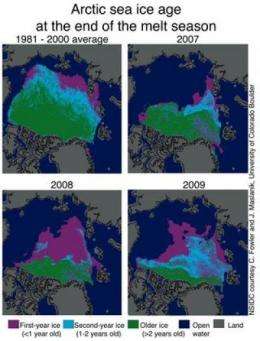
This graphics show multi-year Arctic sea ice changes. Credit: Courtesy C. Fowler and J. Maslanik, University of Colorado at Boulder

(PhysOrg.com) -- Despite a slight recovery in summer Arctic sea ice in 2009 from record-setting low years in 2007 and 2008, the sea ice extent remains significantly below previous years and remains on a trend leading toward ice-free Arctic summers, according to the University of Colorado at Boulder's National Snow and Ice Data Center.

According to the CU-Boulder center, the 2009 minimum sea extent was the third lowest since satellite record-keeping began in 1979. The past five years have seen the five lowest ice extents ever recorded.

"It's nice to see a little recovery over the past couple of years, but there's no reason to think that we're headed back to conditions seen in the 1970s," said NSIDC Director Mark Serreze, also a professor in CU-Boulder's geography department. "We still expect to see ice-free summers sometime in the next few decades."

This video is not supported by your browser at this time.

Sea ice cover reaches its minimum extent at the end of each summer. This animation shows the summer retreat of sea ice over the Arctic from July 1 through September 12, as recorded by the AMSR-E instrument on NASA's Aqua satellite. Credit: Cyndi Starr and Trent Schindler, NASA Scientific Visualization Studio

The average ice extent during September, a standard measurement for studies, was 2.07 million square miles (5.36 million square kilometers). This was 409,000 square miles (1.06 million square kilometers) greater than the record low for the month in 2007, and 266,000 square miles (690,000 square kilometers) greater than the second-lowest extent recorded in September 2008.

The 2009 extent was still 649,000 square miles (1.68 square kilometers) below the 1979-2000 September average, according to the report. Arctic sea ice in September is now declining at a rate of 11.2 percent per decade and in the winter months by about 3 percent per decade. The consensus of scientists is that the shrinking Arctic sea ice is tied to warming temperatures caused by an increase in human-produced greenhouse gases being pumped into Earth's atmosphere, as reported by the Intergovernmental Panel on Climate Change.

Sea surface temperatures in the Arctic this season remained higher than normal, but slightly lower than the past two years, according to data from University of Washington Senior Mike Steele. The cooler conditions, which resulted largely from cloudy skies during late summer, slowed ice loss compared to the past two years. In addition, atmospheric patterns in August and September helped to spread out the ice pack, keeping extent higher.

This video is not supported by your browser at this time.

Each winter existing sea ice thickens and new, thinner ice is formed. This conceptual animation shows a cutaway view of the seasonal advance and retreat of Arctic sea ice, demonstrating the current trend toward a thinning ice pack, with less of the thicker multi-year ice surviving each summer's melt. Credit: Megan Willy, UMBC

The September 2009 ice cover remained thin, leaving it vulnerable to melt in coming summers, according to the CU-Boulder report. At the end of the summer, younger, thinner ice less than one year in age accounted for 49 percent of the ice cover. Second- year ice made up 32 percent of the ice cover, compared to 21 percent in 2007 and 9 percent in 2008.

Only 19 percent of the ice cover was over two years old -- the least ever recorded in the satellite record and far below the 1981-2000 summer average of 48 percent, according to the CU-Boulder report. Measurements of sea ice thickness by satellites are used to determine the age of the ice.

Earlier this summer, NASA researcher Ron Kwok and colleagues from the University of Washington in Seattle published satellite data showing that ice thickness declined by 2.2 feet between 2004 and 2008.

"We've preserved a fair amount of first-year ice and second-year ice after this summer compared to the past couple of years," said NSIDC scientist Walt Meier of CU-Boulder's Cooperative Institute for Research in Environmental Sciences. "If this ice remains in the Arctic thorough the winter, it will thicken, which gives some hope of stabilizing the ice cover over the next few years. However, the ice is still much younger and thinner than it was in the 1980s, leaving it vulnerable to melt during the summer."

Arctic sea ice follows an annual cycle of melting through the warm summer months and refreezing in the winter. Sea ice reflects sunlight, keeping the Arctic region cool and moderating global climate temperatures.

While Arctic extent varies from year to year because of changing atmospheric conditions, ice extent has shown a dramatic overall decline over the past 30 years.

"A lot of people are going to look at the graph of ice extent and think that we've turned the corner on climate change," said NSIDC Lead Scientist Ted Scambos of CU-Boulder's CIRES. "But the underlying conditions are still very worrisome."

Source: University of Colorado at Boulder (news : web)

2.4 /5 (14 votes)  

Filter


Move the slider to adjust rank threshold, so that you can hide some of the comments.


Display comments: newest first

mongander
Oct 06, 2009

Rank: 3.7 / 5 (3)


That's a pretty broad statement. How many hundreds of millions of previous years have you measured?
GrayMouser
Oct 06, 2009

Rank: 4.2 / 5 (5)
Don't complicate their narrow time slice with side issues, like the fact that it was smaller in the 1930s-1940s timeframe (or even before that.)

They do shoot themselves in the foot though since the interval has to be 30+ years for it to be climate as opposed to weather...
GrayMouser
Oct 06, 2009

Rank: 3.7 / 5 (3)
And as an addendum:
http://www.worldc...ite-era/
toyo
Oct 07, 2009

Rank: 3.3 / 5 (3)
I wonder whether this new data will be fed back in to their "climate change" models to refine them.
More to the point, I wonder whether these computer models predicted this outcome, and if not why not?
After all, those models are at the basis for governments around the world preparing to spend billions!
ooooooooooooo
Oct 07, 2009

Rank: 4 / 5 (4)
Another thing which has "recovered some but is still on a downward trend" is global temperature. That's been declining overall since the interglacial maximum 5000 years ago when the Arctic was totally ice-free in summer. Always remember to correct for randomness and transitory blips in statistical data by means of a large enough sample.
Rick69
Oct 07, 2009

Rank: 2.5 / 5 (2)
If the ice recovered some that would seem to indicate an upward trend.
GrayMouser
Oct 07, 2009

Rank: 2.3 / 5 (3)
If the ice recovered some that would seem to indicate an upward trend.

Not really, most of the recent loss was due to a shift in the warm currents sending warmer waters to the Arctic Ocean than they normally get. These currents have shifted back towards their normal paths allowing ice to accumulate again.
Nartoon
Oct 10, 2009

Rank: 1 / 5 (1)
20% increase is a slight gain, but 5% loss in Antarctica (ice shelves) is catastrophic!
Rank 2.4 /5 (14 votes)
Relevant PhysicsForums posts
  • Do some geologists actually act a lot like Randy Marsh?
    createdFeb 11, 2012
  • Discrepancy between oxygen and carbon-dioxide levels
    createdFeb 09, 2012
  • where gems are found in the world
    createdFeb 09, 2012
  • Wind Waves in Reservoir ~ Wind run-up and Wind set-up
    createdFeb 08, 2012
  • Balance of oxygen in the atmosphere
    createdFeb 01, 2012
  • The case for a methanol-based economy
    createdJan 30, 2012
  • More from Physics Forums - Earth

More news stories

Salvage workers begin pumping fuel from Italian shipwreck

Salvage workers Sunday began pumping fuel from the shipwrecked Italian cruise liner Costa Concordia, a day ahead of schedule, officials said.

Space & Earth / Environment

created 6 hours ago | popularity 5 / 5 (1) | comments 0

Latin America mining boom clashes with conservation

Latin America is experiencing a mining boom as prices rise fuelled by a hike in global demand, but the region is also being hit by a wave of violent protests, strikes and rallies by environmentalists.

Space & Earth / Environment

created 14 hours ago | popularity 5 / 5 (1) | comments 1

Political leaders play key role in how worried Americans are by climate change: study

More than extreme weather events and the work of scientists, it is national political leaders who influence how much Americans worry about the threat of climate change, new research finds.

Space & Earth / Environment

created Feb 06, 2012 | popularity 5 / 5 (7) | comments 73

NASA budget will axe Mars deal with Europe: scientists

US President Barack Obama's budget proposal to be submitted next week for 2013 will cut NASA's budget by 20 percent and eliminate a major partnership with Europe on Mars exploration, scientists said Thursday.

Space & Earth / Space Exploration

created Feb 10, 2012 | popularity 5 / 5 (3) | comments 58

Humans may have helped the decline of African rainforests 3000 years ago

(PhysOrg.com) -- Large areas of rainforests in Central Africa mysteriously disappeared over three thousand years ago, to be replaced by savannas. The prevailing theory has been that the cause was a change ...

Space & Earth / Environment

created Feb 10, 2012 | popularity 4.1 / 5 (14) | comments 21 | with audio podcast report


Scientists discover molecular secrets of 2,000-year-old Chinese herbal remedy

For roughly two thousand years, Chinese herbalists have treated Malaria using a root extract, commonly known as Chang Shan, from a type of hydrangea that grows in Tibet and Nepal. More recent studies suggest that halofuginone, ...

New method to examine batteries -- MRI from the inside

There is an ever-increasing need for advanced batteries for portable electronics, such as phones, cameras, and music players, but also to power electric vehicles and to facilitate the distribution and storage of energy derived ...

Overeating may double risk of memory loss

New research suggests that consuming between 2,100 and 6,000 calories per day may double the risk of memory loss, or mild cognitive impairment (MCI), among people age 70 and older. The study was released today and will be ...

A mitosis mystery solved: How chromosomes align perfectly in a dividing cell

Although the process of mitotic cell division has been studied intensely for more than 50 years, Whitehead Institute researchers have only now solved the mystery of how cells correctly align their chromosomes during symmetric ...

Lab study raises questions over nano-particle impact

Tests involving chickens have raised questions about the impact on health from engineered nano-particles, the ultra-fine grains commonly used in drugs and processed foods, scientists said on Sunday.

Google might launch Drive for cloud storage soon

(PhysOrg.com) -- Google's next big move, according to the Wall Street Journal, is a cloud storage service called Drive. Hardly first to the plate, Google is simply catching up to introducing its cloud reposi ...