New findings about brain proteins suggest possible way to fight Alzheimer's
October 6, 2009 New findings about brain proteins suggest possible way to fight Alzheimer's

Enlarge

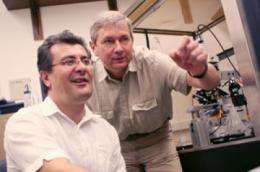
Here are Drs. Joachim Herz (right), Murat Durakoglugil of UT Southwestern Medical Center. Credit: UT Southwestern Medical Center

The action of a small protein that is a major villain in Alzheimer's disease can be counterbalanced with another brain protein, researchers at UT Southwestern Medical Center have found in an animal study.

The findings, available online in the journal , suggest a promising new tactic against the devastating illness, the researchers said.

The harmful protein, called beta-amyloid, is found in the brain and, when functioning properly, suppresses nerve activity involved with memory and . Its normal function can be likened to a red traffic light, restraining nerve cells from getting overexcited when they receive stimulating signals from neighboring cells. People with Alzheimer's disease, however, accumulate too much beta-amyloid - the traffic light gets stuck on "red" and nerve cells become less responsive.

Another , called Reelin, acts as a "green light," stimulating nerve cells to respond more strongly to their neighbors' signals.

The new study shows that applying Reelin directly to brain slices from mice prevents excess beta-amyloid from completely silencing nerves.

"If we can identify a mechanism to keep the nerve cells functioning strongly, that might provide a way to fight Alzheimer's disease," said Dr. Joachim Herz, professor of and neuroscience at UT Southwestern and the study's senior author.

In the study, the researchers recorded electrical currents in the mouse hippocampus, an area of the brain associated with learning and . From their experiments they determined that Reelin and beta-amyloid interact with the same protein complex, called an NMDA receptor, which plays an important role in coordinating chemical signals between adjacent .

They found that Reelin activates and strengthens the response of the NMDA receptor. In the presence of too much beta-amyloid, the receptor migrates into the cell, reducing the cell's sensitivity to incoming signals. By contrast, in strong concentrations of Reelin, the receptor remains active and the cell has the green light to continue receiving normally.

Dr. Herz said the study is especially important because this mechanism involves another protein involved in Alzheimer's called ApoE4, which is the primary risk factor for the most frequent late-onset form of the disease. The receptor that binds to ApeE molecules also binds to Reelin, and is part of the red-light/green-light complex that controls the sensitivity of the NMDA receptors.

"These results imply that Reelin, ApoE and beta-amyloid converge on the same molecular mechanism, which is critical in the Alzheimer's disease process, and Reelin may be a common factor to fight both beta-amyloid and mutated ApoE," Dr. Herz said. "This study establishes a rationale that ApoE receptors have an action that can keep the Alzheimer's disease process at bay by preventing damage in the first place."

The researchers are currently studying the role of ApoE4 in this mechanism. Mimicking or preserving normal Reelin function to stimulate the ApoE receptors might provide a path to stave off the disease, Dr. Herz said.

Source: UT Southwestern Medical Center (news : web)


print this article email this article download pdf blog this article bookmark this article     Stumble it Digg this share on Facebook retweet share on Reddit add to delicious
Rate this story - 5 /5 (2 votes)


October 6, 2009 all stories

Comments: 0

5 /5 (2 votes)
  • Stumble this up

  • Digg this

  • share this

  • hide
  • Related Stories

  • Protein linked to Alzheimer's disease doesn't act alone
    created Jun 10, 2009 | popularity not rated yet | comments 0
  • Anti-inflammatory drug blocks brain plaques
    created Jun 24, 2008 | popularity not rated yet | comments 0
  • QBI neuroscientists make Alzheimer's disease advance
    created Jun 10, 2008 | popularity not rated yet | comments 0
  • Alzheimer's gene slows brain's ability to export toxic protein
    created Nov 13, 2008 | popularity not rated yet | comments 0
  • Mechanism explains link between apolipoprotein E and Alzheimer's disease
    created Jun 11, 2008 | popularity not rated yet | comments 0


  • hide
  • Relevant PhysicsForums posts

  • 23 Years in a Vegetative State....or not?
    created Nov 25, 2009
  • Has the H1N1 vaccine been scientifically proven to work?
    created Nov 24, 2009
  • nesfatin
    created Nov 22, 2009
  • Obsessive Compulsive Disorder
    created Nov 20, 2009
  • More from Physics Forums - Medical Sciences

Other News

Implant-based cancer vaccine is first to eliminate tumors in mice

Implant-based cancer vaccine is first to eliminate tumors in mice

Medicine & Health / Cancer

created 11 hours ago | popularity 4.9 / 5 (18) | comments 4

(PhysOrg.com) -- A cancer vaccine carried into the body on a carefully engineered, fingernail-sized implant is the first to successfully eliminate tumors in mammals, scientists report this week in the journal ...


Brain's endocannabinoid signaling pathway kept in check by two enzymes

Medicine & Health / Research

created 9 hours ago | popularity 5 / 5 (2) | comments 0

(PhysOrg.com) -- A research team has shown that blocking the degradation of two naturally occurring cannabinoids in the endocannabinoid signaling pathway of the brain produces marijuana-like behavioral effects in mice, according ...


Scale of justice

fMRI scans used in murder trial sentencing

Medicine & Health / Other

created 19 hours ago | popularity 1 / 5 (1) | comments 4

(PhysOrg.com) -- Functional Magnetic Resonance Imaging (fMRI) scans have been used, possibly for the first time, in the sentencing phase of a murder trial in Chicago in the US.


Scientists find emotion-like behaviors, regulated by dopamine, in fruit flies

Medicine & Health / Neuroscience

created 13 hours ago | popularity 5 / 5 (3) | comments 0

Scientists at the California Institute of Technology have uncovered evidence of a primitive emotion-like behavior in the fruit fly, Drosophila melanogaster. Their findings, which may be relevant to the relationship betwee ...


Study sheds light on brain's fear processing center

Medicine & Health / Research

created 13 hours ago | popularity 5 / 5 (3) | comments 1

Breathing carbon dioxide can trigger panic attacks, but the biological reason for this effect has not been understood. A new study by University of Iowa researchers shows that carbon dioxide increases brain acidity, which ...