Dino footprints enter record books
October 6, 2009 Giant dinosaur footprints site discovered in April

Enlarge

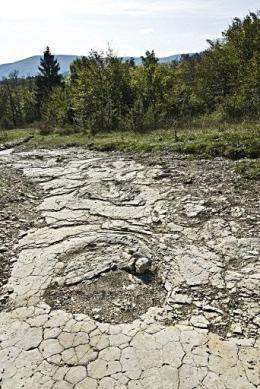
This handout picture released by French national center for scientific research CNRS shows a giant dinosaur footprints site discovered in April 2009 in Plagne, French Jura mountain, near Switzerland. French researchers on Tuesday said they had uncovered the biggest dinosaur footprints in the world, left by giant sauropods that may have weighed 40 tonnes or more.

French researchers on Tuesday said they had uncovered the biggest dinosaur footprints in the world, left by giant sauropods that may have weighed 40 tonnes or more.

Footprints from sauropod dinosaurs, giant herbivores with long necks, were found in Plagne, near Lyon, France. Discovered by Marie-Hélčne Marcaud and Patrice Landry, two nature enthusiasts, the dinosaur footprints have been authenticated by Jean-Michel Mazin and Pierre Hantzpergue, both of the Paléoenvironnements et Paléobiosphčres laboratory (CNRS, France).

According to the researchers' initial analyses, these dinosaur footprints are the largest found to date. Furthermore, the tracks spread over dozens and possibly even hundreds of meters. More significant digs will be conducted over the next few years and could result in the Plagne site being one of the largest known dinosaur sites on earth.

Marie-Hélčne Marcaud, Patrice Landry and other members of the Société des naturalistes d'Oyonnax (SDNO) have been searching for dinosaur footprints for years. Convinced that the region had a rich paleontological heritage, they focused on potential sites and have been exploring them systematically.

It was during one of these outings, on April 5, 2009, that Marie-Hélčne Marcaud and Patrice Landry discovered the extraordinary footprints at Plagne. They contacted Jean-Michel Mazin and Pierre Hantzpergue, of the Paléoenvironnements et Paléobiosphčres laboratory. The researchers authenticated the footprints based on morphological criteria and the sediment containing them. They believe that the Plagne site was along a route used by sauropod dinosaurs. The dinosaur footprints in Plagne are circular depressions surrounded by a fold of limestone sediment. These depressions are very large, up to 1.50 m in total diameter, suggesting that the animals were larger than 40 tonnes and 25 meters in length. The limestone dates to the Tithonian stage (Upper Jurassic, -150MY), a period during which the area was covered by a warm and shallow sea. The discovery of these footprints shows that sauropods moved around during a phase of emersion of the area, when sea levels were low.

The Plagne site is exceptional, both for the size of the prints and the number of tracks which can be seen and those potentially left to discover. Geological studies and digs of such a large surface area require significant technical and human resources over several years.

Provided by CNRS


print this article email this article download pdf blog this article bookmark this article     Stumble it Digg this share on Facebook retweet share on Reddit add to delicious
Rate this story - 4.4 /5 (8 votes)

Rank Filter

Move the slider to adjust rank threshold, so that you can hide some of the comments.


Display comments: newest first

  • verkle - Oct 07, 2009
    • Rank: 1 / 5 (2)
    How in the world could such footprints be 150 million years old? Impossible. Try slashing at least 4 zeros from that date and you are a lot closer to reality.

  • frajo - Oct 07, 2009
    • Rank: not rated yet
    How in the world could such footprints be 150 million years old? Impossible.

    Why?
  • Ethelred - Oct 30, 2009
    • Rank: not rated yet
    Try slashing at least 4 zeros from that date and you are a lot closer to reality.


    How about you present some evidence to support that claim.

    Physical evidence that is. Not a quote from book written thousands of years ago by ignorant men.

    Aggressive ignorance will not make the evidence for Evolution disappear.

    Ethelred

October 6, 2009 all stories

Comments: 3

4.4 /5 (8 votes)
  • Stumble this up

  • Digg this

  • share this

  • hide
  • Related Stories

  • Aussie museum displays huge dinosaur bones
    created Jul 20, 2005 | popularity not rated yet | comments 0
  • Long-necked dinos didn't reach for the skies
    created Mar 31, 2009 | popularity not rated yet | comments 0
  • Dinosaur tracks attract a crowd
    created Jan 15, 2008 | popularity not rated yet | comments 0
  • Ancient mammal tracks found at national monument
    created Jul 24, 2009 | popularity not rated yet | comments 0
  • Sensational Find: the Mini-Dinosaurs from the Harz Mountains
    created Jun 07, 2006 | popularity not rated yet | comments 0


  • hide
  • Relevant PhysicsForums posts

  • Questions about diffusion
    created 6 hours ago
  • Human Leukocyte Antigen (HLA) typing
    created 13 hours ago
  • Breeding program
    created Nov 20, 2009
  • How does a concentration gradient provide energy?
    created Nov 20, 2009
  • More from Physics Forums - Biology

Other News

Researcher: Faint writing seen on Shroud of Turin (AP)

Researcher: Faint writing seen on Shroud of Turin (Update)

Other Sciences / Archaeology & Fossils

created Nov 20, 2009 | popularity 2.1 / 5 (25) | comments 23

(AP) -- A Vatican researcher has rekindled the age-old debate over the Shroud of Turin, saying that faint writing on the linen proves it was the burial cloth of Jesus. Experts say the historian may be reading ...


Museum: Galileo's fingers, tooth are found (AP)

Museum: Galileo's fingers, tooth are found

Other Sciences / Archaeology & Fossils

created Nov 21, 2009 | popularity 4 / 5 (1) | comments 6

(AP) -- Two fingers and a tooth removed from Galileo Galilei's corpse in a Florentine basilica in the 18th century and given up for lost have been found again and will soon be put on display, an Italian museum ...


Maya

New insights into the life of the Maya

Other Sciences / Archaeology & Fossils

created Nov 16, 2009 | popularity 4.6 / 5 (15) | comments 7

(PhysOrg.com) -- Ancient artifacts are almost always concerned with rich and powerful religious and political leaders, but new excavations of an ancient Maya site have unearthed a pyramid decorated with murals ...


Three of a kind

Three of a kind: Revealing language’s universal essence

Other Sciences / Social Sciences

created Nov 20, 2009 | popularity 3.9 / 5 (11) | comments 6

(PhysOrg.com) -- On the surface, English, Japanese, and Kinande, a member of the Bantu family of languages spoken in the Democratic Republic of Congo, have little in common. It is not just that the vocabularies ...


Only tax increase can cure Illinois budget woes, study says

Other Sciences / Economics

created Nov 18, 2009 | popularity 1 / 5 (1) | comments 3

Tax increases are the only solution to a widening budget crisis that a new study says has landed Illinois among the nation's most financially troubled states, a soon-to-be-released report by a team of University of Illinois ...