Sand dunes reveal unexpected dryness during heavy monsoon
October 6, 2009 by Jill Sakai Sand dunes reveal unexpected dryness during heavy monsoon

Enlarge

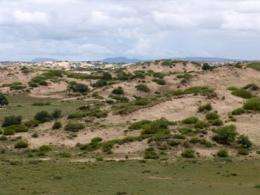
Sand dunes in northern China, such as these in the Otindag dunefield, are a rich source of information about past climates in Asia. Research led by University of Wisconsin-Madison geographer Joseph Mason has uncovered evidence of an unexpectedly dry climate in northern China during a strong monsoon cycle 8,000 to 11,500 years ago. The results challenge common assumptions about future climate changes -- including likely effects of the stronger monsoon rains predicted by many climatologists as global temperatures warm -- and suggest that Chinese desert margin regions may actually become drier, with potentially negative impacts on water resources, grazing, and air quality. Photo by: Joseph Mason, UW-Madison

(PhysOrg.com) -- The windswept deserts of northern China might seem an odd destination for studying the heavy monsoon rains that routinely drench the more tropical regions of Southeast Asia.

But the sandy dunefields that mark the desert margin between greener pastures to the south and the to the north are a rich source of information about past climates in Asia, says University of Wisconsin-Madison geographer Joseph Mason. Wetter periods allow vegetation to take root on and stabilize sand dunes. During dry spells, plants die off and the dunes are more active, constantly shifting as sand is blown away and replenished.

Such patterns of dune activity provide a history of the area's — if one can read them, Mason says. "When did those periods of stability or activity occur and from that, what can we infer about climate change?"

As reported in a new paper in the October issue of the journal Geology, Mason and colleagues mapped sand dune activity across northern and found unexpectedly high levels of mobility and change 8,000 to 11,500 years ago, a time period generally thought to have a wetter climate. The result challenges existing ideas about the monsoon's regional influence and could impact future climate predictions.

Today, the dunes are at the edge of the monsoon region and the scientists expected to find close correlation between precipitation in the dunefields and the strength of the monsoon.

What they found instead was rather surprising. "They turn out to be almost completely out of phase," Mason says. "Where we find lots of active dunes turns out to be a time when the monsoon system is supposed to have been stronger in southern and central China."

Part of the explanation may lie in local patterns of atmospheric circulation. At the peak of the summer monsoon, central China experiences both heavy summer rainfall and strong upward airflow. That upward flow tends to be balanced out by more downward air motion — which suppresses precipitation — in areas north and west of the monsoon core.

Regional climate modeling data from the UW-Madison Center for Climatic Research, led by co-author and UW-Madison professor of atmospheric and oceanic sciences Zhengyu Liu, shows that this pattern may have been strengthened between 8,000 and 11,500 years ago. The models also show high summer temperatures at that time, which would have increased evaporation and further reduced the moisture that supports dune-stabilizing plants.

This pattern of climate change had been described for areas distant from the monsoon, like Central Asia around the Caspian and Aral Seas and in northern Mongolia. However, Mason says, "It hasn't really been recognized that this effect could be going on in northern China, which is where our study sites are. What it means is there's much more of a contrast in across a fairly short distance."

The new findings relied on a technique called optically stimulated luminescence (OSL), which dates the last time the sand was exposed to sunlight. Radiocarbon dating methods are of limited use since sand typically contains little or no organic material. The OSL method identifies time periods when the sand was actively moving around, indicating little precipitation, and times when dunes were stable.

Mason's previous work in the area suggests that moisture and precipitation are the most significant factors in determining the activity of the Chinese dunes. The new results mean that common assumptions about the effects of future climate changes — including the increased monsoon rainfall predicted by many climatologists — may be incorrect.

"If monsoon rainfall increases in southern China over the next century, the logical assumption would be that these dunes would become more stable as more precipitation also reaches the dune fields and increases vegetation cover," Mason says. "That may not be true… The dunes can become active and the climate there can become drier even when the is getting stronger."

Even if future in northern China isn't reduced by changing air circulation patterns as it was in the past, rising temperatures will undoubtedly increase evaporation, he says, exacerbating the water shortages that already plague the area. An accompanying increase in sand dune activity would reduce available grazing land and worsen air quality.

"If it's drier you have less vegetation and the dunes are active. There will almost certainly be more dust produced, which is a major environmental hazard. Some of the dust from northern China actually reaches Korea, Japan and even the western U.S.," says Mason.

Source: University of Wisconsin-Madison (news : web)


print this article email this article download pdf blog this article bookmark this article     Stumble it Digg this share on Facebook retweet share on Reddit add to delicious
Rate this story - 4.8 /5 (6 votes)

Rank Filter

Move the slider to adjust rank threshold, so that you can hide some of the comments.


Display comments: newest first

  • defunctdiety - Oct 06, 2009
    • Rank: not rated yet
    Pretty picture. Reminds me of the Sandhills of western Nebraska. I bet the two ecosystems have very similar geological histories.
  • RayCherry - Oct 07, 2009
    • Rank: not rated yet
    We have been looking at cryonic freezing for years for the preservation of life 'in suspension'.

    It appears that nature uses the deserts for a different form of life suspension, with the sand and dust also carrying sufficient biological materials (germinated seeds) within the dunes for vegetation to emerge when water is available.

    Perhaps these seeds have even adapted to such conditions to permit them to move with the dunes to more favourable (humid) conditions.

    Provokes the imagination to consider the consequences of using a large mirror to heat the dark side of Mars ... would the additional warmth promote the melting of ice, flowing water, mud and soil, vegetation and eventual atmosphere? The same mirror could also capture solar energy to power the observation equipment.

October 6, 2009 all stories

Comments: 2

4.8 /5 (6 votes)
  • Stumble this up

  • Digg this

  • share this

  • hide
  • Related Stories

  • Study projects weakened monsoon season in South Asia
    created Feb 27, 2009 | popularity not rated yet | comments 0
  • Scientists Link Wind Shift, Medieval Mega-drought in Sandhills
    created Jul 21, 2006 | popularity not rated yet | comments 0
  • Dry spells spelled trouble in ancient China: Weakening of summer monsoons to blame
    created Nov 06, 2008 | popularity not rated yet | comments 0
  • Abrupt global warming could shift monsoon patterns, hurt agriculture
    created Jun 11, 2009 | popularity not rated yet | comments 0
  • Dazzling Dunes on Mars
    created Aug 10, 2004 | popularity not rated yet | comments 0


  • hide
  • Relevant PhysicsForums posts

Other News

Baby can wait as expectant dad finishes spacewalk (AP)

Baby can wait as expectant dad finishes spacewalk

Space & Earth / Space Exploration

created 12 hours ago | popularity 3 / 5 (2) | comments 0

(AP) -- A spacewalking astronaut put aside the impending birth of his daughter and blazed through his first-ever venture outside the International Space Station on Saturday.


Unseasonably hot and dry weather combined with strong winds to fan scores of blazes in the country's southeastern states

Australia issues 'catastrophic' alerts as fires rage

Space & Earth / Environment

created 18 hours ago | popularity 4 / 5 (3) | comments 0

Australia has issued "catastrophic" alerts after record-breaking temperatures and wild lightning storms sparked more than 100 fires across the country, officials said Saturday.


Commuters wait on the platform shrouded by fog in London

Climate change not man-made, say majority of Britons: poll

Space & Earth / Environment

created Nov 15, 2009 | popularity 3.3 / 5 (15) | comments 46

Less than half of Britons believes that human activity is to blame for global warming, according to a poll carried out for The Times newspaper and published on Saturday.


Mysteriously warm times in Antarctica

Mysteriously warm times in Antarctica

Space & Earth / Earth Sciences

created Nov 18, 2009 | popularity 4.2 / 5 (21) | comments 28

(PhysOrg.com) -- A new study of Antarctica's past climate reveals that temperatures during the warm periods between ice ages (interglacials) may have been higher than previously thought. The latest analysis ...


UN: Fight climate change with free condoms (AP)

UN: Fight climate change with free condoms

Space & Earth / Environment

created Nov 18, 2009 | popularity 3.1 / 5 (11) | comments 24

(AP) -- The battle against global warming could be helped if the world slowed population growth by making free condoms and family planning advice more widely available, the U.N. Population Fund said Wednesday.