Black Holes Go 'Mano a Mano'
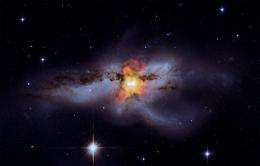
October 6, 2009 Black Holes Go 'Mano a Mano'

Enlarge

Credits: X-ray: NASA/CXC/MIT/C.Canizares, M.Nowak; Optical: NASA/STScI

(PhysOrg.com) -- Two black holes in galaxy NGC 6240 are only 3,000 light years apart -- and getting closer.

This image of NGC 6240 contains new X-ray data from Chandra (shown in red, orange, and yellow) that has been combined with an from the originally released in 2008. In 2002, the discovery of two merging was announced based on Chandra data in this galaxy. The two black holes are a mere 3,000 light years apart and are seen as the bright point-like sources in the middle of the image.

Scientists think these black holes are in such close proximity because they are in the midst of spiraling toward each other -- a process that began about 30 million years ago. It is estimated that the two black holes will eventually drift together and merge into a larger black hole some tens or hundreds of millions of years from now.

Finding and studying merging black holes has become a very active field of research in . Since 2002, there has been intense interest in follow-up observations of NGC 6240 by Chandra and other telescopes, as well as a search for similar systems. Understanding what happens when these exotic objects interact with one another remains an intriguing question for scientists.

The formation of multiple systems of supermassive black holes should be common in the Universe, since many galaxies undergo collisions and mergers with other galaxies, most of which contain supermassive black holes. It is thought that pairs of massive black holes can explain some of the unusual behavior seen by rapidly growing supermassive black holes, such as the distortion and bending seen in the powerful jets they produce. Also, pairs of massive black holes in the process of merging are expected to be the most powerful sources of gravitational waves in the Universe.

Provided by Chandra X-ray Observatory


print this article email this article download pdf blog this article bookmark this article     Stumble it Digg this share on Facebook retweet share on Reddit add to delicious
Rate this story - 4.3 /5 (15 votes)

Rank Filter

Move the slider to adjust rank threshold, so that you can hide some of the comments.


Display comments: newest first

  • yyz - Oct 06, 2009
    • Rank: 4.5 / 5 (4)
    A multiwavelength study of NGC 6240 in optical, IR and x-ray frequencies was published in 2008 and can be found here: http://arxiv.org/...49v1.pdf . Many studies at various wavelengths have been made of this peculiar interacting galaxy, which may contain two orbiting SMBHs. What an awesome multispectral image clearly showing the two presumed SMBHs and at the same time highlighting the star clusters detected by the HST in the visible band of the electromagnetic spectrum!
  • Graeme - Oct 06, 2009
    • Rank: 4 / 5 (1)
    How do these black holes lose angular momentum? Are they orbiting against the flow of stars?
  • Sanescience - Oct 06, 2009
    • Rank: 3 / 5 (2)
    So, if black holes actually exist, how do they overcome angular momentum as they crush down to a singularity? And the original equations from Einstein made no use of quantum mechanics, how is the uncertainty principle overcome with a singularity, and if the probability of tunneling is inversely proportional to distance, what happens when matter is infinitely close?
    I suspect what is now called a black hole are gravistars that do not have infinite density.
  • chelovek - Oct 06, 2009
    • Rank: 4 / 5 (1)
    "In the case of Kerr and Schwarzschild black holes there exist continuous
    standing wave solutions in the total interval 0 < r < co at certain real frequencies. This means that we can see into these black holes at these frequencies with
    gravitational-wave detectors, studying the radial structure inside the event
    horizon. too."

    International Journal of Theoretical Physics; http://works.bepr...szaros/6
  • vidar_lund - Oct 07, 2009
    • Rank: 4.5 / 5 (2)
    How do these black holes lose angular momentum? Are they orbiting against the flow of stars?


    The process is probably a result of drag from material in the galaxy (as you suggests). When the black holes gets very close to each other the system also loses momentum by emission of gravitational waves.
  • vidar_lund - Oct 07, 2009
    • Rank: 5 / 5 (1)
    Interesting story, but . . .

    Our research suggests that repulsive forces between neutrons will prevent the formation of black holes. [If you Google my research profile you can find links to the peer-reviewed papers that document this fact.]

    With kind regards,
    Oliver K. Manuel


    To some extent yes but neutron stars can only grow to about 1.4 solar masses before they collapse.
  • BrianH - Oct 08, 2009
    • Rank: 1 / 5 (1)
    So far, no evidence that gravitational waves actually exist, despite increasingly sensitive detection attempts. If they don't, then what?
  • frajo - Oct 08, 2009
    • Rank: 5 / 5 (2)
    So far, no evidence that gravitational waves actually exist, despite increasingly sensitive detection attempts. If they don't, then what?

    Before you can assume that there are no gravitational waves you'll have to come forth with a sound theory that tells us that there are no such waves.
    As long as we don't have this kind of theory it's only a matter of measurement sensitivity.
  • Sparkygravity - Oct 08, 2009
    • Rank: 5 / 5 (3)
    Actually there is a great deal of evidence that gravity waves exist through indirect observation of binary systems. Adding to that we first predicted them from a theoretical basis. That's one of the reasons why we're so busy looking for direct evidence.
  • sjm - Oct 11, 2009
    • Rank: 5 / 5 (2)
    There is a common belief that black holes are true singularities. A black hole is any object whose physical size is smaller thatn the Schwarzschild radius which is Rs=2GM/c^2. Given that this is not a radius of zero, angular momentum can be conserved for macro black holes. The interesting thing about this object is that there should be intesting gravity waves generated from the interaction. Given the potentially strong magnetic fields coupled with the rotation of field lines, interaction with matter outside of the interacting black holes should, due to friction, lose some of their angular momentum thus changing the dynamics of the interaction leading to the generation of gravity waves should evolve over time in a predictable manner. This is a truly interesting object worthy of close study.
  • yyz - Oct 14, 2009
    • Rank: not rated yet
    sjm, quite right about the importance of systems like this in studying gravity waves. In the discovery paper ( http://arxiv.org/...99v1.pdf ), the authors point out in their conclusion that detecting objects like this will be a major goal for GW detectors like LISA. And, indeed, dynamical friction and GW emission will doom these two supermassive black holes.(Btw, the first paper I linked to above put the SMBHs masses at 1 and 5 million solar mass).

October 6, 2009 all stories

Comments: 11

4.3 /5 (15 votes)
  • Stumble this up

  • Digg this

  • share this

  • hide
  • Related Stories

  • Proto supermassive binary black hole detected in X-rays
    created Apr 06, 2006 | popularity not rated yet | comments 0
  • Chandra data reveal rapidly whirling black holes
    created Jan 10, 2008 | popularity not rated yet | comments 0
  • A new way to weigh giant black holes
    created Jul 16, 2008 | popularity not rated yet | comments 0
  • Chandra finds black holes are 'green'
    created Apr 24, 2006 | popularity not rated yet | comments 0
  • Why Are Galaxies without Black Holes Uncommon?
    created May 30, 2007 | popularity not rated yet | comments 0


  • hide
  • Relevant PhysicsForums posts

  • Sideral question
    created 6 hours ago
  • Doppler shifted blackbody spectrum
    created 8 hours ago
  • Earth v. Moon
    created 11 hours ago
  • help me with coordinates and orbits
    created 11 hours ago
  • More from Physics Forums - General Astronomy

Other News

Unseasonably hot and dry weather combined with strong winds to fan scores of blazes in the country's southeastern states

Australia issues 'catastrophic' alerts as fires rage

Space & Earth / Environment

created 3 hours ago | popularity 4 / 5 (1) | comments 0

Australia has issued "catastrophic" alerts after record-breaking temperatures and wild lightning storms sparked more than 100 fires across the country, officials said Saturday.


Atlantis astronauts take 2nd spacewalk of mission (AP)

Atlantis astronauts take 2nd spacewalk of mission

Space & Earth / Space Exploration

created 8 hours ago | popularity 5 / 5 (1) | comments 0

(AP) -- An astronaut anticipating the birth of his daughter at any moment embarked on the first spacewalk of his career Saturday, tackling a load of maintenance work outside the International Space Station.


Commuters wait on the platform shrouded by fog in London

Climate change not man-made, say majority of Britons: poll

Space & Earth / Environment

created Nov 15, 2009 | popularity 3.3 / 5 (15) | comments 45

Less than half of Britons believes that human activity is to blame for global warming, according to a poll carried out for The Times newspaper and published on Saturday.


Mysteriously warm times in Antarctica

Mysteriously warm times in Antarctica

Space & Earth / Earth Sciences

created Nov 18, 2009 | popularity 4.3 / 5 (19) | comments 27

(PhysOrg.com) -- A new study of Antarctica's past climate reveals that temperatures during the warm periods between ice ages (interglacials) may have been higher than previously thought. The latest analysis ...


UN: Fight climate change with free condoms (AP)

UN: Fight climate change with free condoms

Space & Earth / Environment

created Nov 18, 2009 | popularity 3.1 / 5 (11) | comments 22

(AP) -- The battle against global warming could be helped if the world slowed population growth by making free condoms and family planning advice more widely available, the U.N. Population Fund said Wednesday.