Antarctic expedition studies survival strategies of Weddell seals
October 6, 2009 By Tim Stephens Antarctic expedition studies survival strategies of Weddell seals

Enlarge

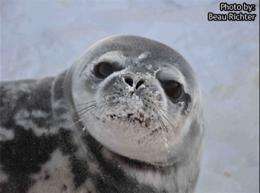
Weddell seals, such as this female, are being studied by biologist Terrie Williams during an 8-week expedition to Antarctica.

(PhysOrg.com) -- Eight years after her last major expedition to Antarctica, biologist Terrie Williams is back on the ice. This time, however, her team began the expedition during the Antarctic winter, the harshest season in the harshest environment on Earth.

From a remote field site on the Antarctic sea ice, the researchers are posting notes, photos, and video on an web site.

Their goal is to discover how Weddell survive the winter beneath the sea ice of McMurdo Sound. The Weddell seal is the only mammal, other than well-equipped humans such as Williams and her colleagues, to live in McMurdo Sound during the brutal winter months.

"We have already gone through a 100-degree change in wind-chill temperatures, from minus 100 to 0 degrees Fahrenheit," said Williams, a professor of ecology and , in an e-mail.

In 2001, Williams studied the underwater world of Weddel seals during the Antarctic summer using video cameras worn by the seals during their dives beneath the ice. That expedition was also documented on a web site, and Williams described her adventures studying Weddell seals in a 2004 book, The Hunter's Breath.

This year, thanks to technological improvements, the monitoring equipment is smaller and more sophisticated than ever, giving the team a new perspective on the lives of Weddell seals. The miniaturized instrument packs worn by the seals record what they see and hear underwater, monitor where they go, and even record the ocean temperatures and other environmental conditions they encounter.

Williams said she is particularly interested in how the seals will respond to changes in their environment caused by global warming. "The seals are monitoring marked changes in the polar environment that will ultimately dictate their survival," she said.

The researchers will be posting updates on the web site each week for eight weeks. The nine members of the expedition team include researchers from UCSC, Texas A&M University, and University of Texas. Their expedition is funded by the National Science Foundation, Division of Polar Programs.

Provided by University of California - Santa Cruz (news : web)


print this article email this article download pdf blog this article bookmark this article     Stumble it Digg this share on Facebook retweet share on Reddit add to delicious
Rate this story - 5 /5 (1 vote)

Rank Filter

Move the slider to adjust rank threshold, so that you can hide some of the comments.


Display comments: newest first

  • zevkirsh - Oct 07, 2009
    • Rank: not rated yet
    damn, i'm sure those seals would be thrilled if the tempratures warmed up a few degrees.

October 6, 2009 all stories

Comments: 1

5 /5 (1 vote)
  • Stumble this up

  • Digg this

  • share this

  • hide
  • Related Stories

  • Mercury levels in Arctic seals may be linked to global warming
    created Apr 29, 2009 | popularity not rated yet | comments 0
  • Southern Ocean seals dive deep for climate data
    created Aug 11, 2008 | popularity not rated yet | comments 0
  • NASA astronaut to call home this week
    created May 15, 2006 | popularity not rated yet | comments 0
  • Secret Life of Elephant Seals Not Secret Anymore
    created Aug 07, 2007 | popularity not rated yet | comments 0
  • Texas researchers and educators head for Antarctica
    created Aug 15, 2007 | popularity not rated yet | comments 0


  • hide
  • Relevant PhysicsForums posts

  • What is transpulmonary pressure?
    created Nov 24, 2009
  • Is there a gay gene?
    created Nov 23, 2009
  • Super quick question about Starling forces?
    created Nov 22, 2009
  • Questions about diffusion
    created Nov 22, 2009
  • More from Physics Forums - Biology

Other News

'Safety valve' protects photosynthesis from too much light

Biology / Cell & Microbiology

created 9 minutes ago | popularity not rated yet | comments 0

Photosynthetic organisms need to cope with a wide range of light intensities, which can change over timescales of seconds to minutes. Too much light can damage the photosynthetic machinery and cause cell death. Scientists ...


Cells defend themselves from viruses, bacteria with armor of protein errors

Biology / Cell & Microbiology

created 22 minutes ago | popularity not rated yet | comments 0

When cells are confronted with an invading virus or bacteria or exposed to an irritating chemical, they protect themselves by going off their DNA recipe and inserting the wrong amino acid into new proteins to defend them ...


Researchers discover biological basis of 'bacterial immune system'

Biology / Cell & Microbiology

created 54 minutes ago | popularity 4 / 5 (1) | comments 0

Bacteria don't have easy lives. In addition to mammalian immune systems that besiege the bugs, they have natural enemies called bacteriophages, viruses that kill half the bacteria on Earth every two days.


Redback spiders were first spotted in Japan in 1995

Venomous Aussie redback spiders invading Japan

Biology / Ecology

created 7 hours ago | popularity 5 / 5 (2) | comments 0

Australia's venomous redback spiders are on the march in Japan, where they are believed to have arrived years ago as stowaways on cargo ships, a wildlife expert warned Wednesday.


Sustainable Corn Production Supports Advanced Biofuel Feedstocks

Sustainable Corn Production Supports Advanced Biofuel Feedstocks

Biology / Biotechnology

created 4 hours ago | popularity 3.3 / 5 (3) | comments 1

(PhysOrg.com) -- Researchers worldwide are trying to economically convert cellulosic biomass such as corn stover into "cellulosic ethanol." But Agricultural Research Service (ARS) scientists have found that ...