Novel polymer delivers genetic medicine, allows tracking
October 6, 2009 Novel polymer delivers genetic medicine, allows tracking

Enlarge

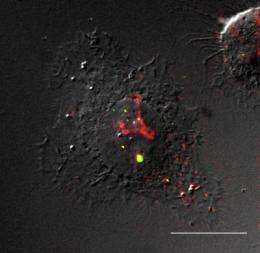
Researchers at Virginia Tech and at the University of Cincinnati designed novel polymeric beacons capable of delivering plasmid DNA into mammalian cells. This image shows a deconvoluted micrograph of a HeLa cell transfected with DNA-polymer beacon complexes. The DNA is labeled with fluorescein isothiocyanate and appears green in the image. Eu3+ luminescence from the polymeric beacon appears red. Yellow pixels can be qualitatively used to visualize regions of co-localization of DNA and polymer beacon. The DNA and polymer beacon signals are overlaid with the DIC image to show contrast and morphology of the cell (scale bar = 20 micrometers). Credit: Image provided by Joshua Bryson.

Theresa M. Reineke, associate professor of chemistry in the College of Science, and colleagues in her lab at Virginia Tech and at the University of Cincinnati have developed a new molecule that can travel into cells, deliver genetic cargo, and packs a beacon so scientists can follow its movements in living systems.

"My lab has been trying to find a way to deliver genetic-based drugs into cells." said Reineke.

Scientists worldwide are using information from the human genome project as an approach to treat disease. Reineke's focus is cancer and cardiovascular disease. "Traditional drugs are aimed at treating disease at the protein level," she said. "Genetic drugs - such as those that can alter or control - aim to treat disease at the genetic level and have the added benefit of being more specific for their medicinal target." An example would be a genetic message that would arrest tumor growth.

A challenge has been that and drugs - pieces of that store information and instructions - cannot diffuse through the cell the way traditional small molecule drugs can. "We needed a vehicle to carry them into cells," said Reineke. One such vehicle has been engineered viruses. Reineke's group has been working on a more elegant solution. Their discovery is the topic of the PNAS article.

The scientists created novel polycations. A polycation is a polymer chain with positive charges, which is not too unusual. DNA itself is a polyanion, a polymer with negative charges. However, the Reineke Group's supramolecule has options. It contains chemistry (oligoethyleneamines) that binds and compacts - pieces of the DNA - into . It also incorporates a group of rare-earth elements known as lanthanides. The repackaged DNA is protected from damage as it travels into the cells and the lanthanides allow visualization of the delivery into cells.

"In our experiments, these delivery beacons provide the ability to track DNA delivery into living cells," said Reineke. "They provide the potential for tracking genetic therapies within the living body," she said.

At the nanometer or cellular scale, the researchers are able to track the polymers using sensitive microscopes, which capture the nanoparticle luminescence. At the sub-millimeter or tissue scale, magnetic resonance imaging (MRI) is used to see where the nanoparticles are going.

"This ability to track the movement and delivery of a gene-based drug provides an opportunity to understand the mechanism of delivery and monitor efficacy in real time, so that we can develop better materials for delivering genetic therapeutics and ultimately better treatments," Reineke said.

More information: The research was published in the September 23, 2009 online early edition of the Proceedings of the National Academy of Sciences (PNAS), in the article "Polymer beacons for luminescence and magnetic resonance imaging of DNA delivery." http://www.pnas.org/content/early/2009/09/23/0904860106.abstract

Source: Virginia Tech (news : web)


print this article email this article download pdf blog this article bookmark this article     Stumble it Digg this share on Facebook retweet share on Reddit add to delicious
Rate this story - 5 /5 (3 votes)


October 6, 2009 all stories

Comments: 0

5 /5 (3 votes)
  • Stumble this up

  • Digg this

  • share this

  • hide
  • Related Stories


  • hide
  • Relevant PhysicsForums posts

  • More from

Other News

GE Scientists Developing Wearable RFID Sensors to Detect Airborne Chemical Agents

GE Scientists Developing Wearable RFID Sensors to Detect Airborne Chemical Agents

Chemistry / Analytical Chemistry

created 20 hours ago | popularity not rated yet | comments 0

GE Global Research, the technology development arm for the General Electric, today announced a $2 million award from the National Institute of Environmental Health Sciences to develop wearable RFID sensors ...


Accidental discovery produces durable new blue pigment for multiple applications

Accidental discovery produces durable new blue pigment for multiple applications

Chemistry / Biochemistry

created Nov 16, 2009 | popularity 4.5 / 5 (30) | comments 6

An accidental discovery in a laboratory at Oregon State University has apparently solved a quest that over thousands of years has absorbed the energies of ancient Egyptians, the Han dynasty in China, Mayan ...


Ethanol

Microbes to Take Over Ethanol Production?

Chemistry / Biochemistry

created Nov 20, 2009 | popularity 3.8 / 5 (5) | comments 0

(PhysOrg.com) -- Not too long ago, it seemed that ethanol production was the wave of the future. The use of trash, wood chips or different types of plants -- usually grass or corn -- to make ethanol was considered ...


One word: bioplastics

One word: bioplastics

Chemistry / Materials Science

created Nov 17, 2009 | popularity 4.5 / 5 (10) | comments 4

(PhysOrg.com) -- Every year, more than 250 billion pounds of plastic are produced worldwide. Much of it ends up in the world's oceans, a fact that troubles MIT biology professor Anthony Sinskey.


New on-off 'switch' triggers and reverses paralysis in animals with a beam of light

New on-off 'switch' triggers and reverses paralysis in animals with a beam of light (w/ Video)

Chemistry / Biochemistry

created Nov 18, 2009 | popularity 5 / 5 (4) | comments 3

In an advance with overtones of Star Trek phasers and other sci-fi ray guns, scientists in Canada are reporting development of an internal on-off "switch" that paralyzes animals when exposed to a beam of ultraviolet ...