Can Nanotubes Help Your Garden Grow?

October 6, 2009 by Miranda Marquit Tomatoes

Enlarge

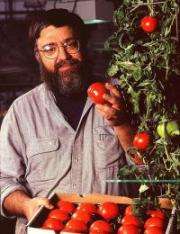
Image credit: Jack Dykinga. These are tomatoes grown with the ACC synthase gene.

(PhysOrg.com) -- When we think of nanotubes, we often think of solar panels and physical science. However, it appears that nanotubes can also provide valuable help to plants as a fertilizer. Just add carbon nanotubes, say researchers at the University of Arkansas in Little Rock, and you can get plants that grow faster and bigger than their counterparts.

According to New Scientist, Mariya Khodakovskaya, a plant biologist, and Alexandru Biris, a nanotechnologist, used carbon nanotubes to encourage germination of tomato plants. Tomato seeds were planted, some with a growth medium containing carbon nanotubes, and some without nanotubes in the growth medium. It took only three days for more than 30% of the nanotube tomato seeds to begin sprouting. In that time, none of the non-treated seeds had even germinated.

In fact, it took 12 days for 32% of the tomato seeds without nanotube help to germinate.
Can Nanotubes Help Your Garden Grow?
Enlarge

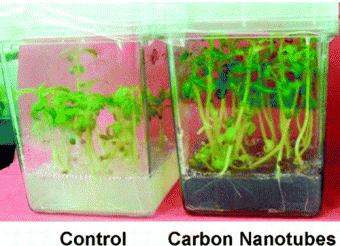
Image: ACS Nano, DOI: 10.1021/nn900887m

After four weeks, the researchers noticed that the tomato plants that had been treated with carbon nanotubes had two times the biomass and two times the height of their non-treated counterparts. The current theory is that the nanotubes penetrate the seed coat of the tomato seeds, allowing water to more rapidly penetrate the seeds and boost their development.

Interestingly, the root systems were similar in all of the plants, so the nanotubes did not change the way the roots established themselves. Another issue is that the nanotubes seem to be causing abnormally long internodes, and that might affect the ultimate outcome regarding the viability of mature plants. Additionally, carbon nanotubes as fertilizer might present hazards when used for food plants, since they were found to trigger some toxic effects in mice.

In the end, though, it appears that carbon may be more versatile than originally imagined.

More information: The research has been published in ACS Nano: Carbon Nanotubes Are Able To Penetrate Plant Seed Coat and Dramatically Affect Seed Germination and Plant Growth, DOI: 10.1021/nn900887m

© 2009 PhysOrg.com


Rate this story - 3.9 /5 (12 votes)

Rank Filter

Move the slider to adjust rank threshold, so that you can hide some of the comments.


Display comments: newest first

  • rincewind - Oct 06, 2009
    • Rank: 3.7 / 5 (3)
    Sometimes it feels like we're just making up execuses to use nanotubes for more applications.

    The article ends in a massive understatement:

    "...it appears that carbon nanotubes may be more versatile than originally imagined." - oh really?

  • gmurphy - Oct 06, 2009
    • Rank: 3.5 / 5 (2)
    "two times the biomass and two times the height of their non-treated counterparts", these numbers are unreal, the best fertilisers could only hope to get a fraction of this, if this is verified independently then agriculture is going to get a major boost, toxicity concerns must addressed still though
  • danman5000 - Oct 06, 2009
    • Rank: 3.6 / 5 (5)
    Did they ever consider that it's not the nanotubes, but the carbon that does this? I mean doesn't ash make a good fertilizer? That's just carbon. They should show results of nanotubes vs crushed charcoal imo.

    I also agree with rincewind - seems like every other day there's another article up here proclaiming a new miracle that nanotubes can perform. Boosts solar call efficiency, facilitates drug transport, make them conductors/semiconductors, and now they can replace miraclegrow! Oh what wonders will they come up with next? Sprinkle some on your head to regrow your hair!
  • Going - Oct 07, 2009
    • Rank: 3.5 / 5 (4)
    I'll just let other people conduct the experiment on themselves by eating this stuff thanks. Bio active in plants = bio active in people.
  • ArtflDgr - Oct 07, 2009
    • Rank: 5 / 5 (2)
    just what the world needs, a new $20,000 tomato.
  • ArtflDgr - Oct 08, 2009
    • Rank: 5 / 5 (1)
    Bio active in plants = bio active in people.

    not necessarily...

  • plasticpower - Oct 12, 2009
    • Rank: not rated yet
    I'm with the guy who says sprinkle some ash and charcoal and see if you get the same result. Twice the growth is completely insane though.
  • cybrbeast - Oct 12, 2009
    • Rank: not rated yet
    Did they ever consider that it's not the nanotubes, but the carbon that does this? I mean doesn't ash make a good fertilizer? That's just carbon. They should show results of nanotubes vs crushed charcoal imo.

    Not true. Ash is not just carbon. Carbon mostly burns off when fire makes ash, that's where the CO2 comes from. The ash is composed of all the incombustible minerals. Potassium, calcium phosphorous etc. These are important fertilizers.

October 6, 2009 all stories

Comments: 8

3.9 /5 (12 votes)

  • hide
  • Related Stories

  • Silicon nanotubes for hydrogen storage in fuel cell vehicles
    created Apr 21, 2008 | popularity not rated yet | comments 0
  • High Value Semiconducting Carbon Nanotubes
    created Jul 12, 2004 | popularity not rated yet | comments 0
  • Tweezers Trap Nanotubes by Color
    created Sep 26, 2008 | popularity not rated yet | comments 0
  • Modification Turns Ultra-Short Nanotubes into Molecule-Like Drug Capsules
    created Oct 23, 2006 | popularity not rated yet | comments 0
  • Nanotube Coating Meshes with Living Cells
    created Aug 14, 2006 | popularity not rated yet | comments 0


  • hide
  • Relevant PhysicsForums posts

Other News

Nanoscale Structures with Superior Mechanical Properties Developed

Nanoscale Structures with Superior Mechanical Properties Developed

Nanotechnology / Nanomaterials

created 17 hours ago | popularity 4.6 / 5 (9) | comments 1 | with audio podcast

(PhysOrg.com) -- Researchers at the California Institute of Technology have developed a way to make some notoriously brittle materials ductile -- yet stronger than ever -- simply by reducing their size.


Spray-on liquid glass

Spray-on liquid glass is about to revolutionize almost everything

Nanotechnology / Nanomaterials

created Feb 02, 2010 | popularity 4.7 / 5 (240) | comments 93 | with audio podcast report

(PhysOrg.com) -- Spray-on liquid glass is transparent, non-toxic, and can protect virtually any surface against almost any damage from hazards such as water, UV radiation, dirt, heat, and bacterial infections. ...


IBM Scientists Demonstrate World's Fastest Graphene Transistor

IBM Scientists Demonstrate World's Fastest Graphene Transistor

Nanotechnology / Nanophysics

created Feb 05, 2010 | popularity 4.9 / 5 (38) | comments 25 | with audio podcast

(PhysOrg.com) -- In a just-published paper in the magazine Science, IBM researchers demonstrated a radio-frequency graphene transistor with the highest cut-off frequency achieved so far for any graphene device ...


Conductive eTextiles: Stanford finds a new use for cloth

Conductive eTextiles: Researchers move from making batteries from paper to making batteries from cloth

Nanotechnology / Nanomaterials

created Feb 05, 2010 | popularity 4.3 / 5 (7) | comments 4 | with audio podcast

(PhysOrg.com) -- Stanford researchers have moved from making batteries from paper to making batteries from cloth. Your-T-shirt could become a lighted, moving display.


Carbon Based Chips May One Day Replace Silicon Transistors

Carbon Based Chips May One Day Replace Silicon Transistors

Nanotechnology / Nanomaterials

created Feb 03, 2010 | popularity 4.7 / 5 (18) | comments 3 | with audio podcast weblog

(PhysOrg.com) -- IBM researchers are hopeful that, over the next decade, silicon-based transistors will be replaced by carbon-based transistors. IBM has already laid out the ground work for carbon-based transistors.