Where's the next boom? Maybe in 'cleantech'
(AP) -- Our economy sure could use the Next Big Thing. Something on the scale of railroads, automobiles or the Internet - the kind of breakthrough that emerges every so often and builds industries, generates jobs and mints fortunes.
Silicon Valley investors are pointing to something called cleantech - alternative energy, more efficient power distribution and new ways to store electricity, all with minimal impact to the environment - as a candidate for the next boom.
And while no two booms are exactly alike, some hallmarks are already showing up.
Despite last fall's financial meltdown, public and private investments are pouring in, fueling startups and reinvigorating established companies. The political and social climates are favorable. If it takes off, cleantech could seep into every part of the economy and our lives.
Some of the biggest booms first blossomed during recessions. The telephone and phonograph were developed during the depression of the 1870s. The integrated circuit, a milestone in electronics, was invented in the recessionary year of 1958. Personal computers went mainstream, spawning a huge industry, in the slumping early 1980s.
A year into the Great Recession, innovation isn't slowing. This time, it's better batteries, more efficient solar cells, smarter appliances and electric cars, not to mention all the infrastructure needed to support the new ways energy will be generated and the new ways we'll be using it.
Yet for all the benefits that might be spawned by cleantech breakthroughs, no one knows how many jobs might be created - or how many old jobs might be cannibalized. It also remains to be seen whether Americans will clamor for any of its products.
Still, big bets are being placed. The Obama administration is pledging to invest $150 billion over the next decade on energy technology and says that could create 5 million jobs. This recession has wiped out 7.2 million.
And cleantech is on track to be the dominant force in venture capital investments over the next few years, supplanting biotechnology and software. Venture capitalists have poured $8.7 billion into energy-related startups in the U.S. since 2006.
That pales in comparison with the dot-com boom, when venture cash sometimes topped $10 billion in a single quarter. But the momentum surrounding clean energy is reminiscent of the Internet's early days. Among the similarities: Although big projects are still dominated by large companies, the scale of the challenges requires innovation by smaller firms that hope to be tomorrow's giants.
"Ultimately IBM and AT&T didn't build the Internet. It was built by Silicon Valley startups," says Bob Metcalfe, an Internet pioneer who now invests in energy projects with Polaris Venture Partners. "And energy is going to be solved by entrepreneurial activity."
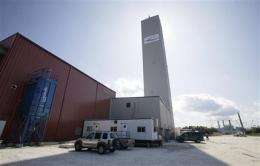
The action is happening at companies like GreatPoint Energy in Cambridge, Mass., which has developed a technique for turning coal into natural gas more cheaply and efficiently than previous methods.
GreatPoint plans to break ground next year on a power plant in Houston that will cost $800 million and create thousands of construction jobs, says its CEO, Andrew Perlman. Dow Chemical Co. and energy giants AES Corp., Suncor Energy Inc. and Peabody Energy are all GreatPoint investors.
"The opportunities," Perlman says, "are staggering."
A123 Systems, a Watertown, Mass., maker of lithium-ion batteries for electric cars, had one of the most lucrative public stock offerings this year, raising $437.5 million. Its stock price jumped more than 50 percent on the first day of trading in September, with investors willing to overlook that the company has yet to make money.
The Obama administration's promises about cleantech funding have galvanized the industry, reassuring entrepreneurs that they will have paying customers. The administration has said it will focus on putting more hybrid cars on the road, boosting the amount of electricity from renewable sources and investing in ways to cut pollution from coal.
One target is "smart grids." As utilities install digital meters in homes and Americans buy appliances that can communicate with the electric system, individual power consumption can be monitored more closely. People could be cued to dial down appliances such as refrigerators and air conditioners when electricity is in highest demand. Such fine-tuning in millions of homes can reduce the need for new power plants.
At Tendril Networks Inc. of Boulder, Colo., which makes software that links utilities to smart-grid devices in homes, the staff has tripled over the past five months to 90. CEO Adrian Tuck says Tendril could grow even more if some of the $4.5 billion earmarked for smart grids in this year's federal stimulus goes to Tendril's clients.
"What we're about to see is every bit as big as the telecom revolution that gave birth to the Internet and cell phones," Tuck says. "It's going to create as many jobs and as much wealth for this country, if they get it right. Big, Google-sized companies are going to be born in this era, and we hope to be one of them."
The government's push for these developments parallels the expansion of railroads in the 19th century, when the government granted blocks of land to companies laying track, says Jack Brown, an associate professor in the University of Virginia's Department of Science, Technology and Society.
One difference, Brown points out, is that clean energy is such a vast field that government could make the wrong choice in backing one type of technology over another.
It's not just startups getting in the game. General Electric Co. plans to string transmission lines to deliver solar or wind power. Hewlett-Packard Co. is adapting techniques for printer cartridge chips so digital sensors can send data to smart grids.
But how much of an economic boost does all this add up to? It's hard to tell - at least at this stage, without products people actually want to buy.
The laser, for instance, was a big innovation, but it wasn't clear at first what it could be used for. That's why there wasn't an economic boom in the 1960s from the advent of lasers, even though they ended up driving everything from medical devices to CD players for four decades.
Sung Won Sohn, an economics professor at California State University, Channel Islands, believes upgrading electric grids and finding new sources of power will provide steady job growth - but won't be an economic powder keg.
Clean energy projects could simply replace old jobs and functions, like meter-readers. And there's no guarantee new jobs won't shift to countries with cheaper labor.
Some innovations take longer to reveal their economic effects. There are big booms based on specific innovations - along the lines of railroads, automobiles and the Internet - and then there are technologies that grow slowly, spawning offshoot industries for entrepreneurs to exploit over decades.
For example, the emergence of the integrated circuit led to the development of computer microprocessors, which enabled the PC revolution and in turn the Internet age. There's every reason to believe energy technology will fall into the same category, Brown says, but he adds: "It depends on how the bets actually play out."
©2009 The Associated Press. All rights reserved. This material may not be published, broadcast, rewritten or redistributed.


