Large-scale cousin of elusive 'magnetic monopoles' found
October 6, 2009 Large-scale cousin of elusive 'magnetic monopoles' found at NIST

Enlarge

(PhysOrg.com) -- Any child can tell you that a magnet has a "north" and a "south" pole, and that if you break it into two pieces, you invariably get two smaller magnets with two poles of their own. But scientists have spent the better part of the last eight decades trying to find, in essence, a magnet with only one pole. A team working at the National Institute of Standards and Technology has found one.*

In 1931, , one of the rock stars of the physics world, made the somewhat startling prediction that " monopoles," or particles possessing only a single pole—either north or south—should exist. His conclusion stemmed from examining a famous set of equations that explains the relationship between and magnetism. Maxwell's equations apply to long-known electric monopole particles, such as negatively charged and positively charged protons; but despite Dirac's prediction, no one has found particles.

Now, a research team working at NIST's Center for Neutron Research (NCNR), led by Hiroaki Kadowaki of Tokyo Metropolitan University, has found the next best thing. By creating a compound that under certain conditions forms large, molecule-sized monopoles that behave exactly as the predicted particles should, the team has found a way to explore magnetic monopoles in the laboratory, not just on the chalkboard. (Another research team, working simultaneously, published similar findings in Science last month.**)

Large-scale cousin of elusive 'magnetic monopoles' found at NIST
Enlarge


Large-scale cousin of elusive 'magnetic monopoles' found at NIST
Enlarge


Large-scale cousin of elusive 'magnetic monopoles' found at NIST
Enlarge

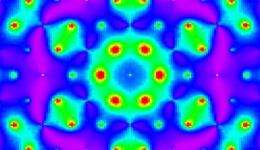
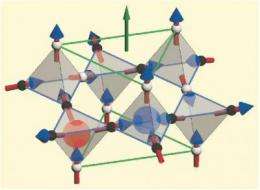
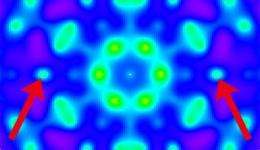
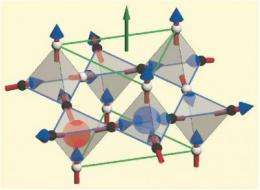
Magnetic monopoles are created (top) when the spin of an ion in one corner of a spin ice crystal is knocked askew, creating a monopole (red sphere) and adjacent antimonopole (blue sphere). Neutron scattering at the NCNR allowed the team to see the spin ice's transition from its normal state (center) to the monopole state. Monopoles scatter neutrons in a telltale fashion indicated by the red arrows in (bottom.) Credit: NIST

"These are not the monopole particles Dirac predicted—ours are huge in comparison—but they behave like them in every way," says Jeff Lynn, a NIST physicist. "Their properties will allow us to test how theoretical monopole particles should behave and interact."

The team created their monopoles in a compound made of oxygen, titanium and dysprosium that, when cooled to nearly absolute zero, forms what scientists call "spin ice." The material freezes into four-sided crystals (a pyramid with a triangular base) and the magnetic orientation, or "spin," of the ions at each of the four tips align so that their spins are balanced—two spins point inward and two outward. But using neutron beams at the NCNR, the team found they could knock one of the spins askew so that instead three point in, one out … "creating a monopole, or at least its mathematical equivalent," Lynn said.

Because every crystal pyramid shares its four tips with adjacent pyramids, flipping the spin of one tip creates an "anti-monopole" in the next pyramid over. The team has created monopole-antimonopole pairs repeatedly in a relatively large chunk of the spin ice, allowing them to confirm the monopoles' existence through advanced imaging techniques such as neutron scattering.

While the findings will not tell the team where in the universe to search for Dirac's still-elusive magnetic monopole particles, Lynn says that examining the spin ice will permit scientists to test certain predictions about monopoles. "Maxwell's equations indicate that monopoles should obey Coulomb's Law, which indicates their interaction should weaken as distance between them increases," he says. "Using the spin ice crystals, we can test ideas like this."

More information:

* H. Kadowaki, N. Doi, Y. Aoki, Y. Tabata, T.J. Sato, J.W. Lynn, K. Matsuhira and Z. Hiroi. Observation of magnetic monopoles in spin ice. Journal of the Physical Society of Japan,78, No. 10, Oct. 13, 2009. (The team first presented their findings in an invited talk at the International Conference on Neutron Scattering in May 2009.)

** D. J. P. Morris, et al. Dirac strings and magnetic monopoles in spin ice Dy2Ti2O7. Science, online publication Sept. 3, 2009.

Source: National Institute of Standards and Technology (news : web)


print this article email this article download pdf blog this article bookmark this article     Stumble it Digg this share on Facebook retweet share on Reddit add to delicious
Rate this story - 4.2 /5 (17 votes)

Rank Filter

Move the slider to adjust rank threshold, so that you can hide some of the comments.


Display comments: newest first

  • bluehigh - Oct 07, 2009
    • Rank: 3 / 5 (2)
    What is an anti-monopole? Do they mean that the 2 opposite magnetic fields are separated in space? Is this actually a mono anything, if it only co-exists with a manifestation of the opposite field trapped in a crystal lattice?
  • Alexa - Oct 07, 2009
    • Rank: not rated yet
    Rather then just about monopoles we should talk about free ends of long, noodle-like dipoles.

    http://images.iop...ole1.jpg

    (image of Dirac strings from original article)
  • Alexa - Oct 07, 2009
    • Rank: not rated yet
    What is an anti-monopole?
    It's the second end of Dirac string, forming monopole pair.
  • otto1923 - Oct 07, 2009
    • Rank: not rated yet
    Heres a question:
    Rosy Teh, Khai-Ming Wong
    (Submitted on 9 Jun 2004 (v1), last revised 28 Apr 2005 (this version, v4))
    Abstract: The SU(2) Yang-Mills-Higgs theory supports the existence of monopoles, antimonopoles, and vortex rings. In this paper, we would like to present new exact static antimonopole-monopole-antimonopole (A-M-A) configurations. The net magnetic charge of these configurations is always negative one, whilst the net magnetic charge at the origin is always positive one for all positive integer values of the solution's parameter $m$. However, when $m$ increases beyond one, vortex rings appear coexisting with these A-M-A configurations. The number of vortex rings increases proportionally with the value of $m$. They are located in space where the Higgs field vanishes along rings.
    'where the Higgs field vanishes...' -does something at this location lose mass??
  • mattytheory - Oct 12, 2009
    • Rank: not rated yet
    ^If the Higgs field is the mechanism by which particles have mass, then the asbence of such a field would imply that mass is no longer there, right?

October 6, 2009 all stories

Comments: 5

4.2 /5 (17 votes)
  • Stumble this up

  • Digg this

  • share this

  • hide
  • Related Stories

  • Magnetic monopoles detected in a real magnet for the first time
    created Sep 03, 2009 | popularity not rated yet | comments 0
  • Physicists Propose a Method to Observe Dirac Monopoles
    created Jul 28, 2009 | popularity not rated yet | comments 0
  • Making magnetic monopoles, and other exotica, in the lab
    created Feb 05, 2009 | popularity not rated yet | comments 0
  • Physics failure could mean success
    created Jan 25, 2005 | popularity not rated yet | comments 0
  • Probing a rare material spin state
    created Sep 14, 2007 | popularity not rated yet | comments 0


  • hide
  • Relevant PhysicsForums posts

Other News

Restored machine to explore mysteries of Big Bang (AP)

Restored machine to explore mysteries of Big Bang

Physics / General Physics

created 23 hours ago | popularity 4.5 / 5 (16) | comments 11

(AP) -- Scientists are preparing the world's largest atom smasher to explore the depths of matter after successfully restarting the $10 billion machine following more than a year of repairs.


nuclear power plant

Doubts raised on nuclear industry viability

Physics / General Physics

created Nov 19, 2009 | popularity 3.1 / 5 (20) | comments 19

(PhysOrg.com) -- The investment in nuclear power has been growing around the world over the last few years, being viewed as a means for countries to control their energy security, avoid the price fluctuations ...


Researchers Find Innate Correlations Among Different Power Law Phenomena

Researchers Find Innate Correlations Among Different Power Law Phenomena

Physics / General Physics

created Nov 17, 2009 | popularity 4.3 / 5 (15) | comments 14

(PhysOrg.com) -- Studying the patterns that emerge in natural and social phenomena is a popular area of research, although usually individual phenomena are studied separately from each other. In a recent study, ...


Scientists demonstrate 'universal' programmable quantum processor

Scientists demonstrate 'universal' programmable quantum processor

Physics / Quantum Physics

created Nov 15, 2009 | popularity 4.6 / 5 (21) | comments 11

Physicists at the National Institute of Standards and Technology have demonstrated the first "universal" programmable quantum information processor able to run any program allowed by quantum mechanics -- th ...


Proton's party pals may alter its internal structure

Proton's party pals may alter its internal structure

Physics / General Physics

created Nov 18, 2009 | popularity 4.6 / 5 (20) | comments 9

A recent experiment at the DOE's Thomas Jefferson National Accelerator Facility has found that a proton's nearest neighbors in the nucleus of the atom may modify the proton's internal structure.