Largest Ring Around Saturn Discovered
October 7, 2009 Largest Ring Around Saturn

Enlarge

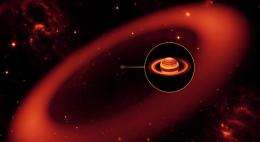
NASA's Spitzer Space Telescope has spotted a nearly invisible ring around Saturn -- the largest of the giant planet's many rings. Image credit: NASA/JPL-Caltech/Keck

(PhysOrg.com) -- NASA's Spitzer Space Telescope has discovered an enormous ring around Saturn -- by far the largest of the giant planet's many rings.

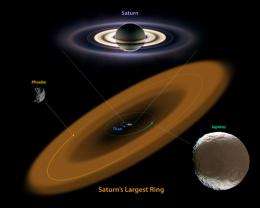
The new belt lies at the far reaches of the Saturnian system, with an orbit tilted 27 degrees from the main ring plane. The bulk of its material starts about six million kilometers (3.7 million miles) away from the planet and extends outward roughly another 12 million kilometers (7.4 million miles). One of Saturn's farthest moons, Phoebe, circles within the newfound ring, and is likely the source of its material.

Saturn's newest halo is thick, too -- its vertical height is about 20 times the diameter of the planet. It would take about one billion Earths stacked together to fill the ring.
Largest Ring Around Saturn Discovered
Enlarge

This diagram illustrates the extent of the largest ring around Saturn, discovered by NASA's Spitzer Space Telescope. The ring is huge, and far from the gas planet and the rest of its majestic rings. Image credit: NASA/JPL-Caltech

"This is one supersized ring," said Anne Verbiscer, an astronomer at the University of Virginia, Charlottesville. "If you could see the ring, it would span the width of two full moons' worth of sky, one on either side of Saturn." Verbiscer; Douglas Hamilton of the University of Maryland, College Park; and Michael Skrutskie, of the University of Virginia, Charlottesville, are authors of a paper about the discovery to be published online tomorrow by the journal Nature.

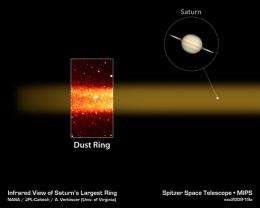
The ring itself is tenuous, made up of a thin array of ice and . Spitzer's infrared eyes were able to spot the glow of the band's cool dust. The telescope, launched in 2003, is currently 107 million kilometers (66 million miles) from Earth in orbit around the .

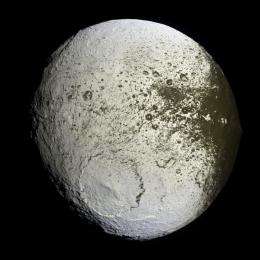
The discovery may help solve an age-old riddle of one of Saturn's moons. Iapetus has a strange appearance -- one side is bright and the other is really dark, in a pattern that resembles the yin-yang symbol. The astronomer Giovanni Cassini first spotted the moon in 1671, and years later figured out it has a dark side, now named Cassini Regio in his honor. .
Iapetus
Enlarge

Iapetus. Cassini captured the first high-resolution glimpse of the bright trailing hemisphere of Saturn's moon Iapetus. Image: NASA

Saturn's newest addition could explain how Cassini Regio came to be. The ring is circling in the same direction as Phoebe, while Iapetus, the other rings and most of Saturn's moons are all going the opposite way. According to the scientists, some of the dark and dusty material from the outer ring moves inward toward Iapetus, slamming the icy moon like bugs on a windshield.

"Astronomers have long suspected that there is a connection between Saturn's outer moon Phoebe and the dark material on Iapetus," said Hamilton. "This new ring provides convincing evidence of that relationship."

Verbiscer and her colleagues used Spitzer's longer-wavelength infrared camera, called the multiband imaging photometer, to scan through a patch of sky far from Saturn and a bit inside Phoebe's . The astronomers had a hunch that Phoebe might be circling around in a belt of dust kicked up from its minor collisions with comets -- a process similar to that around stars with dusty disks of planetary debris. Sure enough, when the scientists took a first look at their Spitzer data, a band of dust jumped out.
Largest Ring Around Saturn Discovered
Enlarge

This diagram highlights a slice of Saturn's largest ring. The ring (red band in inset photo) was discovered by NASA's Spitzer Space Telescope, which detected infrared light, or heat, from the dusty ring material. Spitzer viewed the ring edge-on from its Earth-trailing orbit around the sun. Spitzer image credit: NASA/JPL-Caltech/Univ. of Virginia

The ring would be difficult to see with visible-light telescopes. Its particles are diffuse and may even extend beyond the bulk of the ring material all the way in to Saturn and all the way out to interplanetary space. The relatively small numbers of particles in the ring wouldn't reflect much visible light, especially out at where sunlight is weak.

"The particles are so far apart that if you were to stand in the ring, you wouldn't even know it," said Verbiscer.

Spitzer was able to sense the glow of the cool dust, which is only about 80 Kelvin (minus 316 degrees Fahrenheit). Cool objects shine with infrared, or thermal radiation; for example, even a cup of ice cream is blazing with infrared light. "By focusing on the glow of the ring's cool dust, Spitzer made it easy to find," said Verbiscer.

These observations were made before Spitzer ran out of coolant in May and began its "warm" mission.

Provided by JPL/NASA (news : web)


print this article email this article download pdf blog this article bookmark this article     Stumble it Digg this share on Facebook retweet share on Reddit add to delicious
Rate this story - 4.6 /5 (31 votes)

Rank Filter

Move the slider to adjust rank threshold, so that you can hide some of the comments.


Display comments: newest first

  • RayCherry - Oct 07, 2009
    • Rank: 3.3 / 5 (3)
    A ring of dust around one of the largest objects in the solar system. How fast does that dust need to be moving to remain in orbit?

    It is a fast moving cloud of invisible dust, and we have been sending billions of dollars worth of equipment through it for many years. How many other such bands of material exist in the solar system, and outside (beyond the Kuiper belt)?

    Excellent discovery. Well done to the Spritzer team. Hope that Jupiter, Neptune and Uranus also yield similar rings (or spheres).
  • RigorMan - Oct 07, 2009
    • Rank: 4 / 5 (2)
    Nice discovery!
    RayCherry, the orbital speed of a particle of negligible mass with respect to a large body with mass M, can be approximated by v~Sqrt(μ/r), where the greek letter mu is the standard gravitational parameter μ=GM (about 38 millions for Saturn, in km^3/s^2), r may be taken as the radius. With the internal and external radii mentioned in the article, one gets a velocity of about 2 km/s, pretty fast, but if you also consider the relatively low density of the disk a collision becomes very improbable.
  • probes - Oct 07, 2009
    • Rank: 2.2 / 5 (5)
    Yes, Well done Spritzer - with results like this, it is only a matter of time before the discovery of a large ring around Uranus.
  • yyz - Oct 07, 2009
    • Rank: 3 / 5 (1)
    Hey people, it's called the Spitzer Space Telescope in honor of Dr. Lyman Spitzer.

    Scientific American is reporting that these observations were obtained only 3 months before the coolant ran out on the 24 micron MIPS camera. Great timing!
  • Rick69 - Oct 07, 2009
    • Rank: 1 / 5 (1)
    "Largest Ring Around Saturn Discovered" doesn't this assume that a larger ring won't be discovered in the future? Why would this be assumed as they just discovered the biggest ring so far which leads to the possibility that an even bigger ring could be discovered in the future.
  • frajo - Oct 07, 2009
    • Rank: not rated yet
    Well done Spritzer
    Hey people, it's called the Spitzer Space Telescope in honor of Dr. Lyman Spitzer.
    User "probes" is a troll. Look at his remarks under other Physorg articles.
  • Caliban - Oct 07, 2009
    • Rank: not rated yet
    Wonder how much, if any, of this ice is remnant of earlier Terran and/or Martian atmoshere, stripped and propeled outwards by solar wind?
  • Zeke001 - Oct 07, 2009
    • Rank: not rated yet
    They seem to find more rings around the planets every day. I believe they announced one around Neptune a few weeks ago.
  • RayCherry - Oct 08, 2009
    • Rank: not rated yet
    Apologies to Dr. Lyman Spitzer, and further congratulations to the Spitzer Space Telescope team.

    Thanks for the correction, yyz.
  • RayCherry - Oct 08, 2009
    • Rank: not rated yet
    Thinking about Caliban's comment, it is interesting that the image and the report appear to indicate that the new ring is 'edge on' to our view from Earth, which is unlike the rings immediately around Saturn and (coincidentally?) places the new material in the plane of the solar system.

    Materials carried from the planets of the inner solar system by the solar wind would be expected to remain in this plane (the ecliptic), would they not?

    Good call, Caliban.

    RigorMan, thanks for the calculations, but if we are ever going to send manned crafts out that far, I think it would be a good idea to avoid driving through any such dust cloud - unless slowing down the craft purposefully to do so, which would probably mark the end of the journey (for the crew at least)
  • quantumspacetime - Oct 10, 2009
    • Rank: not rated yet
    Just a thought, since the Cassini probe is currently in orbit around Saturn, could there be a way to directly image this new ring from Cassini? Maybe observe an attenuation of background objects as the new ring passes in between. Or as a last act of the mission, an escape trajectory could send Cassini through the new ring. I haven't looked into exactly what Cassini is equipped with, but it might be able to make some measurement with what it has.
  • Husky - Oct 11, 2009
    • Rank: not rated yet
    maybe such rings could be used by bussard ramjets as fueling circuits to accellerate through

October 7, 2009 all stories

Comments: 12

4.6 /5 (31 votes)
  • Stumble this up

  • Digg this

  • share this

  • hide
  • Related Stories

  • NASA Finds Saturn's Moons May be Creating New Rings
    created Oct 11, 2006 | popularity not rated yet | comments 0
  • Saturn has small moon hidden in ring
    created Mar 03, 2009 | popularity not rated yet | comments 0
  • Cassini Discovers Ring and One, Possibly Two, Objects at Saturn
    created Sep 10, 2004 | popularity not rated yet | comments 0
  • Cassini Spacecraft Witnesses Saturn's Blues
    created Feb 09, 2005 | popularity not rated yet | comments 0
  • Cassini Images Ring Arcs Among Saturn's Moons
    created Sep 05, 2008 | popularity not rated yet | comments 0


  • hide
  • Relevant PhysicsForums posts

  • Sideral question
    created 8 hours ago
  • Doppler shifted blackbody spectrum
    created 10 hours ago
  • Earth v. Moon
    created 12 hours ago
  • help me with coordinates and orbits
    created 13 hours ago
  • basic 'our universe' question..
    created 23 hours ago
  • deriving keplers law
    created Nov 19, 2009
  • More from Physics Forums - General Astronomy

Other News

Unseasonably hot and dry weather combined with strong winds to fan scores of blazes in the country's southeastern states

Australia issues 'catastrophic' alerts as fires rage

Space & Earth / Environment

created 5 hours ago | popularity 4 / 5 (1) | comments 0

Australia has issued "catastrophic" alerts after record-breaking temperatures and wild lightning storms sparked more than 100 fires across the country, officials said Saturday.


Atlantis astronauts take 2nd spacewalk of mission (AP)

Atlantis astronauts take 2nd spacewalk of mission

Space & Earth / Space Exploration

created 9 hours ago | popularity 5 / 5 (1) | comments 0

(AP) -- An astronaut anticipating the birth of his daughter at any moment embarked on the first spacewalk of his career Saturday, tackling a load of maintenance work outside the International Space Station.


Commuters wait on the platform shrouded by fog in London

Climate change not man-made, say majority of Britons: poll

Space & Earth / Environment

created Nov 15, 2009 | popularity 3.3 / 5 (15) | comments 45

Less than half of Britons believes that human activity is to blame for global warming, according to a poll carried out for The Times newspaper and published on Saturday.


Mysteriously warm times in Antarctica

Mysteriously warm times in Antarctica

Space & Earth / Earth Sciences

created Nov 18, 2009 | popularity 4.3 / 5 (20) | comments 27

(PhysOrg.com) -- A new study of Antarctica's past climate reveals that temperatures during the warm periods between ice ages (interglacials) may have been higher than previously thought. The latest analysis ...


UN: Fight climate change with free condoms (AP)

UN: Fight climate change with free condoms

Space & Earth / Environment

created Nov 18, 2009 | popularity 3.1 / 5 (11) | comments 22

(AP) -- The battle against global warming could be helped if the world slowed population growth by making free condoms and family planning advice more widely available, the U.N. Population Fund said Wednesday.