Fill 'er up -- with algae
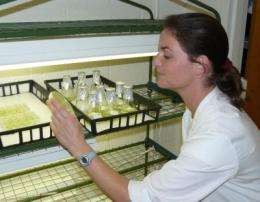
Imagine filling up your car with fuel that comes from inexpensive algae that grow quickly, don't use up freshwater supplies and can be cultivated in areas where they won't compete with traditional food crops, such as corn or soybeans. Researchers at North Carolina State University are working to make that a reality, with a $2 million grant from the National Science Foundation.
The researchers are studying algae as a fuel source because they grow quickly and can be grown throughout the year, providing the potential to create 100 times as much feedstock per acre as conventional crops, says Dr. Bill Roberts, professor of mechanical and aerospace engineering at NC State and primary investigator of the grant.
Roberts explains that algae can also be grown on marginal land, so they would not compete with food crops such as corn or soybeans for arable land. Furthermore, Roberts says the researchers are looking specifically at a type of marine algae called Dunaliella, which grows in brackish or salty water - so cultivating the primitive, tiny plant-like creatures would not compete for valuable freshwater resources. This is especially important for states like North Carolina, where seasonal droughts affect agricultural and urban demand for fresh water.
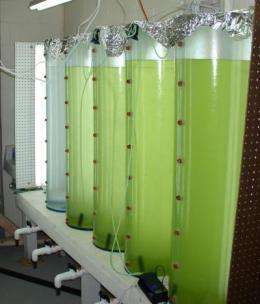
"We're looking at microscopic marine algae that produce fatty acids and do not have a cell wall. We plan to genetically modify the algae so that they will continuously produce these fatty acids, which we can then continually harvest," Roberts says. "We also plan to genetically modify the algae to produce fatty acids of a specific length, to expedite the conversion of the fatty acids into fuels that can be used by our existing transportation infrastructure." Specifically, Roberts says, "the goal is to create fuels that can be used in place of diesel, gasoline and jet fuel - though jet fuel will be the most technically challenging." In other words, they hope to make fuels that are 100 percent compatible with the existing fuels' storage and distribution system and run in existing vehicles - no modifications necessary.
And, Roberts stresses, "it has to be cost-competitive, or none of this makes sense. It's easy to be cost-competitive when oil is at $300 a barrel, but it's harder when the price of oil drops. Our goal is to optimize this technology so that it is cost-competitive, renewable, can be produced domestically and is environmentally friendly."
Roberts adds that an additional benefit to using algae as a fuel source is that the algal cultures would be transportable. For example, people in a remote area could set up a system to grow the algae and produce the fuel on-site, rather than shipping the finished product thousands of miles.
The first of many parallel steps for the research effort is to mass-culture the best oil-producing strains of Dunaliella, and then to map the Dunaliella genome and identify the genes responsible for regulating the quantities and qualities of the produced fatty acids. Once that has been done, the researchers plan to replace those genes with genes from other organisms to produce the desired fatty acids and overcome the internal regulatory mechanisms that could potentially limit fatty acid production. Next, the necessary technology and protocols to grow the algae and extract the fatty acids will need to be fine-tuned. Simultaneously, the researchers will ascertain which chemical catalysts and operating parameters should be used to optimize the conversion of the fatty acids into the desired fuels. Finally, the various fuels will be tested to ensure that they can be used in place of conventional diesel, gasoline and jet fuels.
The $2 million grant is part of the federal stimulus package and comes from NSF's Emerging Frontiers in Research and Innovation program. The funding is spread over four years, with the algae research scheduled for completion in July 2013, and will draw on the expertise of an interdisciplinary team of scientists from NC State. The research team includes Roberts, Dr. JoAnn Burkholder, William Neal Reynolds Professor of plant biology; Dr. Henry Lamb, professor of chemical and biomolecular engineering; Dr. Heike Sederoff, assistant professor of plant biology; Dr. Larry Stikeleather, professor of biological and agricultural engineering; Dr. Amy Grunden, associate professor of microbiology; and Dr. Wendy Boss, William Neal Reynolds Professor of plant biology. The researchers will also be collaborating with NC State Ph.D. student Tim Turner, and industry partners Diversified Energy Corp. and Innova Tech.
Source: North Carolina State University (news : web)


