Astronomers capture spectacular meteor footage and images (w/ Video)
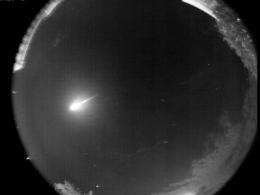
(PhysOrg.com) -- Astronomers from The University of Western Ontario in London, Canada have released footage of a meteor that was approximately 100 times brighter than a full moon. The meteor lit up the skies of southern Ontario two weeks ago and Western astronomers are now hoping to enlist the help of local residents in recovering one or more possible meteorites that may have crashed in the area of Grimsby, Ontario.
The Physics and Astronomy Department at Western has a network of all-sky cameras in southern Ontario that scan the atmosphere monitoring for meteors. Associate Professor Peter Brown, who specializes in the study of meteors and meteorites, says that on Friday, September 25 at 9:03 p.m. EST seven all-sky cameras of Western's Southern Ontario Meteor Network (SOMN) recorded a brilliant fireball in the evening sky over the west end of Lake Ontario.
Brown along with Phil McCausland, a postdoctoral fellow at Western's Centre for Planetary Science & Exploration, are now working to get the word out amongst interested people who may be willing to see if they can spot any fallen meteorites.
"This particular meteorite fall, if any are found, is very important because its arrival was so well recorded. We have good camera records as well as radar and infrasound detections of the event, so that it will be possible to determine its orbit prior to collision with the Earth and to determine the energy of the fireball event," says McCausland. "We can also figure out where it came from and how it got here, which is rare. In all of history, only about a dozen meteorite falls have that kind of record."
The fireball was first detected by Western's camera systems at an altitude of 100 km over Guelph moving southeastwards at 20.8 km/s. The meteoroid was initially the size of a child's tricycle. Analysis of the all-sky camera records as well as data from Western's meteor radar and infrasound equipment indicates that this bright fireball was large enough to have dropped meteorites in a region south of Grimsby on the Niagara Peninsula, providing masses that may total as much as several kilograms.
Researchers at Western are interested in hearing from anyone within 10 km of Grimsby who may have witnessed or recorded this event, seen or heard unusual events at the time, or who may have found possible fragments of the freshly fallen meteorite.
According to McCausland, meteorites are of great scientific value. He also points out that in Canada meteorites belong to the owner of the land upon which they are discovered. If individuals intend to search they should, in all cases, obtain the permission of the land owner before searching on private land.
Meteorites may best be recognized by their dark and scalloped exterior, and are usually denser than normal rock and will often attract a fridge magnet due to their metal content. In this fall, meteorites may be found in a small hole produced by their dropping into soil. Meteorites are not dangerous, but any recovered meteorites should be placed in a clean plastic bag or container and be handled as little as possible to preserve their scientific information.
More information: For video footage, still images and site maps, please visit http://aquarid.physics.uwo.ca/research/fireball/events/25sept2009/
Source: University of Western Ontario


