Satellite data instrumental in combating desertification
October 7, 2009
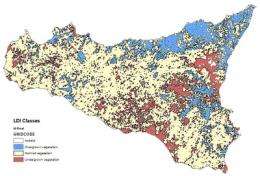
The Land Degradation Index (LDI) exploits remote sensing images, in conjunction with climatic and physiographic parametres, for assessing the landscape status with respect to its natural resources potential. Homogeneous land systems are identified and their status is expressed in terms of number of standard deviations from the population mean. The final values are then converted into 3 broad classes that indicate overgrown, normal and undergrown vegetation. These results were obtained from ESA's DesertWatch project. Credits: ESA, Advanced Computer Systems SpA (ACS), Italy and National Research Council - Arid Zones Research Station (EEZA), Spain
With land degradation in dryland regions continuing to worsen, the UN Convention to Combat Desertification has agreed on scientist-recommended indicators for monitoring and assessing desertification that signatory countries must report on.
The landmark agreement was reached after two weeks of negotiations involving hundreds of scientists and government ministers attending the Ninth Session of the Conference of the Parties (COP 9) of the UN Convention to Combat Desertification (UNCCD) in Buenos Aires, Argentina, from 21 September to 2 October.
Desertification, land degradation and drought deprive people of food and water and force millions to leave their homes. Desertification refers to the creation of new deserts through the degradation of drylands, which cover 40% of the world's land surface. Land degradation, caused by over-cultivation, over-grazing, deforestation and inefficient irrigation, affects roughly 20% of Earth's drylands.
Since dryland desertification can be remedied or even reversed by using appropriate management techniques, scientists attending the first scientific session of the COP, held from 22 to 24 September, stressed the importance of developing science-based methods for monitoring the areas most at risk to support land and water management decisions. Satellite technologies were recognised as playing an important role in achieving this objective.
ESA has been working closely with the UNCCD secretariat for nearly 10 years, developing and demonstrating innovative information services based on satellite Earth observation (EO) technologies that allow land degradation processes to be monitored over time.
Monitoring desertification, land degradation and droughts requires the continuous evaluation of a complex set of parameters and indicators, some of which can be retrieved with EO technologies and state-of-the-art geo-spatial applications. For instance, the status of land cover - one of the 11 indicators defined by COP - can be monitored from space.
In 2004, ESA launched a large pilot project called DesertWatch to develop a set of land degradation indicators based principally on land surface parameters retrieved from satellite observations. These indicators were developed with the support of Italy, Portugal and Turkey - three of the European countries mostly affected by desertification.
DesertWatch also helped these countries fulfil their UNCCD reporting requirements by combining satellite data with weather and in-situ data, numerical models and geo-information systems to create standardised geo-information products.
ESA recently extended the project so that its methodology may be adapted and put to wider use. To demonstrate its applicability, the methodology will be applied to arid and semi-arid areas in Portugal, Brazil and Mozambique.
According to the UNCCD, soil moisture is another key parameter that should be monitored, because it is an indicator of water scarcity and vegetation stress. Soil moisture data can also be used for assessing drought risk.
The ESA-backed SHARE (Soil Moisture for Hydrometeorological Applications in the Southern African Development Community Region) project has developed a pre-operational soil moisture monitoring service with the long-term goal of supplying free soil moisture information for all of Africa, at a resolution of 1 km, via the Internet. SHARE was developed under ESA's TIGER initiative, which helps African countries to overcome water problems. DesertWatch and SHARE are funded by the Data User Element (DUE) under ESA's EO Envelope Programme.
ESA hosted an exhibition booth and a side event at COP 9 entitled 'Earth observations from space for the UNCCD', where the latest DesertWatch findings and results were presented. The side event also served as a platform for demonstrating the benefits of EO technology for the UNCCD Convention.
Speaking of DesertWatch, Dr Lucio do Rosario of the Portuguese delegation said: "We recommend the UNCCD Contracting Parties to adopt these methodologies. The benefits are multiple. They improve the monitoring and assessment of land degradation, provide more efficient decision-making and facilitate the reporting to the Convention on the indicators adopted by COP 9."
In a message to COP 9, UN Secretary General Banki-Moon said: "In addressing climate change, the international community has tended, quite understandably, to focus on cutting greenhouse-gas emissions. But tackling the issue in all its complexity also requires to go beyond mitigation and take into account the intrinsic linkages between desertification, land degradation and climate change."
-
Value of satellites recognized for conserving wetlands
Nov 14, 2008 |
not rated yet |
0
-
Extreme weather monitoring boosted by space sensor
Jul 16, 2007 |
not rated yet |
0
-
Connection between health of wetlands and humans in focus
Feb 01, 2008 |
not rated yet |
0
-
Perennial vegetation, an indicator of desertification in Spain
Sep 04, 2009 |
not rated yet |
0
-
Satellites help locate water in Niger
Jan 19, 2009 |
not rated yet |
0
-
Engineers build first sub-10-nm carbon nanotube transistor
Feb 01, 2012 |
4.9 / 5 (31) |
30
-
Something old, something new: Evolution and the structural divergence of duplicate genes
Jan 31, 2012 |
4.6 / 5 (7) |
1
-
The hidden nanoworld of ice crystals: Revealing the dynamic behavior of quasi-liquid layers
Jan 30, 2012 |
5 / 5 (3) |
1
-
Stock market network reveals investor clustering
Jan 27, 2012 |
3.9 / 5 (23) |
8
-
Of microchemistry and molecules: Electronic microfluidic device synthesizes biocompatible probes
Jan 26, 2012 |
5 / 5 (1) |
0
-
Do some geologists actually act a lot like Randy Marsh?
Feb 11, 2012
-
Discrepancy between oxygen and carbon-dioxide levels
Feb 09, 2012
-
where gems are found in the world
Feb 09, 2012
-
Wind Waves in Reservoir ~ Wind run-up and Wind set-up
Feb 08, 2012
-
Balance of oxygen in the atmosphere
Feb 01, 2012
-
The case for a methanol-based economy
Jan 30, 2012
- More from Physics Forums - Earth
More news stories
Latin America mining boom clashes with conservation
Latin America is experiencing a mining boom as prices rise fuelled by a hike in global demand, but the region is also being hit by a wave of violent protests, strikes and rallies by environmentalists.
3 hours ago |
not rated yet |
0
Europe stakes billion-dollar bet on new rocket
A pencil-slim rocket is scheduled to lift into space from South America on Monday, carrying a billion-dollar bet that Europe can grab a juicy slice of the market to place satellites in low orbit.
Space & Earth / Space Exploration
22 hours ago |
4 / 5 (3) |
0
Political leaders play key role in how worried Americans are by climate change: study
More than extreme weather events and the work of scientists, it is national political leaders who influence how much Americans worry about the threat of climate change, new research finds.
Feb 06, 2012 |
5 / 5 (6) |
72
NASA budget will axe Mars deal with Europe: scientists
US President Barack Obama's budget proposal to be submitted next week for 2013 will cut NASA's budget by 20 percent and eliminate a major partnership with Europe on Mars exploration, scientists said Thursday.
Space & Earth / Space Exploration
Feb 10, 2012 |
5 / 5 (3) |
55
Humans may have helped the decline of African rainforests 3000 years ago
(PhysOrg.com) -- Large areas of rainforests in Central Africa mysteriously disappeared over three thousand years ago, to be replaced by savannas. The prevailing theory has been that the cause was a change ...
Google might launch Drive for cloud storage soon
(PhysOrg.com) -- Google's next big move, according to the Wall Street Journal, is a cloud storage service called Drive. Hardly first to the plate, Google is simply catching up to introducing its cloud reposi ...
Walney offshore wind farm is world's biggest (for now)
(PhysOrg.com) -- The Walney wind farm on the Irish Sea--characterized by high tides, waves and windy weather--officially opened this week. The farm is treated in the press as a very big deal as the Walney ...
Love a click away in Indonesia's Twitter Republic
He was a geeky kid from Yogyakarta, she a glamorous city girl in Jakarta. In a country with one of the world's most vibrant social networking scenes they fell in love on Twitter.
GPS court ruling leaves US phone tracking unclear
A US Supreme Court decision requiring a warrant to place a GPS device on the car of a criminal suspect leaves unresolved the bigger issue of police tracking using mobile phones, legal experts say.
Europeans protest controversial Internet pact
Tens of thousands of people marched in protests in more than a dozen European cities Saturday against a controversial anti-online piracy pact that critics say could curtail Internet freedom.
Study finds that anti-diabetic medication can prevent the long-term effects of maternal obesity
In a study to be presented today at the Society for Maternal-Fetal Medicine's annual meeting, The Pregnancy Meeting, in Dallas, Texas, researchers will report findings that show that short therapy with the anti-diabetic medication ...