Climate: What's to become of the Kyoto Protocol?
October 7, 2009 by Marlowe Hood
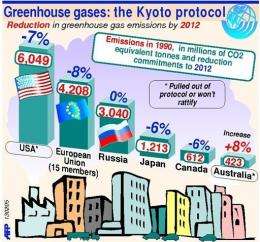
A gaphic showing the reduction of greenhouse gas emissions required by the Kyoto protocol. Whether to tweak, bolster or bury the Kyoto Protocol -- the only binding global agreement for curbing greenhouse gases -- has become a red-hot issue as UN negotiators in Bangkok try to lay the groundwork for a successor treaty.
Whether to tweak, bolster or bury the Kyoto Protocol -- the only binding global agreement for curbing greenhouse gases -- has become a red-hot issue as UN negotiators in Bangkok try to lay the groundwork for a successor treaty.
The flare-up has erupted only two months before the December 7-18 UN conference tasked with delivering a planet-saving climate deal. It pits rich nations against poor and raises fundamental questions about the architecture of any future treaty.
"Do we keep totally separate regimes for the two constituencies, or do we start building what the United States calls a continuum that includes both -- that's the big question," said Claire Parker, a consultant for IUCN, an intergovernmental environmental group.
The two-week session in Bangkok, attended by delegates from 180 nations, ends Friday.
All parties agree that the central aim must be to radically slash carbon pollution in order to forestall climate catastrophe.
But how to share out that task, and who should foot the bill, remain highly contentious.
Framed in 1997 and put into force in 2005, Kyoto legally binds 37 industrialised countries to cut greenhouse gas output by a total of more than five percent before 2012, compared to 1990 levels. The efforts demanded from each country varies.
The United States signed the protocol but never ratified it, objecting to the fact that it did not cover major emerging economies such as China, which has since become the world's top carbon polluter.
Even with a new administration, the US position has not changed. "We are not going to ratify the Kyoto Protocol. That is out," US climate negotiator Jonathan Pershing told AFP on Wednesday.
What the United States favours instead, he said, is a new legal framework in which all countries would lay out their carbon-curbing schemes, and agree that they be measured and verified by outside experts.
"We are not asking (developing) countries to commit to the outcome. We are asking them to commit to the action itself," Pershing said earlier in a press conference. "We have to commit to the outcome. There is a big difference."
China, India and dozens of developing countries say this approach is unfair.
"This is a problem that has been created by a small minority of countries. The vast majority of the developing countries are victims," China's climate change ambassador Yu Qingtai told journalists Wednesday.
Kyoto spells out that historical responsibility, he said.
And until rich nations make new commitments to cut CO2 pollution and put money on the table to help poor countries fight global warming and cope with its consequences, Kyoto is the only guarantee the developing world has, he argued.
"Keeping Kyoto is non-negotiable," Quamrul Islam Chowdhury, a delegate from Bangladesh, told journalists.
The European Union has said it supports strengthening Kyoto, but created an uproar here this week in suggesting that its major provisions could be imported into a new framework.
"I think they have seen that there will not be a regime unless they move in that direction," said Parker.
Emmanuel Guerin, an analyst at the Institute for Sustainable Development and International Relations in France, also thinks that Kyoto's days are numbered.
"The Kyoto process as such, with its provisions and its name, is probably dead because the United States will never ratify it and we need their participation," he told AFP.
For Dessima Williams, chief negotiator for Grenada and head of the Association of Small Island States (AOSIS), the debate over Kyoto is a distraction from the core issues.
"Right now architecture is putting the cart before the horse. The real issue is, we need rigorous and stringent commitments on greenhouse gas reductions," she said.
(c) 2009 AFP
-
U.N. climate change talks open in Montreal
Nov 28, 2005 |
not rated yet |
0
-
Japan: China must commit on global warming
Nov 06, 2006 |
not rated yet |
0
-
US in spotlight as UN climate talks resume
Mar 29, 2009 |
not rated yet |
0
-
Kyoto treaty is ‘failing the world’s poor’, say scientists
Apr 16, 2009 |
not rated yet |
0
-
U.S. and Australia OK secret climate pact
Jul 26, 2005 |
not rated yet |
0
-
Engineers build first sub-10-nm carbon nanotube transistor
Feb 01, 2012 |
4.9 / 5 (31) |
30
-
Something old, something new: Evolution and the structural divergence of duplicate genes
Jan 31, 2012 |
4.6 / 5 (7) |
1
-
The hidden nanoworld of ice crystals: Revealing the dynamic behavior of quasi-liquid layers
Jan 30, 2012 |
5 / 5 (3) |
1
-
Stock market network reveals investor clustering
Jan 27, 2012 |
3.9 / 5 (23) |
8
-
Of microchemistry and molecules: Electronic microfluidic device synthesizes biocompatible probes
Jan 26, 2012 |
5 / 5 (1) |
0
-
Do some geologists actually act a lot like Randy Marsh?
Feb 11, 2012
-
Discrepancy between oxygen and carbon-dioxide levels
Feb 09, 2012
-
where gems are found in the world
Feb 09, 2012
-
Wind Waves in Reservoir ~ Wind run-up and Wind set-up
Feb 08, 2012
-
Balance of oxygen in the atmosphere
Feb 01, 2012
-
The case for a methanol-based economy
Jan 30, 2012
- More from Physics Forums - Earth
More news stories
Latin America mining boom clashes with conservation
Latin America is experiencing a mining boom as prices rise fuelled by a hike in global demand, but the region is also being hit by a wave of violent protests, strikes and rallies by environmentalists.
3 hours ago |
not rated yet |
0
Europe stakes billion-dollar bet on new rocket
A pencil-slim rocket is scheduled to lift into space from South America on Monday, carrying a billion-dollar bet that Europe can grab a juicy slice of the market to place satellites in low orbit.
Space & Earth / Space Exploration
22 hours ago |
4 / 5 (3) |
0
Political leaders play key role in how worried Americans are by climate change: study
More than extreme weather events and the work of scientists, it is national political leaders who influence how much Americans worry about the threat of climate change, new research finds.
Feb 06, 2012 |
5 / 5 (6) |
72
NASA budget will axe Mars deal with Europe: scientists
US President Barack Obama's budget proposal to be submitted next week for 2013 will cut NASA's budget by 20 percent and eliminate a major partnership with Europe on Mars exploration, scientists said Thursday.
Space & Earth / Space Exploration
Feb 10, 2012 |
5 / 5 (3) |
55
Humans may have helped the decline of African rainforests 3000 years ago
(PhysOrg.com) -- Large areas of rainforests in Central Africa mysteriously disappeared over three thousand years ago, to be replaced by savannas. The prevailing theory has been that the cause was a change ...
Google might launch Drive for cloud storage soon
(PhysOrg.com) -- Google's next big move, according to the Wall Street Journal, is a cloud storage service called Drive. Hardly first to the plate, Google is simply catching up to introducing its cloud reposi ...
Walney offshore wind farm is world's biggest (for now)
(PhysOrg.com) -- The Walney wind farm on the Irish Sea--characterized by high tides, waves and windy weather--officially opened this week. The farm is treated in the press as a very big deal as the Walney ...
Love a click away in Indonesia's Twitter Republic
He was a geeky kid from Yogyakarta, she a glamorous city girl in Jakarta. In a country with one of the world's most vibrant social networking scenes they fell in love on Twitter.
GPS court ruling leaves US phone tracking unclear
A US Supreme Court decision requiring a warrant to place a GPS device on the car of a criminal suspect leaves unresolved the bigger issue of police tracking using mobile phones, legal experts say.
Europeans protest controversial Internet pact
Tens of thousands of people marched in protests in more than a dozen European cities Saturday against a controversial anti-online piracy pact that critics say could curtail Internet freedom.
Study finds that anti-diabetic medication can prevent the long-term effects of maternal obesity
In a study to be presented today at the Society for Maternal-Fetal Medicine's annual meeting, The Pregnancy Meeting, in Dallas, Texas, researchers will report findings that show that short therapy with the anti-diabetic medication ...
Oct 07, 2009
Rank: 3 / 5 (2)
Sunspots disappeared; Earth cooled.
Now even school age children are beginning to ask why Nobel Prizes were given to those who said that CO2 had a greater influence on global temperatures than Earth's heat source - the Sun.
With kind regards,
Oliver K. Manuel
Oct 07, 2009
Rank: 5 / 5 (1)
Since the EU hasn't been able to even get close to the Kyoto limits they agreed to you have to wonder why they would propose stricter limits.
Oct 08, 2009
Rank: not rated yet
Yes, we know that it will be too late then, but until the end of the world, there is no need to over react is there?
In the meantime, thank you for your patience and do continue to enjoy the amusing distractions that we provide for you via television, Internet, games consoles and especially your personal transport.
Have a nice day.
Oct 09, 2009
Rank: not rated yet
*Peace* price! Why the adjective is conveniently omited?
Oct 12, 2009
Rank: not rated yet
http://icecap.us/...MPS4.jpg
The chart lists data, up to 2006, for a station that was closed in 1995...
http://icecap.us/...Data.pdf