New aluminum-water rocket propellant promising for future space missions
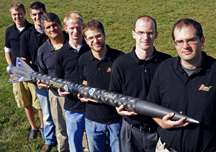
(PhysOrg.com) -- Researchers are developing a new type of rocket propellant made of a frozen mixture of water and "nanoscale aluminum" powder that is more environmentally friendly than conventional propellants and could be manufactured on the moon, Mars and other water-bearing bodies.
The aluminum-ice, or ALICE, propellant might be used to launch rockets into orbit and for long-distance space missions and also to generate hydrogen for fuel cells, said Steven Son, an associate professor of mechanical engineering at Purdue University.
Purdue is working with NASA, the Air Force Office of Scientific Research and Pennsylvania State University to develop ALICE, which was used earlier this year to launch a 9-foot-tall rocket. The vehicle reached an altitude of 1,300 feet over Purdue's Scholer farms, about 10 miles from campus.
"It's a proof of concept," Son said. "It could be improved and turned into a practical propellant. Theoretically, it also could be manufactured in distant places like the moon or Mars instead of being transported at high cost."
Findings from spacecraft indicate the presence of water on Mars and the moon, and water also may exist on asteroids, other moons and bodies in space, said Son, who also has a courtesy appointment as an associate professor of aeronautics and astronautics.
The tiny size of the aluminum particles, which have a diameter of about 80 nanometers, or billionths of a meter, is key to the propellant's performance. The nanoparticles combust more rapidly than larger particles and enable better control over the reaction and the rocket's thrust, said Timothée Pourpoint, a research assistant professor in the School of Aeronautics and Astronautics.
"It is considered a green propellant, producing essentially hydrogen gas and aluminum oxide," Pourpoint said. "In contrast, each space shuttle flight consumes about 773 tons of the oxidizer ammonium perchlorate in the solid booster rockets. About 230 tons of hydrochloric acid immediately appears in the exhaust from such flights."
ALICE provides thrust through a chemical reaction between water and aluminum. As the aluminum ignites, water molecules provide oxygen and hydrogen to fuel the combustion until all of the powder is burned.
"ALICE might one day replace some liquid or solid propellants, and, when perfected, might have a higher performance than conventional propellants," Pourpoint said. "It's also extremely safe while frozen because it is difficult to accidentally ignite."
The research is helping to train a new generation of engineers to work in academia, industry, for NASA and the military, Son said. More than a dozen undergraduate and graduate students have worked on the project.
"It's unusual for students to get this kind of advanced and thorough training - to go from a basic-science concept all the way to a flying vehicle that is ground tested and launched," he said. "This is the whole spectrum."
Research findings were detailed in technical papers presented this summer during a conference of the American Institute of Aeronautics and Astronautics. The papers will be published next year in the conference proceedings.
Leading work at Penn State are mechanical engineering professor Richard Yetter and assistant professor Grant Risha.
The Purdue portion of the research is based at the university's Maurice J. Zucrow Laboratories, where researchers created a special test cell and control room to test the rocket. The rocket's launching site was located on a facility maintained by Purdue's School of Veterinary Medicine.
"Having a launching site near campus greatly facilitated this project," Pourpoint said.
Other researchers previously have used aluminum particles in propellants, but those propellants usually also contained larger, micron-size particles, whereas the new fuel contained pure nanoparticles.
Manufacturers over the past decade have learned how to make higher-quality nano-aluminum particles than was possible in the past. The fuel needs to be frozen for two reasons: It must be solid to remain intact while subjected to the forces of the launch and also to ensure that it does not slowly react before it is used.
Initially a paste, the fuel is packed into a cylindrical mold with a metal rod running through the center. After it's frozen, the rod is removed, leaving a cavity running the length of the solid fuel cylinder. A small rocket engine above the fuel is ignited, sending hot gasses into the center hole, causing the ALICE fuel to ignite uniformly.
"This is essentially the same basic procedure used in the space shuttle's two solid-fuel rocket boosters," Son said. "An electric match ignites a small motor, which then ignites a bigger motor."
Future work will focus on perfecting the fuel and also may explore the possibility of creating a gelled fuel using the nanoparticles. Such a gel would behave like a liquid fuel, making it possible to vary the rate at which the fuel is pumped into the combustion chamber to throttle the motor up and down and increase the vehicle's distance.
A gelled fuel also could be mixed with materials containing larger amounts of hydrogen and then used to run hydrogen fuel cells in addition to rocket motors, Son said.
Provided by Purdue University (news : web)


