NASA Refines Asteroid Apophis' Path Toward Earth
October 7, 2009 NASA Refines Asteroid Apophis' Path Toward Earth

Enlarge

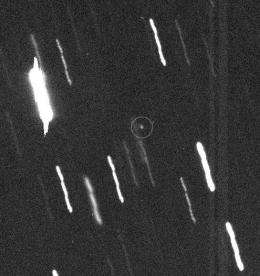
Asteroid Apophis was discovered on June 19, 2004. Image credit: UH/IA

(PhysOrg.com) -- Using updated information, NASA scientists have recalculated the path of a large asteroid. The refined path indicates a significantly reduced likelihood of a hazardous encounter with Earth in 2036.

The Apophis asteroid is approximately the size of two-and-a-half football fields. The new data were documented by near-Earth object scientists Steve Chesley and Paul Chodas at NASA's Jet Propulsion Laboratory in Pasadena, Calif. They will present their updated findings at a meeting of the American Astronomical Society's Division for Planetary Sciences in Puerto Rico on Oct. 8.

"Apophis has been one of those celestial bodies that has captured the public's interest since it was discovered in 2004," said Chesley. "Updated computational techniques and newly available data indicate the probability of an encounter on April 13, 2036, for Apophis has dropped from one-in-45,000 to about four-in-a million."

A majority of the data that enabled the updated orbit of Apophis came from observations Dave Tholen and collaborators at the University of Hawaii's Institute for Astronomy in Manoa made. Tholen pored over hundreds of previously unreleased images of the night sky made with the University of Hawaii's 2.2-meter (88-inch) telescope, located near the summit of Mauna Kea.

Tholen made improved measurements of the asteroid's position in the images, enabling him to provide Chesley and Chodas with new data sets more precise than previous measures for Apophis. Measurements from the Steward Observatory's 2.3 meter (90-inch) Bok telescope on Kitt Peak in Arizona and the Arecibo Observatory on the island of Puerto Rico also were used in Chesley's calculations.

The information provided a more accurate glimpse of Apophis' orbit well into the latter part of this century. Among the findings is another close encounter by the asteroid with Earth in 2068 with chance of impact currently at approximately three-in-a-million. As with earlier orbital estimates where Earth impacts in 2029 and 2036 could not initially be ruled out due to the need for additional data, it is expected that the 2068 encounter will diminish in probability as more information about Apophis is acquired.

Initially, Apophis was thought to have a 2.7 percent chance of impacting Earth in 2029. Additional observations of the asteriod ruled out any possibility of an impact in 2029. However, the asteroid is expected to make a record-setting -- but harmless -- close approach to Earth on Friday, April 13, 2029, when it comes no closer than 29,450 kilometers (18,300 miles) above Earth's surface.

"The refined orbital determination further reinforces that Apophis is an asteroid we can look to as an opportunity for exciting science and not something that should be feared," said Don Yeomans, manager of the Near-Earth Object Program Office at JPL. "The public can follow along as we continue to study Apophis and other near-Earth objects by visiting us on our AsteroidWatch Web site and by following us on the @AsteroidWatch Twitter feed."

The science of predicting orbits is based on a physical model of the solar system which includes the gravitational influence of the sun, moon, other planets and the three largest asteroids.

NASA detects and tracks asteroids and comets passing close to Earth using both ground and space-based telescopes. The Near-Earth Object Observations Program, commonly called "Spaceguard," discovers these objects, characterizes a subset of them and plots their orbits to determine if any could be potentially hazardous to our planet.

JPL manages the Near-Earth Object Program Office for NASA's Science Mission Directorate in Washington. JPL is a division of the California Institute of Technology in Pasadena. Cornell University, Ithaca, N.Y., operates the Arecibo Observatory under a cooperative agreement with the National Science Foundation in Arlington, Va.

For more information about asteroids and near-Earth objects, visit: http://www.jpl.nasa.gov/asteroidwatch

Provided by JPL/NASA (news : web)


print this article email this article download pdf blog this article bookmark this article     Stumble it Digg this share on Facebook retweet share on Reddit add to delicious
Rate this story - 3.9 /5 (12 votes)

Rank Filter

Move the slider to adjust rank threshold, so that you can hide some of the comments.


Display comments: newest first

  • axemaster - Oct 07, 2009
    • Rank: 1 / 5 (1)
    "The Apophis asteroid is approximately the size of two-and-a-half football fields."

    Uh huh... And how big is a football field? How is this supposed to mean anything?
  • sender - Oct 07, 2009
    • Rank: 3 / 5 (2)
    Let's catch this thing in space!
  • drel - Oct 08, 2009
    • Rank: 4 / 5 (1)
    "The Apophis asteroid is approximately the size of two-and-a-half football fields."

    Uh huh... And how big is a football field? How is this supposed to mean anything?


    Q- how big is a football field?
    A- American football field is 360 feet x 160 feet.

    Q- How is this supposed to mean anything?
    A- Exactly, a "football field" is an area. It says nothing as to the volume or mass of the asteroid. one could assume that the third dimensional measurement is less than 160 feet, but you know what happens when you assume...
  • Velanarris - Oct 08, 2009
    • Rank: not rated yet
    A football field is 100 yards long. Apophis' diameter is 250 yards.

    You can get a relatively accurate volume assuming Apophis is approximately round through standard algebra.

    To your second point, we'd have to know what apophis is made of to really know the potential fall out, and last I knew the estimates were that apophis is carboneferous rock, Carbon and Iron, so it would be very damaging if it made contact with the planet.
  • Hernan - Oct 08, 2009
    • Rank: not rated yet
    Check out this link for detailed information : http://ssd.jpl.na...42;orb=1
  • LuckyBrandon - Oct 10, 2009
    • Rank: not rated yet
    "Updated computational techniques and newly available data indicate the probability of an Earth encounter on April 13, 2036, for Apophis has dropped from one-in-45,000 to about four-in-a million

    why in the hell dont they just say "from 1 in 45000 to 1 in 250,000"...
    does 4 in a million make it sound more impressive to anyone here im curious....?

October 7, 2009 all stories

Comments: 6

3.9 /5 (12 votes)
  • Stumble this up

  • Digg this

  • share this

  • hide
  • Related Stories

  • NASA Statement on Student Asteroid Calculations
    created Apr 17, 2008 | popularity not rated yet | comments 0
  • Look out: Asteroid's near-miss may be home run for scientists
    created Aug 16, 2005 | popularity not rated yet | comments 0
  • NASA to Provide Web Updates on Objects Approaching Earth
    created Jul 30, 2009 | popularity not rated yet | comments 0
  • Asteroid is 'practice case' for potential hazards
    created Oct 12, 2007 | popularity not rated yet | comments 0
  • Asteroid to Make Rare Close Flyby of Earth
    created Jan 24, 2008 | popularity not rated yet | comments 0


  • hide
  • Relevant PhysicsForums posts

  • Sideral question
    created 21 hours ago
  • Doppler shifted blackbody spectrum
    created 23 hours ago
  • Earth v. Moon
    created Nov 21, 2009
  • help me with coordinates and orbits
    created Nov 21, 2009
  • basic 'our universe' question..
    created Nov 20, 2009
  • deriving keplers law
    created Nov 19, 2009
  • More from Physics Forums - General Astronomy

Other News

Baby can wait as expectant dad finishes spacewalk (AP)

Baby can wait as expectant dad finishes spacewalk

Space & Earth / Space Exploration

created 12 hours ago | popularity 3 / 5 (2) | comments 0

(AP) -- A spacewalking astronaut put aside the impending birth of his daughter and blazed through his first-ever venture outside the International Space Station on Saturday.


Unseasonably hot and dry weather combined with strong winds to fan scores of blazes in the country's southeastern states

Australia issues 'catastrophic' alerts as fires rage

Space & Earth / Environment

created 18 hours ago | popularity 4 / 5 (3) | comments 0

Australia has issued "catastrophic" alerts after record-breaking temperatures and wild lightning storms sparked more than 100 fires across the country, officials said Saturday.


Commuters wait on the platform shrouded by fog in London

Climate change not man-made, say majority of Britons: poll

Space & Earth / Environment

created Nov 15, 2009 | popularity 3.3 / 5 (15) | comments 46

Less than half of Britons believes that human activity is to blame for global warming, according to a poll carried out for The Times newspaper and published on Saturday.


Mysteriously warm times in Antarctica

Mysteriously warm times in Antarctica

Space & Earth / Earth Sciences

created Nov 18, 2009 | popularity 4.2 / 5 (21) | comments 28

(PhysOrg.com) -- A new study of Antarctica's past climate reveals that temperatures during the warm periods between ice ages (interglacials) may have been higher than previously thought. The latest analysis ...


UN: Fight climate change with free condoms (AP)

UN: Fight climate change with free condoms

Space & Earth / Environment

created Nov 18, 2009 | popularity 3.1 / 5 (11) | comments 24

(AP) -- The battle against global warming could be helped if the world slowed population growth by making free condoms and family planning advice more widely available, the U.N. Population Fund said Wednesday.