The Fall of the Maya: 'They Did it to Themselves'
October 7, 2009 The Fall of the Maya: 'They Did it to Themselves'

Enlarge

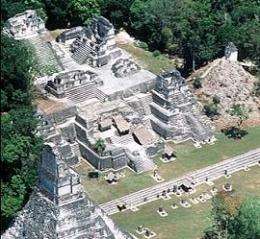
Mayan ruins in Guatemala. Photo copyright Tom Sever.

For 1200 years, the Maya dominated Central America. At their peak around 900 A.D., Maya cities teemed with more than 2,000 people per square mile -- comparable to modern Los Angeles County. Even in rural areas the Maya numbered 200 to 400 people per square mile. But suddenly, all was quiet. And the profound silence testified to one of the greatest demographic disasters in human prehistory -- the demise of the once vibrant Maya society.

What happened? Some NASA-funded researchers think they have a pretty good idea.

"They did it to themselves," says veteran archeologist Tom Sever.

"The Maya are often depicted as people who lived in complete harmony with their environment,' says PhD student Robert Griffin. "But like many other cultures before and after them, they ended up deforesting and destroying their landscape in efforts to eke out a living in hard times."

A major drought occurred about the time the Maya began to disappear. And at the time of their collapse, the Maya had cut down most of the trees across large swaths of the land to clear fields for growing to feed their burgeoning population. They also cut trees for firewood and for making building materials.

"They had to burn 20 trees to heat the limestone for making just 1 square meter of the lime plaster they used to build their tremendous temples, reservoirs, and monuments," explains Sever.

He and his team used to reconstruct how the deforestation could have played a role in worsening the drought. They isolated the effects of deforestation using a pair of proven computer : the PSU/NCAR mesoscale atmospheric circulation model, known as MM5, and the Community Climate System Model, or CCSM.

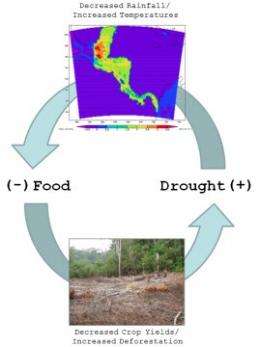
"We modeled the worst and best case scenarios: 100 percent deforestation in the Maya area and no deforestation," says Sever. "The results were eye opening. Loss of all the trees caused a 3-5 degree rise in temperature and a 20-30 percent decrease in rainfall."

The results are telling, but more research is needed to completely explain the mechanisms of Mayan decline. Archeological records reveal that while some Maya city-states did fall during drought periods, some survived and even thrived.

"We believe that drought was realized differently in different areas," explains Griffin. "We propose that increases in temperature and decreases in rainfall brought on by localized deforestation caused serious enough problems to push some but not all city-states over the edge."
The Fall of the Maya: 'They Did it to Themselves'
Enlarge

A deadly cycle of drought, warming and deforestation may have doomed the Maya.

The Maya deforested through the use of slash-and-burn agriculture - a method still used in their old stomping grounds today, so the researchers understand how it works.

"We know that for every 1 to 3 years you farm a piece of land, you need to let it lay fallow for 15 years to recover. In that time, trees and vegetation can grow back there while you slash and burn another area to plant in."

But what if you don't let the land lay fallow long enough to replenish itself? And what if you clear more and more fields to meet growing demands for food?

"We believe that's what happened," says Griffin. "The Maya stripped large areas of their landscape bare by over-farming."

Not only did drought make it difficult to grow enough food, it also would have been harder for the Maya to store enough water to survive the dry season.

"The cities tried to keep an 18-month supply of water in their reservoirs," says Sever. "For example, in Tikal there was a system of reservoirs that held millions of gallons of water. Without sufficient rain, the reservoirs ran dry." Thirst and famine don't do much for keeping a populace happy. The rest, as the saying goes, is history.

"In some of the Maya city-states, mass graves have been found containing groups of skeletons with jade inlays in their teeth - something they reserved for Maya elites - perhaps in this case murdered aristocracy," he speculates.

No single factor brings a civilization to its knees, but the deforestation that helped bring on drought could easily have exacerbated other problems such as civil unrest, war, starvation and disease.

Many of these insights are a result of space-based imaging, notes Sever. "By interpreting infrared satellite data, we've located hundreds of old and abandoned cities not previously known to exist. The Maya used lime plaster as foundations to build their great cities filled with ornate temples, observatories, and pyramids. Over hundreds of years, the lime seeped into the soil. As a result, the vegetation around the ruins looks distinctive in infrared to this day."

"Space technology is revolutionizing archeology," he concludes. "We're using it to learn about the plight of ancients in order to avoid a similar fate today."

Source: Science@NASA, by Dauna Coulter


print this article email this article download pdf blog this article bookmark this article     Stumble it Digg this share on Facebook retweet share on Reddit add to delicious
Rate this story - 4.4 /5 (53 votes)

Rank Filter

Move the slider to adjust rank threshold, so that you can hide some of the comments.


Display comments: newest first

  • plasticpower - Oct 08, 2009
    • Rank: 3.7 / 5 (3)
    Very cool. Wonder what would happen if Mayans never disappeared..
  • Kedas - Oct 08, 2009
    • Rank: 1.9 / 5 (8)
    Interesting article if you change the name 'Maya' by 'Human'.
    Wondering how much longer we have.
  • marjon - Oct 08, 2009
    • Rank: 2.7 / 5 (6)
    Just goes to show how state sponsored religion kills.
  • ian807 - Oct 08, 2009
    • Rank: 2.9 / 5 (10)
    I'm sure they just thought growth could continue forever, like cancer, or free market capitalism.
  • vit - Oct 08, 2009
    • Rank: 2 / 5 (1)
    Jared Diamond had this locked in his book "Collapse."
  • frajo - Oct 08, 2009
    • Rank: 3.8 / 5 (8)
    A society that was as bloody as stupid. Its fate shows that cruelty just doesn't pay off in the long run. Sacrificing/killing people is not profitable.
  • marjon - Oct 08, 2009
    • Rank: 2.6 / 5 (8)
    I'm sure they just thought growth could continue forever, like cancer, or free market capitalism.

    What evidence do you have the Mayan's practiced free market capitalism? If they did, I suspect they would still be around as free markets create incentives for innovations of alternatives.
  • marjon - Oct 08, 2009
    • Rank: 3.3 / 5 (7)
    Interesting article if you change the name 'Maya' by 'Human'.
    Wondering how much longer we have.

    As long as humans are free of state coercion (socialism) and can innovate and adapt.
  • Kedas - Oct 09, 2009
    • Rank: 3.3 / 5 (4)
    Interesting article if you change the name 'Maya' by 'Human'.
    Wondering how much longer we have.

    As long as humans are free of state coercion (socialism) and can innovate and adapt.


    We are using up earths natural resources at a rate that is not acceptable for the long run.(on global level)
    And I would not put my money on a predictable climate either.

    It's not because you can adapt that you will/can adapt fast enough.
  • Nartoon - Oct 10, 2009
    • Rank: 1 / 5 (2)
    I knew it, global warming did it. Just shows CO2 had nothing to do with the temperature rise, yet we continue to slash & burn our forests but never think of the effect it has on AGW.
  • jonnyboy - Oct 11, 2009
    • Rank: 2.3 / 5 (3)
    Why does it appear that I am the only one wondering what in the he11 NASA is doing funding this type of research?
  • elgin - Oct 11, 2009
    • Rank: 2.3 / 5 (3)
    I'm sure they just thought growth could continue forever, like cancer, or free market capitalism.

    About 10 years ago I read about a Mayan city state that archeologists had unearthed. It was situated between 2 powerful warlike cities that were constantly at war and regularly destroyed. Yet the middle city avoided the wars and destruction. It appeared to be a trading center. (Artifacts from distant cities were abundant.) And there was little evidence of a powerful elite, religious or secular. It was not known how the city eventually fell but it would seem that they were practicing free market capitalists and they fared much better than the big government states.
  • bhiestand - Oct 11, 2009
    • Rank: 5 / 5 (2)
    I'm sure they just thought growth could continue forever, like cancer, or free market capitalism.

    About 10 years ago I read about a Mayan city state that archeologists had unearthed...It was not known how the city eventually fell but it would seem that they were practicing free market capitalists and they fared much better than the big government states.

    ... and ultimately met their demise due to unchecked population growth and destruction of their environment, as this article quite clearly shows.

    The entire point is that growth, particularly in population, isn't indefinitely sustainable. There is no "God of Infinite Resources" that will come in to save the day if you stretch the environment past its breaking point. Civilizations can, will, and have completely been destroyed by environmental pressures which they directly caused.
  • marjon - Oct 12, 2009
    • Rank: 1 / 5 (2)
    Interesting article if you change the name 'Maya' by 'Human'.
    Wondering how much longer we have.

    As long as humans are free of state coercion (socialism) and can innovate and adapt.


    We are using up earths natural resources at a rate that is not acceptable for the long run.(on global level)
    And I would not put my money on a predictable climate either.

    It's not because you can adapt that you will/can adapt fast enough.


    When markets are free to meet demand, resources are found to meet that demand. Sperm whale oil was used for lighting, was expensive and in short supply. Free markets found alternatives-kerosene and then electric lights and now LEDs will replace wasteful incandescent bulbs.
    Resources are only limited by imagination and liberty.
  • Azpod - Oct 12, 2009
    • Rank: 4.3 / 5 (3)
    The entire point is that growth, particularly in population, isn't indefinitely sustainable. There is no "God of Infinite Resources" that will come in to save the day if you stretch the environment past its breaking point. Civilizations can, will, and have completely been destroyed by environmental pressures which they directly caused.


    True, but our ability to adapt is much greater than that of the Mayans. Even under the worst credible global warming predictions, we're not talking about civilization-ending disaster. (I say "credible" b/c I know some are predicting a runaway greenhouse that turns Earth into Venus, but the Earth has been MUCH warmer in the past w/o that happening so I hardly consider such predictions credible.) At worst, we're talking trillions of dollars in economic losses over DECADES. Humanity can and would endure such a loss.

    That said, global population growth will stabilize, as will our use of resources. Nothing's spinning out of control.
  • bhiestand - Oct 12, 2009
    • Rank: 5 / 5 (2)
    Our ability to adapt is much greater, but so is our ability to do harm to the environment and overshoot carrying capacity.

    I have no doubt that humanity will find a way to endure all of the realistic scenarios. My concern is that some of them involve billions of people dying, and may result in the collapse of our civilization. I see relatively easy solutions to avoid those catastrophes, solutions that are also more economically sustainable.

    My secondary concern is that faith, distrust in science, and politics are consistently defeating science and reason. In the US, political parties take the side opposite the "other guy" simply because they feel the need to be in opposition rather than listen to the evidence or science.

    I agree that ultimately growth will have to stabilize, the problem is that we could very well have a crash preceding that stabilization, and the chances of that increase the longer we delay corrective measures.

October 7, 2009 all stories

Comments: 16

4.4 /5 (53 votes)
  • Stumble this up

  • Digg this

  • share this

  • hide
  • Related Stories

  • Scientists Uncover Lost Maya Ruins – from Space
    created Feb 15, 2006 | popularity not rated yet | comments 0
  • Ancient Maya Practiced Forest Conservation -- 3,000 Years Ago
    created Jul 21, 2009 | popularity not rated yet | comments 0
  • Mass murder mystery of Maya kingdom
    created Nov 17, 2005 | popularity not rated yet | comments 0
  • New study explores role of theater in Maya political organization
    created Oct 02, 2006 | popularity not rated yet | comments 0
  • Scientists end mystery of Maya city
    created Sep 28, 2005 | popularity not rated yet | comments 0


  • hide
  • Relevant PhysicsForums posts

  • Breeding program
    created 23 hours ago
  • How does a concentration gradient provide energy?
    created Nov 20, 2009
  • Eyesight and Neural Damage from Electronics
    created Nov 19, 2009
  • Quick question about the Golgi Apparatus?
    created Nov 19, 2009
  • The beginning of humans
    created Nov 18, 2009
  • Omega 3 questions
    created Nov 18, 2009
  • More from Physics Forums - Biology

Other News

Museum: Galileo's fingers, tooth are found (AP)

Museum: Galileo's fingers, tooth are found

Other Sciences / Archaeology & Fossils

created 9 hours ago | popularity not rated yet | comments 4

(AP) -- Two fingers and a tooth removed from Galileo Galilei's corpse in a Florentine basilica in the 18th century and given up for lost have been found again and will soon be put on display, an Italian museum ...


Measure to change U. of Neb. stem-cell rule fails (AP)

Measure to change U. of Neb. stem-cell rule fails (Update 2)

Other Sciences / Other

created 9 hours ago | popularity 5 / 5 (1) | comments 0

(AP) -- The University of Nebraska's governing board on Friday voted not to place tighter restrictions on embryonic stem cell research than those outlined under federal guidelines, which were expanded after ...


Researcher: Faint writing seen on Shroud of Turin (AP)

Researcher: Faint writing seen on Shroud of Turin (Update)

Other Sciences / Archaeology & Fossils

created Nov 20, 2009 | popularity 1.8 / 5 (20) | comments 22

(AP) -- A Vatican researcher has rekindled the age-old debate over the Shroud of Turin, saying that faint writing on the linen proves it was the burial cloth of Jesus. Experts say the historian may be reading ...


Three of a kind

Three of a kind: Revealing language’s universal essence

Other Sciences / Social Sciences

created Nov 20, 2009 | popularity 3.5 / 5 (8) | comments 6

(PhysOrg.com) -- On the surface, English, Japanese, and Kinande, a member of the Bantu family of languages spoken in the Democratic Republic of Congo, have little in common. It is not just that the vocabularies ...


Maya

New insights into the life of the Maya

Other Sciences / Archaeology & Fossils

created Nov 16, 2009 | popularity 4.6 / 5 (15) | comments 7

(PhysOrg.com) -- Ancient artifacts are almost always concerned with rich and powerful religious and political leaders, but new excavations of an ancient Maya site have unearthed a pyramid decorated with murals ...