Justice Dept probing IBM's computer market conduct
October 8, 2009 By JORDAN ROBERTSON , AP Technology Writer
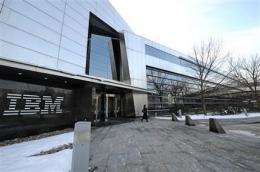
In this Jan. 20, 2009 file photo, IBM headquarters is seen in Armonk, New York. The Computer and Communications Industry Association said Wednesday Oct. 7, 2009, the government has started examining its allegations that IBM Corp. has abused its dominant position in the market for mainframe computers. (AP Photo/ Louis Lanzano, file)
(AP) -- The Justice Department is looking into allegations that IBM Corp. has abused its dominant position in the market for mainframe computers, the data-crunching heavy lifters of the computing world that IBM introduced in the 1960s and which are now used to process some of the most sensitive data in banking, government and health care.
The accusations stem from claims by IBM rivals that they've been illegally frozen out of the mainframe market because of IBM's refusal to allow its mainframe operating software to run on non-IBM computers. IBM doesn't have many rivals anymore that make mainframe computers, but some smaller companies are trying to develop technologies that would allow the software to run on cheaper hardware.
They allege that IBM, which used to license its mainframe software to competitors and for the back half of the last century operated under an antitrust agreement with the government, stopped doing so in recent years to choke off competition.
Known for their reliability, mainframes can cost $1 million or more each and are behind many everyday transactions. Withdrawing cash from an ATM, for example, often involves the ATM pinging a mainframe at the bank where the customer's data is stored to make sure there's enough money in the account.
The Computer and Communications Industry Association, an industry organization that complained to the Justice Department last month about IBM's behavior, said Wednesday the government has started examining its allegations by sending out formal requests for information about the mainframe market to IBM rivals.
"IBM will tell big customers that if you buy that other stuff, we're not going to let that stuff talk to our stuff," said Ed Black, CEO of the trade group. "We think of the Internet as open and innovative, but that's a lock 'em up and keep 'em locked up strategy. That's very unsatisfactory for the customer base."
One of the companies that received a request from the Justice Department was Tampa, Fla.-based T3 Technologies Inc., which in January lodged a formal complaint against IBM with European antitrust regulators and is suing IBM in the U.S. alleging antitrust abuses.
The company, a reseller of IBM mainframes from 1992 to 2002, says IBM has tried to thwart its expansion into making mainframes by denying it licenses for IBM's mainframe software, something done "for no reason other than to remove all competition from the mainframe market."
T3's president, Steven Friedman, didn't respond to messages from The Associated Press late Wednesday.
The Justice Department would not comment on a potential antitrust investigation.
In a statement, IBM pointed to a decision last week by a judge in the U.S. District Court for the Southern District of New York dismissing T3's complaint against IBM.
"We understand the Department of Justice has asked T3 for documents from the litigation," IBM said. "We continue to believe there is no merit to T3's claims, and that IBM is fully entitled to enforce our intellectual property rights and protect the investments that we have made in our technologies."
Armonk, N.Y.-based IBM said it will cooperate with any inquiries from the Justice Department.
That case stems from a conflict between IBM and Platform Solutions Inc., whose technology was used to run IBM's mainframe operating software on non-IBM computers. Platform had also complained to European regulators about IBM's conduct, until IBM bought Platform last year and the companies dropped their lawsuits against each other.
T3 had joined the case on Platform's side.
IBM's clashes with antitrust authorities go far back.
For nearly 50 years the company operated under an agreement with the government that sought to limit IBM's power in certain markets. The agreement, a so-called antitrust consent decree, was struck in 1956 to settle allegations of monopoly abuse in the market for electronic tabulating machines. It also covered computers, and parts of it gradually phased out until all provisions were dropped in 2001.
The company's last clash with antitrust authorities was a 13-year fight that stretched from 1969, when the government filed a separate antitrust lawsuit against the company, until 1982, when the government dropped the case.
©2009 The Associated Press. All rights reserved. This material may not be published, broadcast, rewritten or redistributed.
-
IBM Mainframes Go 3-D
Apr 27, 2007 |
not rated yet |
0
-
SEC launches formal probe of IBM accounts
Jan 13, 2006 |
not rated yet |
0
-
Sun shares dive as IBM buyout talks falter
Apr 06, 2009 |
not rated yet |
0
-
Brocade deepens IBM ties, steps up attack on Cisco
Apr 28, 2009 |
not rated yet |
0
-
IBM Rolls Out New Mainframe
Feb 26, 2008 |
not rated yet |
0
-
Engineers build first sub-10-nm carbon nanotube transistor
Feb 01, 2012 |
4.9 / 5 (33) |
30
-
Something old, something new: Evolution and the structural divergence of duplicate genes
Jan 31, 2012 |
4.6 / 5 (7) |
1
-
The hidden nanoworld of ice crystals: Revealing the dynamic behavior of quasi-liquid layers
Jan 30, 2012 |
5 / 5 (4) |
1
-
Stock market network reveals investor clustering
Jan 27, 2012 |
3.9 / 5 (23) |
8
-
Of microchemistry and molecules: Electronic microfluidic device synthesizes biocompatible probes
Jan 26, 2012 |
5 / 5 (2) |
0
-
How to tilt a object
4 hours ago
-
How to calculate total compressibility in liquid porous solid system
10 hours ago
-
Need help reading 3-D
Feb 11, 2012
-
A way to send and receive wireless data
Feb 11, 2012
-
Calling function with no input argument
Feb 10, 2012
-
Force free body diagram problem on gym equipment
Feb 10, 2012
- More from Physics Forums - General Engineering
More news stories
Google might launch Drive for cloud storage soon
(PhysOrg.com) -- Google's next big move, according to the Wall Street Journal, is a cloud storage service called Drive. Hardly first to the plate, Google is simply catching up to introducing its cloud reposi ...
Iran blocks email, restricts net access: reports
Iran has further restricted access to the Internet and blocked popular email services for the past few days, in a move a top lawmaker said could "cost the regime dearly," media reports said on Sunday.
11 hours ago |
5 / 5 (2) |
5
Walney offshore wind farm is world's biggest (for now)
(PhysOrg.com) -- The Walney wind farm on the Irish Sea--characterized by high tides, waves and windy weather--officially opened this week. The farm is treated in the press as a very big deal as the Walney ...
Navy to begin tests on electromagnetic railgun prototype launcher
The Office of Naval Research (ONR)'s Electromagnetic (EM) Railgun program will take an important step forward in the coming weeks when the first industry railgun prototype launcher is tested at a facility ...
Feb 06, 2012 |
4.6 / 5 (20) |
95
|
New power source discovered
(PhysOrg.com) -- Researchers at the Massachusetts Institute of Technology (MIT) and RMIT University have made a breakthrough in energy storage and power generation.
Technology / Energy & Green Tech
Feb 10, 2012 |
4.6 / 5 (51) |
51
|
Scientists discover molecular secrets of 2,000-year-old Chinese herbal remedy
For roughly two thousand years, Chinese herbalists have treated Malaria using a root extract, commonly known as Chang Shan, from a type of hydrangea that grows in Tibet and Nepal. More recent studies suggest that halofuginone, ...
New method to examine batteries -- MRI from the inside
There is an ever-increasing need for advanced batteries for portable electronics, such as phones, cameras, and music players, but also to power electric vehicles and to facilitate the distribution and storage of energy derived ...
A mitosis mystery solved: How chromosomes align perfectly in a dividing cell
Although the process of mitotic cell division has been studied intensely for more than 50 years, Whitehead Institute researchers have only now solved the mystery of how cells correctly align their chromosomes during symmetric ...
Lab study raises questions over nano-particle impact
Tests involving chickens have raised questions about the impact on health from engineered nano-particles, the ultra-fine grains commonly used in drugs and processed foods, scientists said on Sunday.
Starve a virus, feed a cure? Findings show how some cells protect themselves against HIV
A protein that protects some of our immune cells from the most common and virulent form of HIV works by starving the virus of the molecular building blocks that it needs to replicate, according to research published online ...
Researchers find extensive RNA editing in human transcriptome
In a new study published online in Nature Biotechnology, researchers from BGI, the world's largest genomics organization, reported the evidence of extensive RNA editing in a human cell line by analysis of RNA-seq data, demons ...