Calif. citrus farmers fear tree-killing disease
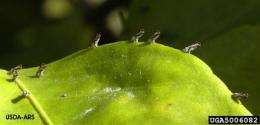
(AP) -- Tom Mulholland is girding for battle against a tiny enemy that could devastate the orange grove he has spent his life cultivating. His adversary: the Asian citrus psyllid, a fruit-fly-sized insect with red eyes and a long, leaf-penetrating beak.
The psyllid, which can carry an incurable disease fatal to citrus trees, was spotted in August in Los Angeles, closer than ever before to the ribbon of central California where the state's $1.6 billion citrus-growing industry is concentrated.
The feared infestation has prompted Mulholland and other citrus-belt farmers to put screens around their young seedlings, vigorously inspect their mature trees and tax themselves to fund research to stop the psyllid.
"It's like a war," Mulholland said in his tidy office set amid some 400 acres of radiantly healthy Clementine and Satsuma trees on his farm some 200 miles north of Los Angeles in the San Joaquin Valley at the base of the foothills beneath Sequoia National Park. "We're sitting here trying to stop this thing, and it wants to keep pushing in."
California growers and agricultural officials are worried the state's citrus industry will be crippled by the disease carried by the psyllid, which devastated Florida's crops. The two states produced about 97 percent of the nation's 12 million tons of citrus during the fiscal year ending in June.
The huanglongbing disease, which spoils the flavor of the fruit and ultimately kills the tree, has been found in all of Florida's 32 citrus-producing counties since its discovery there in 2005, causing about $100 million in damages, said Andrew Meadows, a spokesman for Florida Citrus Mutual, the state's grower trade association.
Florida officials have warned that their $9 billion citrus industry could be wiped out in a decade if a solution isn't found to the disease, also known as citrus greening because of the sickly green cast it lends to infected fruit.
"That's why California is so alarmed," said David Hall, an entomologist with the USDA's agricultural research service in Florida who worked on a team that sequenced the genome of the bacteria that causes citrus greening.
Huanglongbing has been found in Louisiana, Mexico, Brazil and China as well.
In California, the insect has so far been found among planted citrus trees in four southern counties, prompting quarantines that prohibit nurseries from shipping seedlings to other areas. Fruit grown in those counties also must be washed before it can be sold outside the quarantine zone.
Dogs trained to sniff out the pest found packages of curry leaves with psyllids in FedEx packages this summer in Fresno and Sacramento. Only the Fresno psyllids tested positive for huanglongbing.
The psyllid is not the only pest that could threaten California citrus. The state is also home to the glassy-winged sharpshooter, a threat to grapes but also capable of carrying a debilitating disease called citrus variegated chlorosis that has been spotted in Brazil.
California agriculture officials have also been locked in a decades-long struggle with the crop-eating Mediterranean fruit fly, which can harm citrus plants and hundreds of other fruits and vegetables.
But the potential devastation that could accompany a psyllid infestation is especially troubling for Mulholland and other citrus farmers, who have started building screens around the currently open-air nurseries where vulnerable seedlings are cultivated in rows of inverted plastic cones.
Allan Lombardi, who helps oversee 2,100 acres of pink-fleshed Cara Cara oranges, deep-red Fukumoto oranges and other high-value citrus as a manager with Central Valley grower Griffith Farms, said his company is scrambling to enclose its nurseries before the pest reaches the area, but that it's about two years from completion.
"If the disease shows up sooner than that, we'll have to have a Plan B, and I'm not sure what that will be," said Lombardi as he looked down a mountain slope and into a lush valley planted thickly with rows of oranges.
Citrus farmers have also started instructing workers to watch for signs of psyllid infestation, such as wilted-looking leaves or leaves covered in soot-like mold and white waxy deposits.
California's Citrus Research Board, which raises its $5.5 million operating budget by assessing citrus growers a nickel for every 55-pound box of fruit they sell, plans to contribute to the field checks with a team of up to 25 inspectors, operations chief MaryLou Polek said.
She said she hopes to poach trained inspectors from the state agriculture department whose hours or pay have been reduced due to budget cuts.
The board has also embarked on an effort to lay traps for the insect throughout the state that will be monitored by researchers carrying camera-equipped handheld devices that record the map coordinates where insects are found and take pictures of the damage.
That information, along with other data, will be beamed to a database so researchers can better track the insect's movement and deploy insecticides and other resources where they'll be most effective, she said.
Mulholland said he doesn't expect a cure to the disease any time soon, so those efforts to keep the disease-carrying insect from moving any farther north represent growers' best hope against the illness.
"It's like the AIDS of citrus. It's the very worst disease you can have," he said. "The question is, how do we keep the disease from spreading?"
©2009 The Associated Press. All rights reserved. This material may not be published, broadcast, rewritten or redistributed.


