Feds give sea otters habitat protection in Alaska
October 8, 2009 By MARY PEMBERTON , Associated Press Writer Feds give sea otters habitat protection in Alaska (AP)

Enlarge

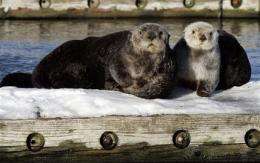
FILE- In this Feb. 7, 2008 file photo, a couple of sea otters sit on a float in the Cordova, Alaska boat harbor. The U.S. Fish and Wildlife Service on Wednesday, Oct. 7, 2009 designated more than 5,800 square miles as critical habitat for sea otters in the Aleutian Islands, Bering Sea and Alaska Peninsula. (AP Photo/Al Grillo, File)

(AP) -- Four years after being placed on the Endangered Species List, the dwindling sea otters of southwest Alaska on Wednesday were given an important recovery tool.

The U.S. Fish and Wildlife Service designated nearly 5,900 square miles as critical habitat for in the Aleutian Islands, Bering Sea and Alaska Peninsula. The designated area includes all nearshore waters.

"Critical habitat has a proven record of aiding the recovery of endangered species," said Rebecca Noblin, a lawyer for the Center for Biological Diversity, which filed two lawsuits and engaged in years of litigation to get the animals protected under the federal Endangered Species Act. The otters in southwest Alaska were listed as threatened in 2005.

"This has been a long time coming," she said.

Critical habitat gives the sea otters - the smallest of marine mammals - a "fighting chance of recovery," she said.

Nearshore areas were chosen because most of the creatures that sea otters eat - sea urchins, crabs, octopuses and some bottom fish - are found in shallow waters. Areas close to shore also provide the best protection from marine predators, especially , according to the Fish and Wildlife Service.

Federal law requires that critical habitat be designated at the time of listing. But when that didn't happen under the Bush administration, the Center for Biological Diversity filed a federal lawsuit in 2006. The following year an agreement was reached that critical habitat would be designated by this October.

Fish and Wildlife said it needed time to conduct an economic impact analysis on what the designation could mean to southwest Alaska. The agency found that designation would not have a large impact and should not result in any commercial fishing closures.

About 90 percent of the world's sea otters are in Alaska waters. There were more than 100,000 sea otters in southwest waters in the 1970s but there are fewer than 40,000 now. Some areas have seen numbers plummet 90 percent.

The reason for the decline is not known but one credible theory is that killer whales are preying on more sea otters, perhaps because other larger marine mammals such as sea lions are also in decline.

Noblin said there isn't much that can be done about killer whales but there are other stressors than can be addressed such as overfishing, the potential for oil development in Bristol Bay and climate change in the Bering Sea.

Critical habitat gives the animals an extra layer of scrutiny when entities are applying for federal permits in the designated area. However, it does not mean that development will stop, Noblin said.

"It just means the developer has to go through an additional process to determine how what they are doing will impact sea otters," she said.

©2009 The Associated Press. All rights reserved. This material may not be published, broadcast, rewritten or redistributed.


print this article email this article download pdf blog this article bookmark this article     Stumble it Digg this share on Facebook retweet share on Reddit add to delicious
Rate this story - not rated yet


October 8, 2009 all stories

Comments: 0

not rated yet
  • Stumble this up

  • Digg this

  • share this

  • hide
  • Related Stories

  • Sea otters pushed out of bay habitat
    created Apr 09, 2007 | popularity not rated yet | comments 0
  • Pollutants killing West Coast sea otters
    created Apr 06, 2006 | popularity not rated yet | comments 0
  • Sea Otters' Diet is Clue to Slow Recovery
    created Feb 12, 2009 | popularity not rated yet | comments 0
  • Decline in Alaskan sea otters affects bald eagles' diet
    created Oct 03, 2008 | popularity not rated yet | comments 0
  • Study finds potential disease threats to Washington sea otters
    created May 06, 2009 | popularity not rated yet | comments 0


  • hide
  • Relevant PhysicsForums posts

  • Human Leukocyte Antigen (HLA) typing
    created 2 hours ago
  • Breeding program
    created Nov 20, 2009
  • How does a concentration gradient provide energy?
    created Nov 20, 2009
  • Eyesight and Neural Damage from Electronics
    created Nov 19, 2009
  • More from Physics Forums - Biology

Other News

The Monarchs' annual migration ritual has yet to be scientifically explained

Tree-eating bugs threaten Monarch butterfly in Mexico

Biology / Ecology

created 3 hours ago | popularity not rated yet | comments 0

The mysterious Monarch butterfly, which migrates en masse annually between Canada and Mexico, is now facing a new peril: another insect thriving in Western Mexican forests.


Extinct goat Myotragus balearicus

Extinct goat was cold-blooded

Biology / Plants & Animals

created Nov 18, 2009 | popularity 4.9 / 5 (31) | comments 10

(PhysOrg.com) -- An extinct goat that lived on a barren Mediterranean island survived for millions of years by reducing in size and by becoming cold-blooded, which has never before been discovered in mammals.


Bigger not necessarily better, when it comes to brains

Bigger not necessarily better, when it comes to brains

Biology / Plants & Animals

created Nov 17, 2009 | popularity 4.5 / 5 (17) | comments 11

(PhysOrg.com) -- Tiny insects could be as intelligent as much bigger animals, despite only having a brain the size of a pinhead, say scientists at Queen Mary, University of London.


Right-handed chimpanzees provide clues to the origin of human language

Biology / Plants & Animals

created Nov 16, 2009 | popularity 3 / 5 (1) | comments 7

Most of the linguistic functions in humans are controlled by the left cerebral hemisphere. A study of captive chimpanzees at the Yerkes National Primate Research Center (Atlanta, Georgia), reported in the January 2010 issue ...


The creature was found at a depth of 161 metres

Japanese researchers film rare baby fish 'fossil'

Biology / Plants & Animals

created Nov 17, 2009 | popularity 4.7 / 5 (7) | comments 4

Japanese marine researchers said Tuesday they had found and successfully filmed a young coelacanth -- a rare type of fish known as "a living fossil" -- in deep water off Indonesia.