Color-changing roof tiles absorb heat in winter, reflect it in summer
October 8, 2009 by David L. Chandler
Energy savings in black and white

Enlarge

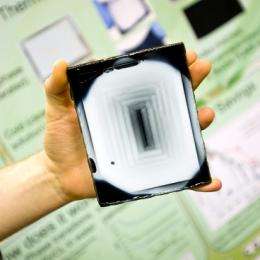
A blast from a heat gun has turned most of the black tile in this image white. The prototype tile, developed by recent MIT graduates, is designed to turn dark in cold weather and white in warm weather. Image: Patrick Gillooly

(PhysOrg.com) -- Anyone who has ever stepped barefoot onto blacktop pavement on a hot sunny day knows the phenomenon very well: Black surfaces absorb the sun's heat very efficiently, producing a toe-scorching surface. In the wintertime, that can be a good thing: A dark roof heats up in the sun and helps reduce your heating bill. But in summertime, it's definitely a bad thing: Your house gets even hotter, and your air conditioning has to work harder. In most places, the summertime penalty is greater than the wintertime gain, it turns out, so that's why many people, including U.S. Secretary of Energy Steven Chu, strongly advocate switching to white roofs.

It's no small matter. In fact, Chu says that turning all the world's roofs white would eliminate as much in 20 years as the whole world produces in a year. But some critics point out that in northern cities, the gain in summer could be outweighed by the loss in winter. The ideal situation, then, would be to get the advantage of white roofs when it's hot and black roofs when it's cold.

Now, there may be a way to have both. A team of recent MIT graduates has developed roof tiles that change color based on the temperature. The tiles become white when it's hot, allowing them to reflect away most of the sun's heat. When it's cold they turn black and absorb heat just when it's needed.

The team's lab measurements show that in their white state, the tiles reflect about 80 percent of the falling on them, while when black they reflect only about 30 percent. That means in their white state, they could save as much as 20 percent of present cooling costs, according to recent studies. Savings from the black state in winter have yet to be quantified.

The team, which the students call Thermeleon (rhymes with , because of its color-changing property), was one of the competitors in this year's Making and Designing Materials Engineering Contest (MADMEC), a competition for teams of MIT students (or 2009 graduates). Now in its third year, the contest this year was specifically devoted to projects aimed at improving energy efficiency through innovative uses of materials. The final showdown was held Wednesday night, and the Thermeleon team took first place, earning $5,000 in the process.

Nick Orf PhD ’09, a member of the Thermeleon team, explains that he and his teammates originally tried to develop a color-shifting roof tile using a system of mixed fluids, one dark and one light, whose density would change with temperature: the dark substance would float to the top when it was cold, and white would float when it was hot. But the system proved too complicated, and instead they hit on a simpler, less expensive method.

Now, they use a common commercial polymer (in one version, one that is commonly used in hair gels) in a water solution. That solution is encapsulated — between layers of glass and plastic in their original prototype, and between flexible plastic layers in their latest version — with a dark layer at the back.

When the temperature is below a certain level (which they can choose by varying the exact formulation), the polymer stays dissolved, and the black backing shows through, absorbing the sun's heat. But when the temperature climbs, the polymer condenses to form tiny droplets, whose small sizes scatter light and thus produce a white surface, reflecting the sun's heat.

They are now working on an even simpler version in which the polymer solution would be micro-encapsulated and the tiny capsules carried in a clear paint material that could be brushed or sprayed onto any existing surface. The tiny capsules would still have the color-changing property, but the surface could easily be applied over an existing black roof, much more inexpensively than installing new roofing material.

Although they have not yet made specific plans for forming a business to commercialize their concept, Orf says the team members are determined to pursue the project and develop it into a marketable product.

Because the materials are common and inexpensive, team members think the tiles could be manufactured at a price comparable to that of conventional roofing materials — although that won't be known for sure until they determine the exact materials and construction of their final version.

The biggest remaining question is over durability, and answering it will require spending some time to do accelerated testing by running the material through repeated hot-cold cycles.

Hashem Akbari, leader of the Heat Island Group at Lawrence Berkeley National Laboratory in California, is a long-time advocate of white roofs as an energy-saving measure. He says that some other groups, including a team at the University of Athens, have done research on the use of color-changing materials for roofs, but that in those tests, "the cost and durability has been a serious issue."

The Thermeleon team hopes to address those concerns. "It's got to stand up to very harsh conditions," Orf says. "Those sorts of tests would have to be done before we'll know if we have a viable product."

Provided by Massachusetts Institute of Technology (news : web)

4.5 /5 (22 votes)  

Filter


Move the slider to adjust rank threshold, so that you can hide some of the comments.


Display comments: newest first

Rick69
Oct 08, 2009

Rank: 4 / 5 (3)
In many northern climes, the fact that the tiles turn black in winter will not be of much consequence as our roofs are usually snow covered most of the winter.
ontheinternets
Oct 08, 2009

Rank: 2.5 / 5 (2)
For those on the threshold, the difference may sometimes prevent the snow from packing in the first place. However, I don't know how significant that might be.

On that note, I wonder if a surface (heat aside) could be devised to make snow more likely to melt and perhaps even channel the cold water away. If possible, they could be paired for greatest effect.

On another note, in certain climates, maybe it could be best to accept that the snow's going to pack up.. though I'm not clever enough to see how that could be a good thing aside from peace of mind.
deatopmg
Oct 08, 2009

Rank: 4.3 / 5 (3)
with new construction the roof "r" values are very high; meaning that the heat gain, summer, and heat loss, winter, are close to insignificant making color changing tiles cost ineffective in Cambridge. they might look nice on the MIT dome though.
Sparkygravity
Oct 08, 2009

Rank: 4 / 5 (2)
I'm confused... Didn't they already invent the "mood" ring. I'm impressed from an problem analysis stand-point. I'd love to see commercially viable, energy efficient roof tops, but seems to me there's got to be a better technology.
ontheinternets
Oct 08, 2009

Rank: 4.5 / 5 (4)
Now I recall that there are many cities in which most homes have a solar hot water heater on the roof. With this (and deatopmg's comment) in mind, doesn't it seem a bit silly to go through a bunch of effort to deflect energy back to the sky during precisely the periods of time in which the energy is most abundant? Doesn't it make more sense to harness the energy for some useful purpose (and if necessary, place some relatively simple insulation underneath)? Solar water heating is perhaps one of the simplest and most efficient uses.. but it could also be used to produce an electrical current (ie. to power air conditioning).

Of course, this is still ongoing research rather than just invention.. and if it gets developed far enough, I'm certain there are enough good uses for it for it to be worthwhile.
Egnite
Oct 09, 2009

Rank: not rated yet
Great idea for new house builds where they can use these instead of loft insulation but I can't see current homeowners being too keen on replacing thier tiles aswell as ripping out that insulation.
otto1923
Oct 09, 2009

Rank: not rated yet
We need thermoelectric materials as an adjunct to flexible photovoltaic systems. A multi-layer membrane with Teflon surface, suitable for sloped roofs, and perhaps a storage capacity of it's own and insulation. Remove heat by converting it to current before it heats the air. Thermoelectrics would work 24/7.
LuckyBrandon
Oct 10, 2009

Rank: not rated yet
and they will cost how much??
Gundar
Nov 01, 2009

Rank: not rated yet
This is a great idea but another company has already thought of it. You can find them at movingcolor.net.
Rank 4.5 /5 (22 votes)
Relevant PhysicsForums posts
  • Does anyone make a small high temperature and high pressure pump?
    created6 hours ago
  • Strange indexing in Fortran Code
    created17 hours ago
  • Car Port post load calculation
    created18 hours ago
  • attempting to spin-cast parabola
    createdFeb 07, 2012
  • Flow around a reducing bend - effect on pumping work
    createdFeb 06, 2012
  • Formula for deflection of 6061 T6 hollow tube, please help.
    createdFeb 06, 2012
  • More from Physics Forums - General Engineering

More news stories

Scientists break satellite telephony security standards

Satellite telephony was thought to be secure against eavesdropping. German researchers at the Horst Gortz Institute for IT-Security (HGI) at the Ruhr University Bochum (RUB) have cracked the encryption algorithms of the European ...

Technology / Computer Sciences

created 4 hours ago | popularity 5 / 5 (2) | comments 0 | with audio podcast

Solar start-ups set new efficiency records

(PhysOrg.com) -- Although Alta Devices and Semprius make different types of solar panels, both start-ups have been breaking records in the past few days. Santa Clara, Calif.-based Alta Devices announced that ...

Technology / Energy & Green Tech

created 9 hours ago | popularity 4.9 / 5 (10) | comments 7 | with audio podcast report

Amazon strikes video deal with Viacom

Amazon announced a deal with entertainment giant Viacom on Wednesday, building up its arsenal of television shows as it takes on video streaming market leader Netflix.

Technology / Business

created 3 hours ago | popularity not rated yet | comments 0

Rambus, Nvidia sign patent licensing deal

Technology licensing company Rambus Inc. said Wednesday it has signed a licensing agreement with chip maker Nvidia Corp. to settle a long-running patent dispute.

Technology / Business

created 3 hours ago | popularity 3 / 5 (1) | comments 0

Hackers post W.Va. police officers' personal info

(AP) -- Hackers affiliated with the Anonymous hacking group obtained more than 150 police officers' personal information from an old website for the West Virginia Chiefs of Police Association and posted it online.

Technology / Internet

created 4 hours ago | popularity not rated yet | comments 0


Short fasting cycles work as well as chemotherapy in mice

Man may not live by bread alone, but cancer in animals appears less resilient, judging by a study that found chemotherapy drugs work better when combined with cycles of short, severe fasting.

Gene therapy for inherited blindness succeeds in patients' other eye

Gene therapy for congenital blindness has taken another step forward, as researchers further improved vision in three adult patients previously treated in one eye. After receiving the same treatment in their ...

Physicists build highly efficient 'no-waste' laser

A team of University of California, San Diego researchers has built the smallest room-temperature nanolaser to date, as well as an even more startling device: a highly efficient, "thresholdless" laser that ...

Study shows how DNA finds its match

It's been more than 50 years since James Watson and Francis Crick showed that DNA is a double helix of two strands that complement each other. But how does a short piece of DNA find its match, out of the millions ...

Transparent iron? For the first time, an experiment shows that atomic nuclei can become transparent

At the high-brilliance synchrotron light source PETRA III, a team of DESY scientists headed by Dr. Ralf Röhlsberger has succeeded in making atomic nuclei transparent with the help of X-ray light. At the ...

'Explorers,' who embrace the uncertainty of choices, use specific part of cortex

Life shrouds most choices in mystery. Some people inch toward a comfortable enough spot and stick close to that rewarding status quo. Out to dinner, they order the usual. Others consider their options systematically ...