Are mobiles and social networking sites changing the way we behave?
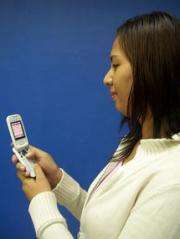
(PhysOrg.com) -- How dependent have we become on mobile phones, and are social networking sites changing the nature of our relationships with other people? A three-year Oxford University study is to address these issues.
How dependent have we become on modern technologies like mobile phones, and are social networking sites significantly changing the nature of our relationships with other people?
These are some of the issues that researchers from Oxford University hope to address in an ambitious new three-year project, launched this month.
The €2.5 million project involves an international team of experts drawn from different disciplines, including psychology, computer science and physics. Researchers will examine electronic records of the mobile phone calls made by 7 million people in a European country to find out whether new trends and patterns of behaviour are emerging at individual, group, and societal levels.
The last two decades have seen tremendous changes in society, driven by information and communication technologies (ICT). From email and the web to facebook and Twitter, the processes of building and strengthening social relationships have been transformed and new forms of community have emerged as a result.
The researchers will analyse information that logs, minute by minute, how a group of 7 million people are using these new communication tools. This vast amount of data and records, which has been rigorously anonymised so that individuals cannot be identified, will reveal the times and variations in the way this section of the population uses mobile phones.
The research team will examine details such as the length of calls and intervals between calls, but for reasons of confidentiality, not the content of the calls themselves which the researchers will never hear.
The researchers will also study the impact of online social networking sites like facebook, looking at how social mechanisms work in an online world and examining whether the trend of shifting our social life to the internet enhances, replaces or threatens social relations based on face-to-face contacts.
Using computer modelling, the team will be able to chart large-scale patterns and trends in human behaviour as well as being able to observe behaviour at an individual level, taking into account important demographic characteristics such as age and gender.
Three research groups from Oxford University are involved - Institute for Science, Innovation and Society (InSIS), CABDyN Complexity Centre, and the Institute of Cognitive and Evolutionary Anthropology (ICEA).
The study will draw on new approaches that explore how cognitive abilities and constraints have evolved in human groups and societies, which extend earlier work by Professor Robin Dunbar of the ICEA in Oxford.
Dr Felix Reed-Tsochas, Director of Complex Systems at InSIS at Oxford University, said: ‘There is an acute lack of understanding of the driving forces and mechanisms behind the way we use these communication tools that we now all take for granted. We have little understanding of how recent forms of social interaction like facebook and Twitter influence individuals and societies as existing knowledge in this area is fragmented.
‘One major goal is to bridge the knowledge gap by creating an interdisciplinary team of researchers from social psychology, computer science and complexity science. This will create a more joined up picture of what is happening in society today, which can inform both policy makers and the ICT industry.’
Provided by Oxford University (news : web)


