Physicists Measure Elusive 'Persistent Current' That Flows Forever
October 8, 2009 Physicists Measure Elusive 'Persistent Current' That Flows Forever

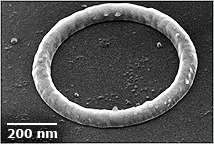
Harris made the first definitive measurement of an electric current that flows continuously in tiny, but ordinary, metal rings. (Photo: Jack Harris/Yale University)

(PhysOrg.com) -- Physicists at Yale University have made the first definitive measurements of "persistent current," a small but perpetual electric current that flows naturally through tiny rings of metal wire even without an external power source.

The team used nanoscale cantilevers, an entirely novel approach, to indirectly measure the current through changes in the magnetic force it produces as it flows through the ring. “They’re essentially little floppy diving boards with the rings sitting on top,” said team leader Jack Harris, associate professor of physics and applied physics at Yale. The findings appear in the October 9 issue of Science.

The counterintuitive current is the result of a quantum mechanical effect that influences how electrons travel through metals, and arises from the same kind of motion that allows the electrons inside an atom to orbit the nucleus forever. “These are ordinary, non-superconducting metal rings, which we typically think of as resistors,” Harris said. “Yet these currents will flow forever, even in the absence of an applied voltage.”

Although persistent current was first theorized decades ago, it is so faint and sensitive to its environment that physicists were unable to accurately measure it until now. It is not possible to measure the current with a traditional ammeter because it only flows within the tiny metal rings, which are about the same size as the wires used on computer chips.

Past experiments tried to indirectly measure persistent current via the magnetic field it produces (any current passing through a metal wire produces a magnetic field). They used extremely sensitive magnetometers known as superconducting devices, or SQUIDs, but the results were inconsistent and even contradictory.

“SQUIDs had long been established as the tool used to measure extremely weak magnetic fields. It was extremely optimistic for us to think that a mechanical device could be more sensitive than a SQUID,” Harris said.

The team used the cantilevers to detect changes in the magnetic field produced by the current as it changed direction in the aluminum rings. This new experimental setup allowed the team to make measurements a full order of magnitude more precise than any previous attempts. They also measured the persistent current over a wider range of temperature, ring size and than ever before.

“These measurements could tell us something about how electrons behave in metals,” Harris said, adding that the findings could lead to a better understanding of how qubits, used in quantum computing, are affected by their environment, as well as which metals could potentially be used as superconductors.

Authors of the paper include Ania Bleszynski-Jayich, William Shanks, Bruno Peaudecerf, Eran Ginossar, Leonid Glazman and Jack Harris (all of Yale University) and Felix von Oppen (Freie Universität Berlin).

Provided by Yale University (news : web)


print this article email this article download pdf blog this article bookmark this article     Stumble it Digg this share on Facebook retweet share on Reddit add to delicious
Rate this story - 4.8 /5 (58 votes)

Rank Filter

Move the slider to adjust rank threshold, so that you can hide some of the comments.


Display comments: newest first

  • Sean_W - Oct 08, 2009
    • Rank: not rated yet
    How often does the curent change direction? Does it do that spontaneously or in reaction to noise in the environment?
  • ruebi - Oct 08, 2009
    • Rank: not rated yet
    Is there a difference between persistent current and perpetual motion? The later is said impossible to exist but that is what this story made me think about.
  • Bob_Kob - Oct 08, 2009
    • Rank: not rated yet
    Well I think if you try to do any work, the current will stop.
  • brant - Oct 08, 2009
    • Rank: not rated yet
    Well I think if you try to do any work, the current will stop.


    I suspect you could do work, stop, the current would return and then do some more work.
    Since it is there in the first place(where does it come from?), why would it disappear for good?
  • lengould100 - Oct 09, 2009
    • Rank: 5 / 5 (1)
    If Brant were correct, where would the extracted power be coming from? Thermal input?
  • DraganGlas - Oct 09, 2009
    • Rank: 5 / 5 (1)
    Greetings,

    @brant/lengould100
    ...

    Since it is there in the first place(where does it come from?), why would it disappear for good?


    The counterintuitive current is the result of a quantum mechanical effect that influences how electrons travel through metals, and arises from the same kind of motion that allows the electrons inside an atom to orbit the nucleus forever. “These are ordinary, non-superconducting metal rings, which we typically think of as resistors,” Harris said. “Yet these currents will flow forever, even in the absence of an applied voltage.”


    It's similar to the molecular bonds of carbon atoms in benzene - they "flicker" between single- and double-bonds.

    Here, as the article indicates, it's due to the passage of electrons (which is basically what an electrical current comprises) between atoms throughout the ring of metal.

    Kindest regards,

    Dragan Glas
  • DraganGlas - Oct 09, 2009
    • Rank: not rated yet
    Greetings,

    @brant/lengould100
    ...

    Since it is there in the first place(where does it come from?), why would it disappear for good?


    The counterintuitive current is the result of a quantum mechanical effect that influences how electrons travel through metals, and arises from the same kind of motion that allows the electrons inside an atom to orbit the nucleus forever. “These are ordinary, non-superconducting metal rings, which we typically think of as resistors,” Harris said. “Yet these currents will flow forever, even in the absence of an applied voltage.”


    It's similar to the molecular bonds of carbon atoms in benzene - they "flicker" between single- and double-bonds.

    Here, as the article indicates, it's due to the passage of electrons (which is basically what an electrical current comprises) between atoms throughout the ring of metal.

    Kindest regards,

    Dragan Glas
  • otto1923 - Oct 09, 2009
    • Rank: not rated yet
    it's due to the passage of electrons (which is basically what an electrical current comprises) between atoms throughout the ring of metal.
    And yet it runs forever, nothing degrades. Where does the power COME from? Where does the charge on an electron come from, and why doesnt it degrade even when the electron does work? Not the vacuum please; thats like saying out of thin air, or out of your butt. People use these theories as approximations to a certain level, but they still cannot EXPLAIN them. Leaves questions open on scalar physics and zero-point energy.
  • SincerelyTwo - Oct 09, 2009
    • Rank: not rated yet
    Maybe it does degrade, but at a rate we cannot reliably measure.

    Besides, perpetual motion and this persistent current don't break the laws of physics, they don't produce excess energy, what you put in is what you have - and what you have just continues to remain in the state that it's in until you interfere.

    You can only minimize the amount energy in a system degrades, maybe removing friction entirely in some controlled experiments or in some unique environments in space. But you can't make there be SO LITTLE friction that you get... INVERTED FRICTION and suddenly the system radiates energy for no freaking reason.

    The problem with all of this is failure to understand and communicate on the topics with clear understanding of terminology. Most people say these things implying excess energy, when objectively from the math it just means lack of friction or degrading forces..
  • zevkirsh - Oct 09, 2009
    • Rank: 3 / 5 (1)
    millions upon millions is being invested in all the roomtemperature superconducting material research.

    it is counterintuitive, but solving the puzzle of the 'persistent' current (as in this article) is going to be a small, yet INTEGRAL, part into making a room temperature superconductor possible

    the big part of the superconducting puzzle is the geometry of the magneto-electrical strucuture of a material. HOWEVER....a another small part of the puzzle is about the freedom of unbound electrons to move through a medium containing an amount of bound electrons. and it lies in this research. unfortunately ...all the superconducting researchers don't yet realize that this area is actually worth a small amount of their time....

    it's about thinking 'out' of the box.

  • sender - Oct 09, 2009
    • Rank: not rated yet
    Using these rings in series-parallel switched arrays should make for some extremely powerful antennas.
  • johanfprins - Oct 10, 2009
    • Rank: not rated yet
    Was an external magnetic-field applied to initiate the persistent current? In the case of a superconducting ring one first have to apply a magnetic-field; One can then switch off the magnetic field and the current with its trapped Lenz field will persist.
  • eurekalogic - Oct 11, 2009
    • Rank: not rated yet
    Its Teslas Ether.
  • NotAsleep - Oct 13, 2009
    • Rank: not rated yet
    To create information requires energy. The cantilevers got that energy from somewhere. I'll bet the actual scientific article would mention something about the current decreasing proportionally to the energy expended in moving the cantilevers. Unfortunately, I can't find it on the Science Magazine webpage. If anyone finds a link to that article, please post here!
  • DraganGlas - Oct 13, 2009
    • Rank: not rated yet
    @NotAsleep

    Here you go...

    http://www.scienc...5950/275

    Kindest regards,

    Dragan Glas
  • NotAsleep - Oct 14, 2009
    • Rank: not rated yet
    Thanks, DraganGlas, although that link seems to go to a different article on the hubble... I DID end up finding the article but t'isn't free and I t'isn't rich enough to afford REAL science articles

October 8, 2009 all stories

Comments: 16

4.8 /5 (58 votes)
  • Stumble this up

  • Digg this

  • share this

  • hide
  • Related Stories

  • Study of 'Persistent Currents' Finally Verifies Theory
    created Apr 28, 2009 | popularity not rated yet | comments 0
  • Quantum physicists control supercurrent
    created Aug 10, 2006 | popularity not rated yet | comments 0
  • Physicists demonstrate quantum mechanical nature of heat flow
    created Apr 15, 2005 | popularity not rated yet | comments 0
  • Superconducting nanowires show ability to measure magnetic fields
    created Jun 16, 2005 | popularity not rated yet | comments 0
  • Chip-Scale Magnetic Sensor Draws on Mini Clock Design
    created Dec 29, 2004 | popularity not rated yet | comments 0


  • hide
  • Relevant PhysicsForums posts

Other News

Restored machine to explore mysteries of Big Bang (AP)

Restored machine to explore mysteries of Big Bang

Physics / General Physics

created 16 hours ago | popularity 4.5 / 5 (15) | comments 9

(AP) -- Scientists are preparing the world's largest atom smasher to explore the depths of matter after successfully restarting the $10 billion machine following more than a year of repairs.


nuclear power plant

Doubts raised on nuclear industry viability

Physics / General Physics

created Nov 19, 2009 | popularity 3.1 / 5 (20) | comments 19

(PhysOrg.com) -- The investment in nuclear power has been growing around the world over the last few years, being viewed as a means for countries to control their energy security, avoid the price fluctuations ...


Researchers Find Innate Correlations Among Different Power Law Phenomena

Researchers Find Innate Correlations Among Different Power Law Phenomena

Physics / General Physics

created Nov 17, 2009 | popularity 4.3 / 5 (15) | comments 14

(PhysOrg.com) -- Studying the patterns that emerge in natural and social phenomena is a popular area of research, although usually individual phenomena are studied separately from each other. In a recent study, ...


Scientists demonstrate 'universal' programmable quantum processor

Scientists demonstrate 'universal' programmable quantum processor

Physics / Quantum Physics

created Nov 15, 2009 | popularity 4.6 / 5 (21) | comments 11

Physicists at the National Institute of Standards and Technology have demonstrated the first "universal" programmable quantum information processor able to run any program allowed by quantum mechanics -- th ...


Proton's party pals may alter its internal structure

Proton's party pals may alter its internal structure

Physics / General Physics

created Nov 18, 2009 | popularity 4.6 / 5 (20) | comments 9

A recent experiment at the DOE's Thomas Jefferson National Accelerator Facility has found that a proton's nearest neighbors in the nucleus of the atom may modify the proton's internal structure.