Goddard Visualization Team Previews Lunar Impact
October 8, 2009 by Francis Reddy Goddard Visualization Team Previews Lunar Impact

Enlarge

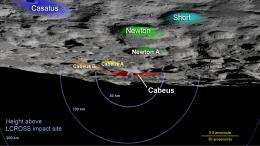
Key lunar landmarks used to locate Cabeus crater, the site of the LCROSS crash, are colored and labeled in this view. The yellow scale shows angular distances in the plane of the impact site; blue arcs show heights 50, 100 and 200 kilometers above it. Credit: NASA/Goddard Space Flight Center Scientific Visualization Studio

(PhysOrg.com) -- At 7:30 a.m. EDT on October 9, a two-ton rocket body will slam into a crater near the moon's south pole. By studying the resulting plume of gas and dust, scientists hope this grand experiment will confirm the presence of ice in permanently shadowed craters at the lunar poles.

The event is the highlight of NASA's Observation and Sensing Satellite (LCROSS) mission. The LCROSS spacecraft flies behind its empty upper stage, which is targeted to strike the floor of Cabeus crater. LCROSS will image the impact and provide direct measurements of the plume before it also plunges into the lunar surface. With LCROSS gone, further measurements of the cloud depend on ground-based observatories around the world.

"This is a completely unique mission that will excavate two large holes dozens of meters across on the lunar surface. It will give us composition measurements we wouldn't otherwise be able to get," said Tim McClanahan, a scientist at Goddard Space Flight Center in Greenbelt, Md.

McClanahan's modeling of the moon's permanently shadowed regions, initially done to support the Lunar Exploration (LEND) instrument aboard NASA's Lunar Reconnaissance Orbiter (LRO), underscored a problem for ground-based follow-up of the LCROSS impact. "We realized that ground observers would have difficulty identifying the location," he said. "It's near the lunar south pole, where illumination is poor and the ability to distinguish nearly edge-on craters is problematic. On top of that, LCROSS will hit the crater floor, but we can only see its rim from Earth."

To provide the detailed information ground-based telescopes needed, McClanahan approached Goddard's Scientific Visualization Studio (SVS). The goal was to find a "sweet spot" where factors such as lunar topography, lighting from the sun, and the view from Earth provided the earliest, highest-contrast view of the rapidly changing plume.
Goddard Visualization Team Previews Lunar Impact
Enlarge

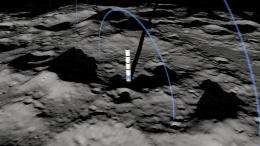
This visualization gives a bird's-eye view of Cabeus crater and the target zone for the crash site. A 3.5-kilometer-wide "flagpole" marks the targeted location within the crater. Colored stripes on the pole indicate one kilometer steps in elevation above the crater floor, black stripes indicate 5 kilometer steps. The pole stands 25 kilometers tall, and the blue rings mark heights of 50 and 100 kilometers above the impact site. Credit: NASA/Goddard Space Flight Center Scientific Visualization Studio

"Visualization aided two aspects of the LCROSS mission," said Ernie Wright at the SVS. "It helped us understand how visible the plume will be from Earth and whether the targeted terrain was flat and in shadow."

The project prefers a crater floor because slopes tend to be rocky, whereas lighter, fluffier materials fall to the lowest elevations. "LCROSS scientists want to send up a debris cloud as high as they can," Wright explained, "so they want to hit these light materials."

Scientists think that hydrogen detected in lunar soil by several instruments, including LEND, may be either icy leftovers from ancient comet impacts or accumulated from the solar wind, a stream of particles flowing from the sun. Whatever its source, scientists assume hydrogen collects in low polar elevations where the sun never shines. This dictates an impact in the shadowed portion of a crater floor.

On September 11, LCROSS mission planners announced that they had targeted a smaller, more northerly crater named Cabeus A. But later that month, analyses of new data from instruments aboard LRO, together with archival measurements from NASA's Lunar Prospector mission of the late 1990s, indicated that the larger Cabeus crater was a better bet.

"The sweet spot for ground-based telescopes lies about two kilometers above the floor of Cabeus," Wright explained. "There, sunlight streaming through a depression in the crater rim will light up the plume while the rest of the crater remains in shadow."

Provided by JPL/NASA (news : web)


print this article email this article download pdf blog this article bookmark this article     Stumble it Digg this share on Facebook retweet share on Reddit add to delicious
Rate this story - not rated yet


October 8, 2009 all stories

Comments: 0

not rated yet
  • Stumble this up

  • Digg this

  • share this

  • hide
  • Related Stories

  • NASA's LCROSS Mission Changes Impact Crater
    created Sep 29, 2009 | popularity not rated yet | comments 0
  • NASA's Quest to Find Water on the Moon Moves Closer to Launch
    created Jan 15, 2008 | popularity not rated yet | comments 0
  • NASA's LCROSS Reveals Target Crater For Lunar South Pole Impacts
    created Sep 11, 2009 | popularity not rated yet | comments 0
  • NASA launches LCROSS Lunar Impactor
    created Jun 19, 2009 | popularity not rated yet | comments 0
  • NASA Moon-Impactor Mission Passes Major Review
    created Feb 02, 2007 | popularity not rated yet | comments 0


  • hide
  • Relevant PhysicsForums posts

  • Sideral question
    created 14 hours ago
  • Doppler shifted blackbody spectrum
    created 17 hours ago
  • Earth v. Moon
    created 19 hours ago
  • help me with coordinates and orbits
    created 19 hours ago
  • basic 'our universe' question..
    created Nov 20, 2009
  • deriving keplers law
    created Nov 19, 2009
  • More from Physics Forums - General Astronomy

Other News

Astronauts finish another spacewalk, still no baby (AP)

Astronauts finish another spacewalk, still no baby

Space & Earth / Space Exploration

created 5 hours ago | popularity 3 / 5 (2) | comments 0

(AP) -- A spacewalking astronaut put aside the impending birth of his daughter and blazed through his first-ever venture outside the International Space Station on Saturday.


Unseasonably hot and dry weather combined with strong winds to fan scores of blazes in the country's southeastern states

Australia issues 'catastrophic' alerts as fires rage

Space & Earth / Environment

created 11 hours ago | popularity 4.5 / 5 (2) | comments 0

Australia has issued "catastrophic" alerts after record-breaking temperatures and wild lightning storms sparked more than 100 fires across the country, officials said Saturday.


Commuters wait on the platform shrouded by fog in London

Climate change not man-made, say majority of Britons: poll

Space & Earth / Environment

created Nov 15, 2009 | popularity 3.3 / 5 (15) | comments 45

Less than half of Britons believes that human activity is to blame for global warming, according to a poll carried out for The Times newspaper and published on Saturday.


Mysteriously warm times in Antarctica

Mysteriously warm times in Antarctica

Space & Earth / Earth Sciences

created Nov 18, 2009 | popularity 4.2 / 5 (21) | comments 28

(PhysOrg.com) -- A new study of Antarctica's past climate reveals that temperatures during the warm periods between ice ages (interglacials) may have been higher than previously thought. The latest analysis ...


UN: Fight climate change with free condoms (AP)

UN: Fight climate change with free condoms

Space & Earth / Environment

created Nov 18, 2009 | popularity 3.1 / 5 (11) | comments 22

(AP) -- The battle against global warming could be helped if the world slowed population growth by making free condoms and family planning advice more widely available, the U.N. Population Fund said Wednesday.