A road of no return: Team implements the first '1-way roads' for light
October 8, 2009 A road of no return

Enlarge

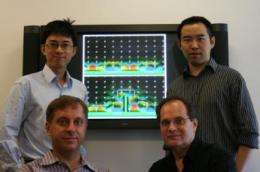
Members of the team that implemented the "lightwave one-way road"; front row: John Joannopoulos (right) and Marin Soljačić; back row: Zheng Wang (right) and Yidong Chong. The screen in the background shows a theoretical simulation of the experimental system. The top panel shows propagation of the light (from right to left) in the topological waveguide without an obstruction. The bottom panel shows behavior in the presence of a large obstacle: light effortlessly flows around the obstacle, without any reflections. Credit: Franklin EW Hadley

Light readily bounces off obstacles in its path. Some of these reflections are captured by our eyes, thus participating in the visual perception of the objects around us. In contrast to this usual behavior of light, MIT researchers have implemented for the first time a one-way structure in which microwave light flows losslessly around obstacles or defects. This concept, when used in lightwave circuits, might one day reduce their internal connections to simple one-way conduits with much improved capacity and efficiency.

The laws of nature that govern the world around us allow for the propagation of light in both directions. If a light beam is observed propagating in a particular direction, one can also shine a light beam to propagate in the opposite (backward) direction. "The very fact that reflected beams are allowed to exist, combined with the fact that light at least partially reflects from most objects it encounters, makes optical reflections ubiquitous in nature," said MIT physics Professor Marin Soljačić, the senior author of the study.

In a dramatic departure from this common phenomenon, a team made up of MIT physicists Dr. Zheng Wang, Dr. Yidong Chong, Prof. John Joannopoulos, and Prof. Marin Soljačić have implemented and experimentally tested so-called topological photonic crystals that completely prohibit the existence of any lightwave back-reflections. The results, published in the 8th October 2009 edition of Nature, show the first experimental observation of the fascinating new phenomena and capabilities associated with microwave light propagating in this uniquely designed waveguide (a tunnel or "road" for guiding light).

Through the application of an external , this specially designed waveguide induces unusual restrictions to the propagation of the light inside it. "We have now found a way to make light travel without bouncing back, by shining it through an array of small ceramic rods placed in a strong magnetic field," said Dr Zheng Wang, a lead author of the paper. For example, instead of light being able to travel to the right or to the left along this waveguide (as is traditionally expected), a magnetic field pointing upwards will allow light propagation only to the right, while a magnetic field pointing downwards allows for of the light only to the left.

"Once a particular forward direction of the light travel is chosen, no backward travel is permitted," said Dr. Yidong Chong, also a lead author of the paper. Therefore, light can never bounce back or reflect. Rather, it effortlessly routes around any obstacles and defects in its path without incurring any dissipation. "Loosely speaking the waveguide acts as a perfect cloak of the defect or obstacle in the path of the light" said Professor Joannopoulos, "the only difference is a phase shift of the guided light."

While the focus of the present work is in the microwave regime, in conventional optics, light reflections present a major roadblock to light-driven circuits reaching the same level of sophistication as widely used microelectronic circuits. A variety of practical applications, such as optical isolation and optical information storage, could potentially benefit from the novel and unparalleled one-way photonic behavior observed by the MIT team. Numerous applications that require strong interactions between and matter could also gain from such an efficiency boost.

Source: Massachusetts Institute of Technology (news : web)


print this article email this article download pdf blog this article bookmark this article     Stumble it Digg this share on Facebook retweet share on Reddit add to delicious
Rate this story - 4.7 /5 (21 votes)

Rank Filter

Move the slider to adjust rank threshold, so that you can hide some of the comments.


Display comments: newest first

  • mroduner - Oct 09, 2009
    • Rank: not rated yet
    This strikes me as something akin to Maxwell's daemon. Considering this is on a reliable site, I assume there is no violation of the second law; but it still has interesting parallels considering that it selectively moves warmer particles into a potentially warmer area, and denies them access to a potentially cooler one.

    I'm probably missing some nuance however.
  • nkalanaga - Oct 09, 2009
    • Rank: not rated yet
    Basically, what they've created is a diode for light. Just as diodes allow electrons to travel one way but not the other, this does the same for photons.

October 8, 2009 all stories

Comments: 2

4.7 /5 (21 votes)
  • Stumble this up

  • Digg this

  • share this

  • hide
  • Related Stories

  • The key to a more efficient nanolaser?
    created Jan 31, 2008 | popularity not rated yet | comments 0
  • The art of invisibility and the perfect cat's eye
    created Jun 30, 2009 | popularity not rated yet | comments 0
  • Physicists hope to tie light beams in knots
    created Sep 12, 2008 | popularity not rated yet | comments 0
  • Creating Faster Integrated Circuits by Slowing Light
    created Apr 24, 2008 | popularity not rated yet | comments 0
  • From electronics to photonics; Modulating light with electricity
    created May 19, 2005 | popularity not rated yet | comments 0


  • hide
  • Relevant PhysicsForums posts

Other News

Restored machine to explore mysteries of Big Bang (AP)

Restored machine to explore mysteries of Big Bang

Physics / General Physics

created 18 hours ago | popularity 4.5 / 5 (15) | comments 9

(AP) -- Scientists are preparing the world's largest atom smasher to explore the depths of matter after successfully restarting the $10 billion machine following more than a year of repairs.


nuclear power plant

Doubts raised on nuclear industry viability

Physics / General Physics

created Nov 19, 2009 | popularity 3.1 / 5 (20) | comments 19

(PhysOrg.com) -- The investment in nuclear power has been growing around the world over the last few years, being viewed as a means for countries to control their energy security, avoid the price fluctuations ...


Researchers Find Innate Correlations Among Different Power Law Phenomena

Researchers Find Innate Correlations Among Different Power Law Phenomena

Physics / General Physics

created Nov 17, 2009 | popularity 4.3 / 5 (15) | comments 14

(PhysOrg.com) -- Studying the patterns that emerge in natural and social phenomena is a popular area of research, although usually individual phenomena are studied separately from each other. In a recent study, ...


Scientists demonstrate 'universal' programmable quantum processor

Scientists demonstrate 'universal' programmable quantum processor

Physics / Quantum Physics

created Nov 15, 2009 | popularity 4.6 / 5 (21) | comments 11

Physicists at the National Institute of Standards and Technology have demonstrated the first "universal" programmable quantum information processor able to run any program allowed by quantum mechanics -- th ...


Proton's party pals may alter its internal structure

Proton's party pals may alter its internal structure

Physics / General Physics

created Nov 18, 2009 | popularity 4.6 / 5 (20) | comments 9

A recent experiment at the DOE's Thomas Jefferson National Accelerator Facility has found that a proton's nearest neighbors in the nucleus of the atom may modify the proton's internal structure.