Philips announces breakthrough in fully digital light detection technology
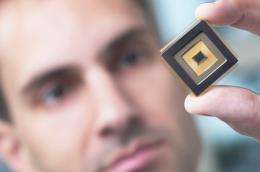
Royal Philips Electronics today announced that its scientists have developed a highly innovative digital silicon photomultiplier technology that will allow faster and more accurate photon (the basic quantum unit of light) counting in a wide range of applications where ultra-low light levels need to be measured.
Areas where the new technology could have a major impact include medical imaging, in particular positron emission tomography (PET), and in-vitro diagnostic tests such as DNA sequencing and protein/DNA microarrays. Other relevant areas include high-energy physics, night-vision systems and other applications that currently use light detectors that are based on so-called photomultiplier tubes.
As with virtually all 'solid-state' alternatives, this new digital silicon photomultiplier technology should enable the production of smaller and lighter battery-powered equipment for use in areas such as medical diagnostics and surveillance.
The unprecedented performance of Philips' prototype detector, in terms of its speed and dark count level (background noise), will be presented at the IEEE Nuclear Science Symposium and Medical Imaging Conference, which will take place on October 25-31 in Orlando, Florida, USA. Other important features of this new light detection technology include its robustness, low power consumption, light detection efficiency, and very high level of integration of the optical detection and associated electronic components.
"Silicon photomultipliers have many advantages over photomultiplier tubes in terms of size, weight, reliability, maintenance, power consumption and supply voltage. It is expected that the photomultiplier world very soon will be converted to silicon," explained Prof. dr. ir. Albert J. P. Theuwissen, professor at the Delft University of Technology, the Netherlands, and a leading digital imaging expert. "The scientists at Philips have obtained ground-breaking results with their R&D work in the new field of silicon photomultipliers. For instance, as far as dark counts are concerned, they have set a world record with their prototype devices."
"Solid-state digital technology has already taken over from outdated analog solutions in every-day applications such as TVs, camcorders and photography," says Rob Ballizany, Vice President of Philips Corporate Technologies and responsible for the commercialization of this new technology. "Based on my many years experience of successfully switching the photographic industry from analog to digital, I am convinced that high-end professional applications such as medical imaging will undergo a similar switch to digital detectors in the next few years."
The key to Philips' breakthrough lies in its ability to combine high quality single-photon detectors (silicon avalanche photodiodes) with low-voltage CMOS logic on the same silicon substrate. Moreover, these revolutionary new silicon photomultipliers can be manufactured using a conventional CMOS process technology.
Given the multidisciplinary nature of many of today's products and businesses, partnerships are the only way to successfully make progress. Bringing together such partnerships is one of the underlying principles behind Philips' policy of open innovation. Philips is actively looking for development partners with application expertise to fully exploit the market potential of its new digital silicon photomultiplier technology.
Provided by Royal Philips Electronics


