Inside the First Bird, Surprising Signs of a Dinosaur
(PhysOrg.com) -- The raptor-like Archaeopteryx has long been viewed as the archetypal first bird, but new research reveals that it was actually a lot less “bird-like” than scientists had believed.
In fact, the landmark study led by paleobiologist Gregory M. Erickson of The Florida State University has upended the iconic first-known-bird image of Archaeopteryx (from the Greek for “ancient wing”), which lived 150 million years ago during the Late Jurassic period in what is now Germany. Instead, the animal has been recast as more of a feathered dinosaur -- bird on the outside, dinosaur on the inside.
That’s because new, microscopic images of the ancient cells and blood vessels inside the bones of the winged, feathered, claw-handed creature show unexpectedly slow growth and maturation that took years, similar to that found in dinosaurs, from which birds evolved. In contrast, living birds grow rapidly and mature in a matter of weeks.
Also groundbreaking is the finding that the rapid bone growth common to all living birds but surprisingly absent from the Archaeopteryx was not necessary for avian dinosaur flight.
The study is published in the Oct. 9, 2009, issue of the journal PLoS One. In addition to Erickson, an associate professor in Florida State’s Department of Biological Science and a research associate at the American Museum of Natural History, co-authors include Florida State University biologist Brian D. Inouye and other U.S. scientists, as well as researchers from Germany and China.
“Living birds mature very quickly,” Erickson said. “That’s why we rarely see baby birds among flocks of invariably identical-size pigeons. Slow-growing animals such as Archaeopteryx would look foreign to contemporary bird-watchers.”
Erickson said evidence already confirms that birds are, in fact, dinosaurs. “But just how dinosaur-like -- or even bird-like -- was the first bird?” he asked. “Almost nothing had been known of Archaeopteryx biology. There has been debate as to how well it flew, if at all. Some have suggested that early bird physiology may have been very different from living birds, but no one had tested fossils that were close to the base of bird ancestry.”
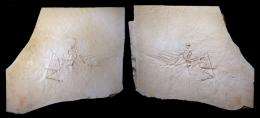
Fossilized remains of Archaeopteryx were found in Germany in 1860, one year after Charles Darwin’s “Origin of Species” was published. With its combination of bird-like features, including feathers and a wishbone, and reptilian ones -- teeth, three-fingered hands, a long bony tail -- the skeleton made evolutionary theory more credible. The 1860s evolutionist Thomas Henry Huxley saw the Archaeopteryx as a perfect transition between birds and reptiles. Erickson calls it “the poster child for evolution.”
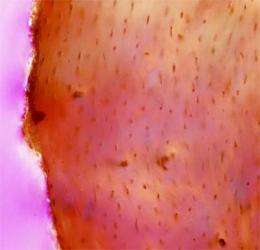
“For our study, which required tremendous collaboration, we set out to determine how Archaeopteryx grew and compare its growth to living birds, closely related non-avian dinosaurs, and other early birds that came after it,” Erickson said. “I went to Munich with my colleague Mark Norell from the American Museum of Natural History, and we met with Oliver Rauhut, curator of the Bavarian State Collection for Palaeontology and Geology, which houses a small juvenile Archaeopteryx that is one of 10 specimens discovered to date. From that specimen, we extracted tiny bone chips and then examined them microscopically.”
Surprisingly, the bones of the juvenile Archaeopteryx were not the highly vascularized, fast-growing type, as in other avian dinosaurs. Instead, Erickson found lizard-like, dense, nearly avascular bone.
“It led us to ask, ‘Did Archaeopteryx grow in a unique way?’” he said.
To explain the strange bone type, the researchers also examined different-size species of dinosaurs that were close relatives of Archaeopteryx, including Deinonychosaurs, the raptors of “Jurassic Park” fame. They then looked to colleagues in China for specimens of two of the earliest birds: Jeholornis prima, a long-tailed creature, and the short-tailed Sapeornis chaochengensi, which had three fingers and teeth.
“In the smallest dinosaur specimens, and in an early bird, we found the same bone type as in the juvenile Archaopteryx specimen,” Erickson said.
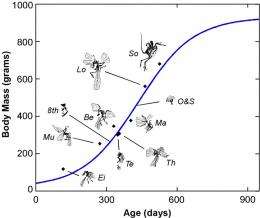
Next, the research team plugged bone formation rates into the sizes of the Archaeopteryx femora (thigh bones) to predict its rate of growth.
“We learned that the adult would have been raven-sized and taken about 970 days to mature,” Erickson said. “Some same-size birds today can do likewise in eight or nine weeks. In contrast, maximal growth rates for Archaeopteryx resemble dinosaur rates, which are three times slower than living birds and four times faster than living reptiles.
“From these findings, we see that the physiological and metabolic transition into true birds occurred millions of years after Archaeopteryx,” he said. “But, perhaps equally important, we’ve shown that avians were able to fly even with dinosaur physiology.”
Inouye added, “Our data on dinosaur growth rates and survivorship are bringing modern physiology and population biology to a field that has historically focused more on finding and naming fossil species.”
Provided by Florida State University (news : web)


.jpg)


