LRO Sees Apollo 14's Rocket Booster Impact Site
October 8, 2009 LRO Sees Apollo 14's Rocket Booster Impact Site

Enlarge

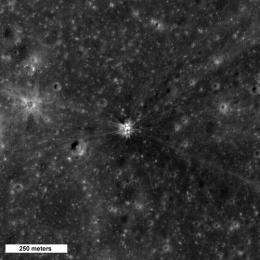
The crater in the center of this image was formed by Apollo 14's Saturn IVB booster. The booster was intentionally impacted into the lunar surface on Feb. 4, 1971. The impact caused a minor "moonquake" that scientists used to learn about the moon's interior structure. Seismometers placed on the surface by Apollo astronauts returned data on the tremor. Credit: NASA/Goddard Space Flight Center/Arizona State University

(PhysOrg.com) -- A distinctive crater about 35 meters (115 feet) in diameter was formed when the Apollo 14 Saturn IVB (upper stage) was intentionally impacted into the moon. The energy of the impact created small tremors that were measured by the seismometer placed on the Moon by Apollo 12 astronauts in 1969.

The interior of the crater has bright mounds, and a bright ejecta blanket surrounds the exterior of the crater. Bright rays are observed to extend across the surface for more than 1.5 km (0.9 miles) from the impact. This LROC image was taken when the sun was relatively high in the sky, bringing out subtle differences in reflectivity or brightness. Scientists noted the unusual occurrence of dark and bright rays when the Apollo 16 observed the site.

The upcoming impact into the crater Cabeus will also be used to probe the lunar subsurface. The Apollo 14 impact was used to send vibrations through the surface to help scientists study the internal structure of the lunar crust, whereas the LCROSS impact will throw debris up into space so a trailing spacecraft and Earth-based telescopes can analyze its composition.

The Apollo impact velocity was at 5,682 mph. The booster component weighed 30,835 lbs at the time of impact, and the impact energy was equivalent to just over 10 tons of TNT. A placed in 1969 by Apollo 12 astronauts recorded the vibrations, which lasted for about three hours. The LCROSS impactor (the upper stage of a Centaur rocket) is much smaller than the S-IVB and thus will make a smaller crater. The Centaur weighs about 4,409 lbs and will hit with a velocity of about 5,592 mph.

Provided by JPL/NASA (news : web)


print this article email this article download pdf blog this article bookmark this article     Stumble it Digg this share on Facebook retweet share on Reddit add to delicious
Rate this story - 4.8 /5 (6 votes)

Rank Filter

Move the slider to adjust rank threshold, so that you can hide some of the comments.


Display comments: newest first

  • nxtr - Oct 08, 2009
    • Rank: not rated yet
    15 tons of metal moving at 5600 MPH. Too bad hollywood couldn't have set a camera there to capture it in slo mo. Would have been very cool to watch.

October 8, 2009 all stories

Comments: 1

4.8 /5 (6 votes)
  • Stumble this up

  • Digg this

  • share this

  • hide
  • Related Stories

  • NASA launches LCROSS Lunar Impactor
    created Jun 19, 2009 | popularity not rated yet | comments 0
  • Apollo 12 and Surveyor 3
    created Sep 03, 2009 | popularity not rated yet | comments 0
  • LCROSS Selects Crater with Best Chance of Finding Water
    created Sep 08, 2009 | popularity not rated yet | comments 0
  • NASA's LCROSS Mission Changes Impact Crater
    created Sep 29, 2009 | popularity not rated yet | comments 0
  • NASA Moon-Impactor Mission Passes Major Review
    created Feb 02, 2007 | popularity not rated yet | comments 0


  • hide
  • Relevant PhysicsForums posts

  • Question about 2-body gravity
    created Nov 24, 2009
  • life on Mars
    created Nov 24, 2009
  • Semi-major axis from cartesian co-ordinates
    created Nov 23, 2009
  • Primary Mirror grinding
    created Nov 23, 2009
  • More from Physics Forums - General Astronomy

Other News

Monster Waves on the Sun are Real

Monster Waves on the Sun are Real (w/ Video)

Space & Earth / Astronomy

created 8 hours ago | popularity 5 / 5 (9) | comments 1

Sometimes you really can believe your eyes. That's what NASA's STEREO (Solar Terrestrial Relations Observatory) spacecraft are telling researchers about a controversial phenomenon on the sun known as the "solar ...


Cosmic 'dig' reveals vestiges of the Milky Way's building blocks

Cosmic 'Dig' Reveals Vestiges of the Milky Way's Building Blocks

Space & Earth / Astronomy

created 13 hours ago | popularity 4.9 / 5 (14) | comments 1

(PhysOrg.com) -- Peering through the thick dust clouds of our galaxy's "bulge" (the myriads of stars surrounding its center), a team of astronomers has unveiled an unusual mix of stars in the stellar grouping ...


No Wheel Stall in Diagnostic Drive

Spirit Mars Rover: No Wheel Stall in Diagnostic Drive

Space & Earth / Space Exploration

created 9 hours ago | popularity 4.5 / 5 (2) | comments 0

(PhysOrg.com) -- On Sol 2095 (Tuesday, Nov. 24), Spirit performed a set of diagnostic actions related to a stall of the right-rear wheel on the previous drive, three days earlier.


Climate experts debate strategies for reducing atmospheric carbon and future warming

Climate experts debate strategies for reducing atmospheric carbon and future warming

Space & Earth / Environment

created 9 hours ago | popularity 2.8 / 5 (6) | comments 8

(PhysOrg.com) -- Reducing carbon dioxide to safe levels may require extracting carbon from the air, says Cornell climate researcher.


Oceanic crust formation is dynamic after all

Oceanic crust formation is dynamic after all

Space & Earth / Earth Sciences

created 12 hours ago | popularity 4.6 / 5 (5) | comments 0

Imagine the Earth's crust as the planet's skin: Some areas are old and wrinkled while others have a fresher, more youthful sheen, as if they had been regularly lathered with lotion.