Kraken becomes first academic machine to achieve petaflop
October 8, 2009 Kraken becomes first academic machine to achieve petaflop

Enlarge

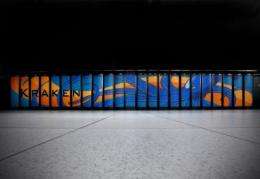
This is the newly upgraded Kraken supercomputer, capable of a peak performance of more than one petaflop Credit: The University of Tennessee and Oak Ridge National Laboratory

The National Institute for Computational Sciences' (NICS's) Cray XT5 supercomputer—Kraken—has been upgraded to become the first academic system to surpass a thousand trillion calculations a second, or one petaflop, a landmark achievement that will greatly accelerate science and place Kraken among the top five computers in the world.

Managed by the University of Tennessee (UT) for the National Science Foundation (NSF), the system came online Oct. 5 with a peak performance of 1.03 petaflops. It features more than 16,000 six-core 2.6-GHz AMD Istanbul processors with nearly 100,000 compute cores.

In addition, an upgrade to 129 terabytes of memory (the equivalent of more than 13 thousand movies on DVD) effectively doubles the size of Kraken for researchers running some of the world's most sophisticated 3-D scientific computing applications. Simulation has become a key tool for researchers in a number of fields, from climate change to materials.

"At over a petaflop of peak , and the ability to routinely run full machine jobs, Kraken will dominate large-scale NSF computing in the near future," said NICS Project Director Phil Andrews. "Its unprecedented computational capability and total available memory will allow academic users to treat problems that were previously inaccessible."

For example, understanding the mechanism behind the explosion of core-collapse supernovas will reveal much about our universe (these cataclysmic events are responsible for more than half the elements in the universe). Essentially three phenomena are being simulated to explore these explosions: hydrodynamics, nuclear burning or fusion, and neutrino transport, said UT astrophysicist Bronson Messer.

At the terascale, or trillions of calculations per second, Messer and his team were forced to simulate the star in 1-D as a perfect sphere and with unrealistic fusion physics. "Now, however, we are getting closer to physical reality," said Messer. "With petascale capability, we can simulate all three phenomena simultaneously with significant realism. This brings us closer to understanding the explosion mechanism and being able to make meaningful predictions."

From the physical makeup of the universe to the causes of global warming to the roles of proteins in disease, Kraken's increased computing muscle will reach far and wide.

As the main computational resource for NICS, the new system is linked to the NSF-supported TeraGrid, a network of supercomputers across the country that is the world's largest computational platform for open scientific research.

The system and the resulting NICS organization are the result of an NSF Track 2 award of $65 million to the University of Tennessee and its partners to provide for next-generation high-performance computing (HPC). The award was won in an open competition among HPC institutions vying to guarantee America's continued competitiveness through the next generation of supercomputers (systems greater than 10 teraflops and into the petascale).

"While reaching the petascale is a remarkable achievement in itself, the real strides will be made in the new science that petascale computing will enable," said Thomas Zacharia, NICS principal investigator, professor in electrical and computer engineering at the University of Tennessee and deputy director for science and technology at Oak Ridge National Laboratory. "Kraken is a game changer for research."

Source: National Institute for Computational Sciences


print this article email this article download pdf blog this article bookmark this article     Stumble it Digg this share on Facebook retweet share on Reddit add to delicious
Rate this story - 4.7 /5 (3 votes)


October 8, 2009 all stories

Comments: 0

4.7 /5 (3 votes)
  • Stumble this up

  • Digg this

  • share this

  • hide
  • Related Stories

  • Jaguar upgrade brings ORNL closer to petascale computing
    created May 15, 2008 | popularity not rated yet | comments 0
  • ORNL Jaguar supercomputer surpasses 50 teraflops
    created Aug 25, 2006 | popularity not rated yet | comments 0
  • DOE's Oak Ridge supercomputer now world's fastest for open science
    created Nov 10, 2008 | popularity not rated yet | comments 0
  • New Supercomputing Center in Pittsburgh
    created Sep 29, 2004 | popularity not rated yet | comments 0
  • Oak Ridge supercomputer is the world's fastest for science
    created Nov 17, 2008 | popularity not rated yet | comments 0


  • hide
  • Relevant PhysicsForums posts

  • Aspiring Engineering major looking for general answers
    created Nov 19, 2009
  • Calculating max load of square tube (steel)
    created Nov 19, 2009
  • Passive Chemical Heating
    created Nov 19, 2009
  • Shortening Boat Trailer
    created Nov 18, 2009
  • More from Physics Forums - General Engineering

Other News

Qualcomm's next e-book to use a mirasol display

Qualcomm's next e-book to use a mirasol display

Electronics / Consumer & Gadgets

created Nov 20, 2009 | popularity 4.7 / 5 (10) | comments 2

(PhysOrg.com) -- Qualcomm subsidiary Mirasol is developing a new e-book reader with a color display that uses ambient light. The reader will be capable of displaying video smoothly, but the new features will ...


'Rationalizer' bracelet tells traders when they're stressed

'Rationalizer' bracelet tells traders when they're stressed

Electronics / Consumer & Gadgets

created Nov 17, 2009 | popularity 4.3 / 5 (6) | comments 4

(PhysOrg.com) -- Philips Electronics and the Dutch bank ABN AMRO have joined forces to develop a "Rationalizer" bracelet system that detects stress levels and displays a warning to help day-traders avoid making ...


Oak Ridge 'Jaguar' supercomputer is World's fastest

Oak Ridge 'Jaguar' supercomputer is World's fastest

Electronics / Hardware

created Nov 16, 2009 | popularity 4.5 / 5 (13) | comments 2

An upgrade to a Cray XT5 high-performance computing system deployed by the Department of Energy has made the "Jaguar" supercomputer the world's fastest. Located at Oak Ridge National Laboratory, Jaguar is ...


New study to evaluate robots as exercise trainers (w/ Video)

Electronics / Robotics

created Nov 19, 2009 | popularity not rated yet | comments 0

Maja Mataric', who directs the University of Southern California Center for Robotics and Embedded Systems, will lead an effort to evaluate robots as exercise coaches for adults of all ages, with a particular focus on the ...


Review: $100 Palm Pixi is stylish but sluggish (AP)

Review: $100 Palm Pixi is stylish but sluggish

Electronics / Consumer & Gadgets

created Nov 18, 2009 | popularity 1 / 5 (1) | comments 0

(AP) -- Palm Inc. is fighting harder than ever to snag a chunk of the smart phone market, and just six months after releasing the stylish Pre it's back with a lighter, more petite and affordable version called ...