Liver cells grown from patients' skin cells
October 8, 2009
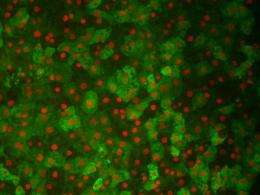
These are liver cells generated from skin that are shown to make human liver proteins Albumin in green and HNF4 in red. Credit: Medical College of Wisconsin
Scientists at The Medical College of Wisconsin in Milwaukee have successfully produced liver cells from patients' skin cells opening the possibility of treating a wide range of diseases that affect liver function. The study was led by Stephen A. Duncan, D. Phil., Marcus Professor in Human and Molecular Genetics, and professor of cell biology, neurobiology and anatomy, along with postdoctoral fellow Karim Si-Tayeb, Ph.D., and graduate student Ms. Fallon Noto.
"This is a crucial step forward towards developing therapies that can potentially replace the need for scarce liver transplants, currently the only treatment for most advanced liver disease," says Dr. Duncan.
Liver disease is the fourth leading cause of death among middle aged adults in the United States. Loss of liver function can be caused by several factors, including genetic mutations, infections with hepatitis viruses, by excessive alcohol consumption, or chronic use of some prescription drugs. When liver function goes awry it can result in a wide variety of disorders including diabetes and atherosclerosis and in many cases is fatal.
The Medical College research team generated patient-specific liver cells by first repeating the work of James Thomson and colleagues at University of Wisconsin-Madison who showed that skin cells can be reprogrammed to become cells that resemble embryonic stem cells. They then tricked the skin-derived pluripotent stem cells into forming liver cells by mimicking the normal processes through which liver cells are made during embryonic development. Pluripotent stem cells are so named because of their capacity to develop into any one of eh more than 200 cell types in the human body.
At the end of this process, the researchers found that they were able to very easily produce large numbers of relatively pure liver cells in laboratory culture dishes. "We were excited to discover that the liver cells produced from human skin cells were able to perform many of the activities associated with healthy adult liver function and that the cells could be injected into mouse livers where they integrated and were capable of making human liver proteins," says Dr. Duncan.
Several studies have shown that liver cells generated from embryonic stem cells could potentially be used for therapy. However, the possible use of such cells is limited by ethical considerations associated with the generation of embryonic stem cells from preimplantation embryos and the fact that embryonic stem cells do not have the same genetic make-up as the patient.
Although the investigations are still at an early stage the researchers believe that the reprogrammed skin cells could be used to investigate and potentially treat metabolic liver disease. The liver may be particularly suitable for stem-cell based therapies because it has a remarkable capacity to regenerate. It is interesting to note that the regenerative nature of the liver was referenced in the ancient Greek tale of Prometheus. When Prometheus was caught stealing the gift of fire from Zeus, he was punished by having his liver eaten daily by an eagle. This provided the eagle with an everlasting meal because each night the liver of Prometheus would re-grow.
The liver is a central regulator of the body's metabolism and is responsible for controlling sugar and cholesterol levels, secretion of a variety of hormones, production of blood clotting factors, and has an essential role in preventing toxins from damaging other organs in the body.
It is possible that in the future a small piece of skin from a patient with loss of liver function could be used to produce healthy liver cells, replacing the diseased liver with normal tissue.
Recently, the National Institutes of Health's National Institute of Diabetes and Digestive and Kidney Diseases through the American Recovery and Reinvestment Act have provided the MCW researchers, in collaboration with Markus Grompe, M.D., at the Oregon Health and Science University, a $1 million research grant to pursue the possibility of using reprogrammed skin cells to study and treat metabolic liver disease. Using this support, as well as donations from individuals throughout Milwaukee, the Medial College researchers are currently producing reprogrammed cells from patients suffering from diabetes, hyperlipidemia, and hypercholesterolemia in an effort to identify new treatments for these diseases.
-
Stem cells with potential to regenerate injured liver tissue identified
Nov 12, 2008 |
not rated yet |
0
-
Stem cells speed growth of healthy liver tissue
Mar 27, 2007 |
not rated yet |
0
-
Frog provides insight into making specialised cells from stem cells
Aug 27, 2006 |
not rated yet |
0
-
Italians report stem-cell advances
Sep 06, 2006 |
not rated yet |
0
-
Liver regeneration may be simpler than previously thought
Apr 11, 2007 |
not rated yet |
0
-
Engineers build first sub-10-nm carbon nanotube transistor
Feb 01, 2012 |
4.9 / 5 (33) |
30
-
Something old, something new: Evolution and the structural divergence of duplicate genes
Jan 31, 2012 |
4.6 / 5 (7) |
1
-
The hidden nanoworld of ice crystals: Revealing the dynamic behavior of quasi-liquid layers
Jan 30, 2012 |
5 / 5 (4) |
1
-
Stock market network reveals investor clustering
Jan 27, 2012 |
3.9 / 5 (23) |
8
-
Of microchemistry and molecules: Electronic microfluidic device synthesizes biocompatible probes
Jan 26, 2012 |
5 / 5 (2) |
0
-
Is Everyday Technology Killing Us?
Feb 08, 2012
-
Exercise and weight loss
Feb 08, 2012
-
Why do we have head aches? Our brains can't feel anything.
Feb 07, 2012
-
"The end of diseases" by David Agus, interview from Daily Show with Jon Stewart
Feb 04, 2012
-
Oncolytic adenovirus
Feb 04, 2012
-
Nutrition label stuffs and diets
Feb 02, 2012
- More from Physics Forums - Medical Sciences
More news stories
Overeating may double risk of memory loss
New research suggests that consuming between 2,100 and 6,000 calories per day may double the risk of memory loss, or mild cognitive impairment (MCI), among people age 70 and older. The study was released today and will be ...
Medicine & Health / Neuroscience
3 hours ago |
5 / 5 (2) |
0
|
Starve a virus, feed a cure? Findings show how some cells protect themselves against HIV
A protein that protects some of our immune cells from the most common and virulent form of HIV works by starving the virus of the molecular building blocks that it needs to replicate, according to research published online ...
6 hours ago |
5 / 5 (1) |
0
|
Declining health-care productivity in England: Who says so?
Reports that the National Health Service in England has been declining in productivity in the last decade appear to have been accepted as fact. However, a Viewpoint published Online First by The Lancet disputes this. The Vi ...
1 hour ago |
not rated yet |
0
Injured boomers beware: Know when to see doctor
(AP) -- It happened to nurse Jane Byron years after an in-line skating fall, business owner Haralee Weintraub while doing "men's" push-ups, and avid cyclist Gene Wilberg while lifting a heavy box.
8 hours ago |
5 / 5 (1) |
0
FDA-approved drug rapidly clears amyloid from the brain, reverses Alzheimer's symptoms in mice
Neuroscientists at Case Western Reserve University School of Medicine have made a dramatic breakthrough in their efforts to find a cure for Alzheimer's disease. The researchers' findings, published in the journal Science, show t ...
Medicine & Health / Neuroscience
Feb 09, 2012 |
4.9 / 5 (58) |
17
|
Scientists discover molecular secrets of 2,000-year-old Chinese herbal remedy
For roughly two thousand years, Chinese herbalists have treated Malaria using a root extract, commonly known as Chang Shan, from a type of hydrangea that grows in Tibet and Nepal. More recent studies suggest that halofuginone, ...
New method to examine batteries -- MRI from the inside
There is an ever-increasing need for advanced batteries for portable electronics, such as phones, cameras, and music players, but also to power electric vehicles and to facilitate the distribution and storage of energy derived ...
A mitosis mystery solved: How chromosomes align perfectly in a dividing cell
Although the process of mitotic cell division has been studied intensely for more than 50 years, Whitehead Institute researchers have only now solved the mystery of how cells correctly align their chromosomes during symmetric ...
Lab study raises questions over nano-particle impact
Tests involving chickens have raised questions about the impact on health from engineered nano-particles, the ultra-fine grains commonly used in drugs and processed foods, scientists said on Sunday.
Google might launch Drive for cloud storage soon
(PhysOrg.com) -- Google's next big move, according to the Wall Street Journal, is a cloud storage service called Drive. Hardly first to the plate, Google is simply catching up to introducing its cloud reposi ...
Researchers find extensive RNA editing in human transcriptome
In a new study published online in Nature Biotechnology, researchers from BGI, the world's largest genomics organization, reported the evidence of extensive RNA editing in a human cell line by analysis of RNA-seq data, demons ...