NASA probes hit moon twice (Update 2)
October 9, 2009 NASA to moon: Get ready because here we come (AP)

Enlarge

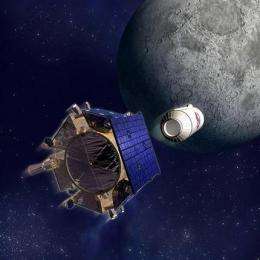
This artist's rendering provided by NASA via Brown University shows the Centaur upper stage rocket separating from its shepherding spacecraft on a trajectory toward the moon. On Friday, Oct. 9, 2009, NASA will crash the Lunar Crater Observation and Sensing Satellite, or LCROSS, into a crater on the moon’s south pole to search for evidence of water ice. (AP Photo/NASA)

NASA's Lunar Crater Observation and Sensing Satellite, or LCROSS, created twin impacts on the moon's surface early Friday in a search for water ice. Scientists will analyze data from the spacecraft's instruments to assess whether water ice is present.

The satellite traveled 5.6 million miles during an historic 113-day mission that ended in the Cabeus crater, a permanently shadowed region near the moon's south pole. The spacecraft was launched June 18 as a companion mission to the Lunar Reconnaissance Orbiter from NASA's Kennedy Space Center in Florida.

"The science instruments worked exceedingly well and returned a wealth of data that will greatly improve our understanding of our closest celestial neighbor," said Anthony Colaprete, LCROSS principal investigator and project scientist at NASA's Ames Research Center in Moffett Field, Calif. "The team is excited to dive into data."

In preparation for impact, LCROSS and its spent Centaur upper stage rocket separated about 54,000 miles above the surface of the on Thursday at approximately 6:50 p.m. PDT.

Moving at a speed of more than 1.5 miles per second, the Centaur hit the lunar surface shortly after 4:31 a.m. Oct. 9, creating an impact that instruments aboard LCROSS observed for approximately four minutes. LCROSS then impacted the surface at approximately 4:36 a.m.

"This is a great day for science and exploration," said Doug Cooke, associate administrator for the Exploration Systems Mission Directorate at NASA Headquarters in Washington. "The LCROSS data should prove to be an impressive addition to the tremendous leaps in knowledge about the moon that have been achieved in recent weeks. I want to congratulate the LCROSS team for their tremendous achievement in development of this low cost and for their perseverance through a number of difficult technical and operational challenges."

Other observatories reported capturing both impacts. The data will be shared with the LCROSS science team for analysis. The LCROSS team expects it to take several weeks of analysis before it can make a definitive assessment of the presence or absence of water ice.
NASA probe hits moon south pole looking for water
Enlarge

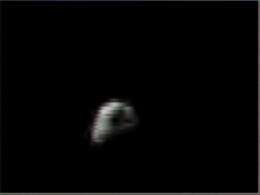
Image of the Centaur separation as viewed from the infrared camera. LCROSS Centaur Separation occurred at 9:50 p.m. EDT (6:50 p.m. PDT), Oct. 8. After separation, the spacecraft performed a 180 degree pitch maneuver (turning around) to reorient the LCROSS science payload towards the receding Centaur. Credit: NASA

"I am very proud of the success of this LCROSS mission team," said Daniel Andrews, LCROSS project manager at Ames. "Whenever this team would hit a roadblock, it conceived a clever work-around allowing us to push forward with a successful mission."

The images and video collected by the amateur astronomer community and the public also will be used to enhance our knowledge about the moon.

"One of the early goals of the mission was to get as many people to look at the LCROSS impacts in as many ways possible, and we succeeded," said Jennifer Heldmann, Ames' coordinator of the LCROSS observation campaign. "The amount of corroborated information that can be pulled out of this one event is fascinating."

"It has been an incredible journey since LCROSS was selected in April 2006," said Andrews. "The LCROSS Project faced a very ambitious schedule and an uncommonly small budget for a mission of this size. LCROSS could be a model for how small robotic missions are executed. This is truly big science on a small budget."

More information: NASA's LCROSS site: http://www.nasa.gov/lcross

Provided by JPL/ (news : web)


print this article email this article download pdf blog this article bookmark this article     Stumble it Digg this share on Facebook retweet share on Reddit add to delicious
Rate this story - 4.4 /5 (7 votes)

Rank Filter

Move the slider to adjust rank threshold, so that you can hide some of the comments.


Display comments: newest first

  • omatumr - Oct 09, 2009
    • Rank: 3.5 / 5 (4)
    It looks crude, . . .

    But perhaps the experiment will release water that could not be detected in the lunar samples that we already have here.

    With kind regards,
    Oliver K. Manuel
  • probes - Oct 09, 2009
    • Rank: 4 / 5 (2)
    Yes, I agree completely with Oliver K. Manuel.
  • Bob_Kob - Oct 09, 2009
    • Rank: 3.5 / 5 (2)
    How so? Couldn't the people in the apollo program have done the same thing by digging the dirt?
  • Egnite - Oct 09, 2009
    • Rank: 1.5 / 5 (2)
    I doubt it. The gravity was so low they couldn't even play golf so swinging a pick would be pretty useless and I doubt they had the drilling tech back then as we do now.
  • RobertKLR - Oct 09, 2009
    • Rank: 5 / 5 (2)
    Sometimes it seems that NASA's public relations and public information services are like a children's show.
  • deatopmg - Oct 09, 2009
    • Rank: 5 / 5 (1)
    "But the big live public splash people anticipated didn't quite happen. Screens got fuzz and no immediate pictures of the crash or the six-mile plume of lunar dust that the mission was all about. The public, which followed the crashes on the Internet and at observatories, seemed puzzled." plus only pictures AT impact were released during the 10:00 am conference, which was mostly PR and rah rah for our side and the groups that helped us.
    No wonder the public is skeptical of the agencies motives. RobertKLR hit the nail on the head.
  • RayCherry - Oct 09, 2009
    • Rank: 5 / 5 (1)
    The LRO will give us some "nice pics" of the new crater in the next few weeks. Hopefully it will be enough to sate public curiousity until the science is ready to be published.
  • probes - Oct 09, 2009
    • Rank: 1 / 5 (1)
    Yes, I for one am very exited about seeing this new, thousand mile wide crater. And all full of water! But, its too dark for LRO to see it?
  • otto1923 - Oct 09, 2009
    • Rank: not rated yet
    This was a cheap mission and a good way to prospect. We ought to hit it again and again. Use nukes- why not? okok, deep penetrator bunker busters then. Lets see whats there.
  • croghan27 - Oct 09, 2009
    • Rank: 3 / 5 (2)
    They have awakened the moon monster.


    and she is pissed?
  • Digi - Oct 10, 2009
    • Rank: 3.7 / 5 (3)
    The follow up conference was difficult to watch. It was mostly self congratulatory back patting and 'what a wonderful team we all are'. I had to switch it off since they obviously wouldn't or couldn't discuss any prelim results. I am looking forward to the news in a few weeks though.

October 9, 2009 all stories

Comments: 11

4.4 /5 (7 votes)
  • Stumble this up

  • Digg this

  • share this

  • hide
  • Related Stories


  • hide
  • Relevant PhysicsForums posts

  • Sideral question
    created 19 hours ago
  • Doppler shifted blackbody spectrum
    created 22 hours ago
  • Earth v. Moon
    created Nov 21, 2009
  • help me with coordinates and orbits
    created Nov 21, 2009
  • basic 'our universe' question..
    created Nov 20, 2009
  • deriving keplers law
    created Nov 19, 2009
  • More from Physics Forums - General Astronomy

Other News

Baby can wait as expectant dad finishes spacewalk (AP)

Baby can wait as expectant dad finishes spacewalk

Space & Earth / Space Exploration

created 11 hours ago | popularity 3 / 5 (2) | comments 0

(AP) -- A spacewalking astronaut put aside the impending birth of his daughter and blazed through his first-ever venture outside the International Space Station on Saturday.


Unseasonably hot and dry weather combined with strong winds to fan scores of blazes in the country's southeastern states

Australia issues 'catastrophic' alerts as fires rage

Space & Earth / Environment

created 17 hours ago | popularity 4 / 5 (3) | comments 0

Australia has issued "catastrophic" alerts after record-breaking temperatures and wild lightning storms sparked more than 100 fires across the country, officials said Saturday.


Commuters wait on the platform shrouded by fog in London

Climate change not man-made, say majority of Britons: poll

Space & Earth / Environment

created Nov 15, 2009 | popularity 3.3 / 5 (15) | comments 46

Less than half of Britons believes that human activity is to blame for global warming, according to a poll carried out for The Times newspaper and published on Saturday.


Mysteriously warm times in Antarctica

Mysteriously warm times in Antarctica

Space & Earth / Earth Sciences

created Nov 18, 2009 | popularity 4.2 / 5 (21) | comments 28

(PhysOrg.com) -- A new study of Antarctica's past climate reveals that temperatures during the warm periods between ice ages (interglacials) may have been higher than previously thought. The latest analysis ...


UN: Fight climate change with free condoms (AP)

UN: Fight climate change with free condoms

Space & Earth / Environment

created Nov 18, 2009 | popularity 3.1 / 5 (11) | comments 24

(AP) -- The battle against global warming could be helped if the world slowed population growth by making free condoms and family planning advice more widely available, the U.N. Population Fund said Wednesday.