Climate talks ending with rich-poor rift wide open
October 9, 2009 by Marlowe Hood The key stumbling blocks are how to share out the job of slashing greenhouse gases

Enlarge

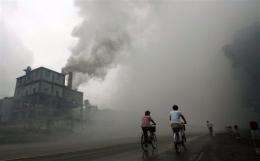
Chinese cyclists passes through thick pollution from a factory. Two weeks of crucial UN climate talks were due to conclude after exposing huge rifts between rich and poor nations, just weeks ahead of the deadline for sealing a planet-saving global deal.

Two weeks of crucial UN climate talks were due to conclude Friday after exposing huge rifts between rich and poor nations, just weeks ahead of the deadline for sealing a planet-saving global deal.

Only five negotiating days remain, in November, before 192 nations converge for a critical December showdown in Copenhagen, where they have pledged to conclude a treaty to tackle global warming.

Without rapid action, scientists say, the world faces catastrophe in the form of drought, flooding, famine and forced migration.

"My feeling is that the ball, immediately, is in the developed country court to make it clearer what they are looking for," said Malta's Michael Cutajar, co-chair of the UN Framework Convention on Climate Change (UNFCCC) talks.

A few minutes later at a separate press conference, US negotiator Jonathan Pershing countered, "I think the ball is in the court of all countries".

He highlighted a key demand from rich countries that emerging giants such as China, India and Brazil commit to binding actions on climate.

"We are at a critical stage with major issues unresolved," said Martin Khor, executive director of the South Centre, a Geneva-based think-tank aligned with developing world positions.

"If there is no improvement in the divisions, the prospects are certainly not bright for an outcome in Copenhagen that is ambitious environmentally, and equitable from a social point of view," he said.

The key stumbling blocks are how to share out the job of slashing the heat-trapping greenhouse gases, and how much money wealthy nations will cough up to help developing ones fight climate change and cope with its impacts.

"At the end of the day, if you don't have ambitious (emissions) targets from rich nations, and if you don't have significant finance on the table, the whole thing falls apart," said Yvo de Boer, the UN's top climate official.

But even as Bangkok inched from procedure to substance, negotiators on both sides of the issues agreed the expert-level dialogue will remain blocked without strong input from world leaders between now and December.

"This is not the only game in town," said de Boer, referring to the UNFCCC, of which he is Executive Secretary.

Expectations are high for a second world leaders' summit on climate before Copenhagen, following a September gathering at the UN in New York, but no dates have been announced.

The looming question of how the United States will fit into any new agreement has dominated the Bangkok meeting, with Pershing making clear that Washington will never join the Kyoto Protocol.

Kyoto legally binds 37 industrialised countries to cut output by a total of more than five percent before 2012 compared to 1990 levels.

This forces the issue of whether to scrap Kyoto and fold some of its provisions into a new accord, or to expand its provisions for another five or seven years while cutting a separate deal for the US.

"A single instrument is more coherent, and for that reason is preferable," said Elliot Diringer, Vice President of the Washington-based Pew Center on Global .

But developing nations -- especially India and China -- expressed deep alarm in Bangkok at what they saw as a shift away from Kyoto toward a US proposal for a "bottom-up" approach, in which countries submit national plans to outside verification.

"The European Union, which was the most loyal to the Protocol up to now -- seems to be wavering. If they jump ship, Kyoto will be an empty shell," said Khor.

(c) 2009 AFP


print this article email this article download pdf blog this article bookmark this article     Stumble it Digg this share on Facebook retweet share on Reddit add to delicious
Rate this story - 2.6 /5 (5 votes)

Rank Filter

Move the slider to adjust rank threshold, so that you can hide some of the comments.


Display comments: newest first

  • GrayMouser - Oct 13, 2009
    • Rank: 2 / 5 (1)
    But developing nations -- especially India and China -- expressed deep alarm in Bangkok at what they saw as a shift away from Kyoto toward a US proposal for a "bottom-up" approach, in which countries submit national plans to outside verification.

    Both China and India can't be considered non-industrialized nations (though because of the large populations they have a lower per-capita standard of living than Europe and North America.) They have large gaps between the richest and poorest segments of society. Another country with this gap is Mexico, with the highest number of billionaires around.

October 9, 2009 all stories

Comments: 1

2.6 /5 (5 votes)
  • Stumble this up

  • Digg this

  • share this

  • hide
  • Related Stories

  • Climate: What's to become of the Kyoto Protocol?
    created Oct 07, 2009 | popularity not rated yet | comments 0
  • US in spotlight as UN climate talks resume
    created Mar 29, 2009 | popularity not rated yet | comments 0
  • Climate talks resume in Bangkok with deal in doubt
    created Sep 26, 2009 | popularity not rated yet | comments 0
  • U.N. climate change talks open in Montreal
    created Nov 28, 2005 | popularity not rated yet | comments 0
  • US more optimistic about climate deal after talks
    created Apr 28, 2009 | popularity not rated yet | comments 0


  • hide
  • Relevant PhysicsForums posts

  • The IPCC and the term "most"
    created Nov 23, 2009
  • Is global warming a fact?
    created Nov 23, 2009
  • Random variability of wind patterns
    created Nov 23, 2009
  • Record precipitation in the UK
    created Nov 22, 2009
  • More from Physics Forums - Earth

Other News

Cosmic 'dig' reveals vestiges of the Milky Way's building blocks

Cosmic 'Dig' Reveals Vestiges of the Milky Way's Building Blocks

Space & Earth / Astronomy

created 9 hours ago | popularity 4.9 / 5 (12) | comments 1

(PhysOrg.com) -- Peering through the thick dust clouds of our galaxy's "bulge" (the myriads of stars surrounding its center), a team of astronomers has unveiled an unusual mix of stars in the stellar grouping ...


No Wheel Stall in Diagnostic Drive

Spirit Mars Rover: No Wheel Stall in Diagnostic Drive

Space & Earth / Space Exploration

created 5 hours ago | popularity 5 / 5 (1) | comments 0

(PhysOrg.com) -- On Sol 2095 (Tuesday, Nov. 24), Spirit performed a set of diagnostic actions related to a stall of the right-rear wheel on the previous drive, three days earlier.


Monster Waves on the Sun are Real

Monster Waves on the Sun are Real (w/ Video)

Space & Earth / Astronomy

created 4 hours ago | popularity 5 / 5 (8) | comments 0

Sometimes you really can believe your eyes. That's what NASA's STEREO (Solar Terrestrial Relations Observatory) spacecraft are telling researchers about a controversial phenomenon on the sun known as the "solar ...


Oceanic crust formation is dynamic after all

Oceanic crust formation is dynamic after all

Space & Earth / Earth Sciences

created 8 hours ago | popularity 4.3 / 5 (3) | comments 0

Imagine the Earth's crust as the planet's skin: Some areas are old and wrinkled while others have a fresher, more youthful sheen, as if they had been regularly lathered with lotion.


Climate experts debate strategies for reducing atmospheric carbon and future warming

Climate experts debate strategies for reducing atmospheric carbon and future warming

Space & Earth / Environment

created 5 hours ago | popularity 3 / 5 (4) | comments 4

(PhysOrg.com) -- Reducing carbon dioxide to safe levels may require extracting carbon from the air, says Cornell climate researcher.