Puzzled Physicists Solve Decade-Long Discrepancies
October 9, 2009 Puzzled Physicists Solve Decade-Long Discrepancies

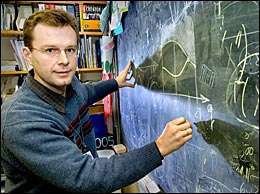
Physicist Igor Zaliznyak

(PhysOrg.com) -- A team led by physicists at the Science and Technology Facilities Council (STFC) and Brookhaven National Laboratory (BNL) have resolved a decade-long puzzle that is set to have huge implications for use of one of the most versatile classes of materials available to us for future technology applications: copper oxide ceramics. The results are published online this week in the journal Nature Physics.

Professor Toby Perring, using the ISIS source at the STFC’s Rutherford Appleton Laboratory and Dr Igor Zaliznyak from BNL have been studying the properties of copper oxide ceramics, some of the most puzzling materials ever made that serve as a grueling testing ground to our basic understanding of physics.

Comparing experimental data with predictions from exact theories and first principle calculations is one of the major parts of any scientific method, allowing scientists to make sure they have a full grasp of the basic principles at work and to study if there are gaps in our understanding. However for copper oxide ceramics, long-standing discrepancies between experiment and calculation have made it difficult to robustly identify the most promising explanations of their physical properties. Many of the copper oxide ceramics are electrically superconducting (a phenomenon occurring in certain materials that happens generally at very low temperatures characterised by exactly zero electrical resistance and the exclusion of the interior ) and also have unusual magnetic properties.

“When making comparisons between experiment and calculation, we, and others, were often finding discrepancies that were then being explained away as systematic errors, imperfections in the samples, or other effects,” said Professor Perring. “But there are only so many times you can ignore these factors before you have to work out why they are there. The answer in the end was as straightforward as making sure to include all the physics”.
Puzzled Physicists Solve Decade-Long Discrepancies
Enlarge

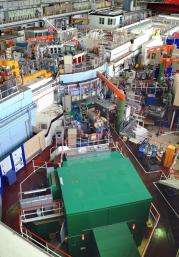
The Maps spectrometer (green, foreground) in the ISIS target 1 experimental hall.

Calculations previously had been based on copper atoms being isolated; the correct shape of the magnetism of copper atoms when part of a covalent bond (a form of chemical bonding that is characterised by the sharing of pairs of electrons between atoms, or between atoms and other covalent bonds) had not been taken into account.

Copper-oxygen-copper bonds are a common feature of the copper oxide ceramic family, with the atomic level magnetism arising from the arrangement of electrons on each copper atom. Their bonding causes the spin distribution of the electrons to be changed quite dramatically from what would be found on a single isolated copper atom.

Dr Zaliznyak from BNL said; “Normally to keep things simple, to describe the magnetism of the copper atoms, people tend to use a spin distribution based on isolated copper atoms. But in reality, the spin density must be spread out along the strong copper-oxygen covalent bonds that are part of the structure of the material and which are responsible for the remarkable in the first place.

“Once colleagues at Brookhaven had correctly calculated the real magnetic form factor for the copper atoms in this material, we found that we could get the exact match between the calculations from Jean Sebastien Caux and our neutron scattering data”.

Now the team has shown how to correctly compare theoretical models to experimental data, they are hoping that the hunt for the answer to high-temperature superconductivity in the cuprate materials can be reached more quickly.

It is widely believed that the magnetism of the copper atoms, which as this study shows is that of copper-oxygen covalent complexes, plays a vital role in superconductivity.

“Whilst we cannot sort out the differences for everyone, we think they should apply our method to their own situation. This could be a great help in narrowing down the range of possible explanations for high-temperature superconductivity”, said Perring.

It is thought that superconductivity could in the future be used for applications such as radiofrequency and microwave filters in mobile phones and powerful electromagnets used in maglev trains which use magnetic levitation from a large number of magnets for lift and propulsion, the result of which has the potential to provide faster, quieter and smoother trains.

More information: “Effect of covalent bonding on magnetism and the missing neutron intensity in compounds”, Andrew C Walters, Toby G Perring, Jean-Sébastien Caux, Andrei T Savici, Genda D Gu, Chi-Cheng Lee, Wei Ku and Igor A Zaliznyak. DOI:10.1038/NPHYS1405

Provided by Brookhaven National Laboratory (news : web)


print this article email this article download pdf blog this article bookmark this article     Stumble it Digg this share on Facebook retweet share on Reddit add to delicious
Rate this story - 4.2 /5 (31 votes)

Rank Filter

Move the slider to adjust rank threshold, so that you can hide some of the comments.


Display comments: newest first

  • wiyosaya - Oct 09, 2009
    • Rank: 2 / 5 (3)
    Fantastic discovery.

    However, I just have to say this:

    (Warning rant follows!)

    Apply the correct shape to the molecule and then you get the correct results. DUH!!!!

    As they say, Garbage In, Garbage Out!

    Sometimes, I lose faith in mainstream science when I hear stuff like this. How many years have we been trying to figure this out because of its applicability to high-temperature superconductors? If I did not find the situation so sad, I would be laughing right now.
    (Rant End!)
  • Sonhouse - Oct 09, 2009
    • Rank: 4.5 / 5 (2)
    Fantastic discovery.

    However, I just have to say this:

    (Warning rant follows!)

    Apply the correct shape to the molecule and then you get the correct results. DUH!!!!

    As they say, Garbage In, Garbage Out!

    Sometimes, I lose faith in mainstream science when I hear stuff like this. How many years have we been trying to figure this out because of its applicability to high-temperature superconductors? If I did not find the situation so sad, I would be laughing right now.
    (Rant End!)


    How do you think science works for gods sake? If they don't know the proper shape, how did you expect them to calculate the resultant fields and such? Science goes in fits and starts and stumbles so don't disparage the research if you haven't been there.
  • Damon_Hastings - Oct 09, 2009
    • Rank: 5 / 5 (8)
    Pretty much every scientific model out there is based on dozens of simplifying assumptions. Without these simplifying assumptions, any scientific model is immediately paralyzed by intractable math. You could spend a lifetime working out the minute details of every bit of friction, turbulence, or brownian motion in your model, only to discover that you wasted your life calculating factors which have less than 0.1% impact on the final outcome. Or you could assume from the beginning that these factors don't matter, only to discover later that they were the most critical piece!

    Choosing the best simplifying assumptions is very much an art form -- arguably a black art, which is glossed over in almost all media reports of any given scientific study. There's a lot of art in science -- more than most people realize. It's a balancing act between thoroughness and speed of progress. But as our tools become more powerful, more and more simplifying assumptions can be removed.
  • david_42 - Oct 09, 2009
    • Rank: 5 / 5 (2)
    There is also the consideration of the volume of calculations required to model the true bonds. Every year the increase in computational power allows us to refine models or even build radically new ones. Ten years ago, modeling anything other than an isolated atom took more power than existed on the planet.
  • phlipper - Oct 09, 2009
    • Rank: 4 / 5 (1)
    I applaud every success in problem solving, no matter how long the solution was overlooked. My hat's off to the physicists.
  • KBK - Oct 10, 2009
    • Rank: 1 / 5 (1)
    Time does not flow with respects to the 'internals' of perfect and matched 'current' flow.

    But it does occur across the differentials in voltage. In the same moment -- magnetism, gravitation, and 'time' occur/appear.
  • Ralph - Oct 13, 2009
    • Rank: not rated yet
    Great work! Viva the solid state. Viva new materials, the only long-term hope for maintaining our way of life.

    Copper is active in many biological systems. Always try to find a connection between physics and biology. Your work could make a great contribution in that realm. Copper has many poorly understood roles in biology, human and otherwise:

    http://www.spirit...ole.html

    A copper atom is the key ingredient in hemocyanin, an oxygen carrier:

    http://en.wikiped...mocyanin

    and in ceruloplasmin:

    http://www.spring...4737121/

    On another topic, would your new calculations be helpful in investigating this supposed 254K transition temperature material?

    http://www.superc...254K.htm

    Skepticism is the natural reaction to that report, but it would make an amazing collaboration if they really have found something with that high a Tc.

October 9, 2009 all stories

Comments: 7

4.2 /5 (31 votes)
  • Stumble this up

  • Digg this

  • share this

  • hide
  • Related Stories

  • Fluid ''Stripes'' May Be Essential for High-Temperature Superconductivity
    created Jun 04, 2004 | popularity not rated yet | comments 0
  • A 'squeeze' in cuprates may explain superconducting temperatures
    created May 07, 2008 | popularity not rated yet | comments 0
  • Three-dimensional polymer with unusual magnetism
    created Nov 13, 2006 | popularity not rated yet | comments 0
  • Study Yields Surprising New Insight into High-Temp Superconductors
    created Mar 17, 2009 | popularity not rated yet | comments 0
  • Secrets behind high temperature superconductors revealed
    created Feb 22, 2009 | popularity not rated yet | comments 0


  • hide
  • Relevant PhysicsForums posts

  • Voltage drop in diode
    created 10 hours ago
  • ZENER BREAKDOWN has caused me a breakdown
    created 22 hours ago
  • Transistor AMPLifier HelP !!!!
    created 22 hours ago
  • A loophole in Kubo formula
    created Nov 20, 2009
  • The differences in zero-point energy between isotopes
    created Nov 19, 2009
  • Effective mass of a charge carrier
    created Nov 19, 2009
  • More from Physics Forums - Atomic, Solid State, Comp. Physics

Other News

A view of a superconducting solenoid magnet at the European Organization for Nuclear Research (CERN) near Geneva

CERN atom-smasher restarts after 14-month hiatus: official

Physics / General Physics

created 19 hours ago | popularity 4.6 / 5 (22) | comments 0

The world's biggest atom-smasher, shut down after its inauguration in September 2008 amid technical faults, restarted on Friday, a spokesman for the European Organisation for Nuclear Research said.


UCSB physicists move one step closer to quantum computing

UCSB physicists move one step closer to quantum computing

Physics / Quantum Physics

created 23 hours ago | popularity 5 / 5 (6) | comments 0

Physicists at UC Santa Barbara have made an important advance in electrically controlling quantum states of electrons, a step that could help in the development of quantum computing. The work is published ...


Tapering a Free-Electron Laser to Extract More Juice

Tapering a Free-Electron Laser to Extract More Juice

Physics / General Physics

created 19 hours ago | popularity not rated yet | comments 0

(PhysOrg.com) -- Researchers from the NSLS and Science Applications International Corporation (SAIC) have demonstrated a technique that could be used to significantly improve the quantity and quality of light ...


Ultra-Powerful Laser Reproduces How Star's Jets Travel through Interstellar Space

Ultra-Powerful Laser Reproduces How Star's Jets Travel through Interstellar Space

Physics / General Physics

created 20 hours ago | popularity 4.3 / 5 (6) | comments 0

(PhysOrg.com) -- A multi-trillion-watt laser at the University of Rochester has simulated a stellar jet -- an outpouring of matter from a fledgling star -- with unprecedented realism.


nuclear power plant

Doubts raised on nuclear industry viability

Physics / General Physics

created Nov 19, 2009 | popularity 3.2 / 5 (17) | comments 16

(PhysOrg.com) -- The investment in nuclear power has been growing around the world over the last few years, being viewed as a means for countries to control their energy security, avoid the price fluctuations ...