Earth from Space: Typhoon Melor
October 9, 2009 Earth from Space: Typhoon Melor

Enlarge

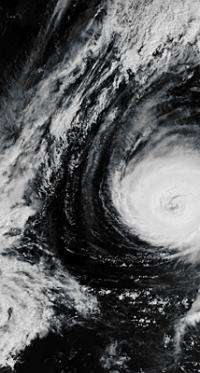
This Envisat image captures Typhoon Melor spinning in the Pacific Ocean northeast of the Philippines on 6 October 2009 before slamming into the main Japanese island of Honshu. Instruments aboard ESA’s Envisat allow it to observe various features of tropical cyclones, including cloud structure, wind and wave fields, sea-surface cloud structure, sea-surface temperature and sea-surface height. Envisat’s Medium Resolution Imaging Spectrometer (MERIS) optical instrument acquired this image working in Full Resolution mode to provide a spatial resolution of 300 m. Credits: ESA

(PhysOrg.com) -- This Envisat image captures Typhoon Melor spinning in the Pacific Ocean northeast of the Philippines on 6 October before slamming into the main Japanese island of Honshu on Thursday.

As the approached Honshu, it was generating winds of 198 km/h, but weakened after making landfall. The strong winds associated with Melor have toppled trees and power lines, leaving some 10 000 homes without electricity.

By early Thursday, the storm was moving northwest at 30 km/h, carrying a maximum sustained wind speed reaching 111 km/h, according to the Japan Meteorological Agency.

Melor is the first typhoon to make landfall in Japan since Typhoon Fitow hit in 2007. Last year was the first time in eight years that a typhoon did not hit the island.

Typhoons and hurricanes are different names for the same kind of storm - a tropical cyclone. If a storm begins in the Atlantic Ocean or the Eastern Pacific Ocean it is called a , and if it begins in the Western Pacific it is called a typhoon. Typhoons usually pack stronger winds than hurricanes.

Tropical cyclones are large powerful storms that rotate around a central area of extreme low pressure. They arise in warm tropical waters that transfer their heat to the air. The warmed air rises rapidly, in the process creating low pressure at the water surface. Winds begin rushing inwards and upwards around this low-pressure zone.

Knowing their strength and path is critical for issuing timely warnings. Earth observation satellites are the best means of providing data on the forces that power the storm.

Instruments aboard ESA’s Envisat allow it to observe various features of , including cloud structure, wind and wave fields, sea-surface cloud structure, sea-surface temperature and sea-surface height.

Envisat’s Medium Resolution Imaging Spectrometer (MERIS) optical instrument acquired this image working in Full Resolution mode to provide a spatial resolution of 300 m.

Provided by European Space Agency (news : web)


print this article email this article download pdf blog this article bookmark this article     Stumble it Digg this share on Facebook retweet share on Reddit add to delicious
Rate this story - 3.3 /5 (3 votes)


October 9, 2009 all stories

Comments: 0

3.3 /5 (3 votes)
  • Stumble this up

  • Digg this

  • share this

  • hide
  • Related Stories

  • Envisat Images Hurricane Gustav
    created Sep 05, 2008 | popularity not rated yet | comments 0
  • Typhoon Melor and Tropical Storm Parma mean double trouble in the western Pacific
    created Oct 07, 2009 | popularity not rated yet | comments 0
  • Two NASA satellites capture monster Super Typhoon Melor
    created Oct 05, 2009 | popularity not rated yet | comments 0
  • NASA's TRMM satellite captures Typhoon Melor as it reaches Japan
    created Oct 08, 2009 | popularity not rated yet | comments 0
  • Hurricane Dean tracked from space
    created Aug 21, 2007 | popularity not rated yet | comments 0


  • hide
  • Relevant PhysicsForums posts

  • Which countries around the world cause the most destruction to the rain forest
    created 20 hours ago
  • HadleyCru data hacked
    created Nov 20, 2009
  • Younger Dryas Caused by Ice Dam Collapse?
    created Nov 17, 2009
  • Modeling rainfall and flooding
    created Nov 15, 2009
  • More from Physics Forums - Earth

Other News

Baby can wait as expectant dad finishes spacewalk (AP)

Baby can wait as expectant dad finishes spacewalk

Space & Earth / Space Exploration

created 20 hours ago | popularity 3 / 5 (2) | comments 0

(AP) -- A spacewalking astronaut put aside the impending birth of his daughter and blazed through his first-ever venture outside the International Space Station on Saturday.


Commuters wait on the platform shrouded by fog in London

Climate change not man-made, say majority of Britons: poll

Space & Earth / Environment

created Nov 15, 2009 | popularity 3.3 / 5 (15) | comments 46

Less than half of Britons believes that human activity is to blame for global warming, according to a poll carried out for The Times newspaper and published on Saturday.


Mysteriously warm times in Antarctica

Mysteriously warm times in Antarctica

Space & Earth / Earth Sciences

created Nov 18, 2009 | popularity 4.2 / 5 (21) | comments 28

(PhysOrg.com) -- A new study of Antarctica's past climate reveals that temperatures during the warm periods between ice ages (interglacials) may have been higher than previously thought. The latest analysis ...


UN: Fight climate change with free condoms (AP)

UN: Fight climate change with free condoms

Space & Earth / Environment

created Nov 18, 2009 | popularity 3.1 / 5 (11) | comments 30

(AP) -- The battle against global warming could be helped if the world slowed population growth by making free condoms and family planning advice more widely available, the U.N. Population Fund said Wednesday.


Mystery of the Solar Tsunami -- Solved

Mystery of the Solar Tsunami -- Solved (w/ Video)

Space & Earth / Astronomy

created Nov 19, 2009 | popularity 4.9 / 5 (24) | comments 8

(PhysOrg.com) -- Sometimes you really can believe your eyes. That's what NASA's Solar Terrestrial Relations Observatory (STEREO) is telling researchers about a controversial phenomenon on the sun known as ...