New age of discovery for new proteins dawns
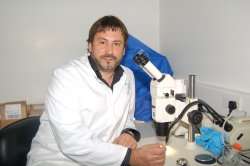
October 9, 2009 New age of discovery for new proteins dawns

(PhysOrg.com) -- We are on the brink of another new age of discovery- this time of countless new proteins, which could be used in a whole range of situations from medicine to industry, following the successful development of a new laboratory technique.

The new technique, a reactome array, is set to transform microbiological research. It is described for the first time today in the internationally prestigious journal Science (9.10.09) in a paper co-authored by Professor Peter Golyshin of Bangor University, along with research colleagues at universities in Spain and Germany.

The new technique pinpoints biochemical activity (metabolism) and energy exchange within the cell and identifies active proteins in individual microbes or communities of microbes, from any environment. It bridges a gap between an ever increasing genome or DNA sequencing dataset and understanding the specific functions of the genes.

"The last 15 years have seen dramatic strides in our knowledge through the development of DNA sequencing. This approach can provide a blueprint for the entire genetic make up of a single microbe or complex . We can easily describe and catalogue the elements that make the DNA sequence, that is, the genes. To identify their function, they usually have to be compared to existing databases of known gene function. In a sense, what currently happens is a comparison against already known genes and proteins.

Reactome Array takes a wholly different approach. The technique identifies the whole set of biochemical reactions and, importantly, captures and identifies the proteins actively involved in the cell's metabolism or energy exchange," explains Professor Peter Golyshin, Professor of Environmental Genomics at Bangor University.

As well as enabling us to have a better understanding of how the world around us functions at a microbial level, these yet to be discovered proteins could have applications in a whole range of situations from medicine or pharmaceuticals to industry to environmental control, from the development of cost effective medical diagnostic kits for particular diseases to the mining of interesting proteins from unusual and extreme microbial habitats where one could anticipate novel proteins for use in food production, cosmetics, agriculture and other industries.

More information: Reactome Array: Forging a Link Between Metabolome and Genome is published in Science, issue 9 October 2009

Provided by Bangor University (news : web)


print this article email this article download pdf blog this article bookmark this article     Stumble it Digg this share on Facebook retweet share on Reddit add to delicious
Rate this story - 5 /5 (4 votes)


October 9, 2009 all stories

Comments: 0

5 /5 (4 votes)
  • Stumble this up

  • Digg this

  • share this

  • hide
  • Related Stories

  • Unique protein from an extremophilic organism discovered
    created Jun 17, 2008 | popularity not rated yet | comments 0
  • Team probes mysteries of oceanic bacteria: Wee creatures are key to Earth's environment
    created Mar 03, 2008 | popularity not rated yet | comments 0
  • Bigelow laboratory scientists doach to study marine microbes
    created May 21, 2007 | popularity not rated yet | comments 0
  • Scientists Expand Microbe 'Gene Language'
    created Feb 28, 2007 | popularity not rated yet | comments 0
  • Protein study finds clues to microbes' survival techniques
    created May 05, 2005 | popularity not rated yet | comments 0


  • hide
  • Relevant PhysicsForums posts

  • Putting every element in a box
    created 5 hours ago
  • a question in Lewis structure???
    created 12 hours ago
  • Paint Technology
    created Nov 24, 2009
  • About pH, Metallic electrodes
    created Nov 24, 2009
  • More from Physics Forums - Chemistry

Other News

Blocking biofilms: Alzheimer's research sheds light on potential treatments for urinary tract infections

Chemistry / Biochemistry

created 10 hours ago | popularity 5 / 5 (1) | comments 0

(PhysOrg.com) -- Research into Alzheimer's disease seems an unlikely approach to yield a better way to fight urinary tract infections (UTIs), but that's what scientists at Washington University School of Medicine in St. Louis ...


Chemists get custom-designed microscopic particles to self-assemble in liquid crystal

Chemists get custom-designed microscopic particles to self-assemble in liquid crystal

Chemistry / Materials Science

created 10 hours ago | popularity 5 / 5 (5) | comments 0

(PhysOrg.com) -- The scientists anticipate their "LithoParticles" will have significant applications in photonics, optical communications and other areas.


Study shows flavanol antioxidant content of US chocolate and cocoa-containing products

Chemistry / Other

created 12 hours ago | popularity 1 / 5 (2) | comments 0

A recent study confirms that the antioxidants and other plant-based nutrients in chocolate and cocoa products are highly associated with the amount of non-fat cocoa-derived ingredients in the product. The study expands on ...


Sandia CR5

Machine Converts CO2 into Gasoline, Diesel, and Jet Fuel

Chemistry / Biochemistry

created Nov 23, 2009 | popularity 4.6 / 5 (30) | comments 19

(PhysOrg.com) -- Researchers at Sandia National Laboratories have built a machine that uses the sun's energy to convert carbon dioxide waste from power plants into transportation fuels such as gasoline, diesel, ...


New hydrogen-storage method discovered

New hydrogen-storage method discovered

Chemistry / Materials Science

created Nov 22, 2009 | popularity 4.3 / 5 (41) | comments 15

Scientists at the Carnegie Institution have found for the first time that high pressure can be used to make a unique hydrogen-storage material. The discovery paves the way for an entirely new way to approach ...