In Brief: Exploring the limits of antiferromagnetism in nanostructured materials
October 9, 2009 Exploring the limits of antiferromagnetism in nanostructured materials

Enlarge

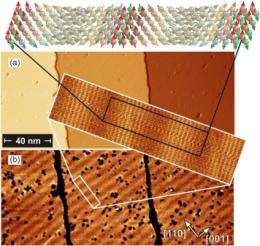
(Top) Schematic of the spin structure of the Mn monolayer on W(110) (6-nm repeat structure). (a) Topography and (b) differential conductance at 40 K. (Inset) High-resolution topographic data taken with a spin-sensitive tip; stripe contrast is related to the degree of antiferromagnetic order.

(PhysOrg.com) -- Researchers in the Electronic & Magnetic Materials & Devices Group (Argonne National Laboratory) and at Politecnico di Milano in Italy explored the limits of antiferromagnetism in a nanostructured material for the first time, measuring the temperature required to support antiferromagnetic order in atomic monolayers of manganese on tungsten as the dimensions of the structures are reduced.

While these boundaries are well understood in ferromagnetic materials, antiferromagnetic materials - where neighboring magnetic moments cancel rather than add together - have proven more challenging to unravel.

This study exploits the unique properties of manganese spin spirals on tungsten to correlate spin-sensitive scanning tunneling microscopy techniques on the atomic scale with electronic signatures, showing that the ordering temperature for the antiferromagnetic structure depends both on its size and its orientation with respect to the crystal lattice.

Such investigations will help guide the way to next generation platforms for ultra-high-density data storage and novel sensing capabilities.

More information: Paolo Sessi, Nathan P. Guisinger, Jeffrey R. Guest, and Matthias Bode, Phys. Rev. Lett. (in press)

Provided by Argonne National Laboratory (news : web)


Rate this story - not rated yet


October 9, 2009 all stories

Comments: 0

not rated yet

  • hide
  • Related Stories


  • hide
  • Relevant PhysicsForums posts

  • Interception angle
    created 1hour ago
  • Pressure created by clamping base and cover
    created 2 hours ago
  • How to find static friction
    created 8 hours ago
  • Calculating decible increases
    created 15 hours ago
  • More from Physics Forums - General Physics

Other News

Nanoscale Structures with Superior Mechanical Properties Developed

Nanoscale Structures with Superior Mechanical Properties Developed

Nanotechnology / Nanomaterials

created 16 hours ago | popularity 4.6 / 5 (9) | comments 1 | with audio podcast

(PhysOrg.com) -- Researchers at the California Institute of Technology have developed a way to make some notoriously brittle materials ductile -- yet stronger than ever -- simply by reducing their size.


Spray-on liquid glass

Spray-on liquid glass is about to revolutionize almost everything

Nanotechnology / Nanomaterials

created Feb 02, 2010 | popularity 4.7 / 5 (240) | comments 93 | with audio podcast report

(PhysOrg.com) -- Spray-on liquid glass is transparent, non-toxic, and can protect virtually any surface against almost any damage from hazards such as water, UV radiation, dirt, heat, and bacterial infections. ...


IBM Scientists Demonstrate World's Fastest Graphene Transistor

IBM Scientists Demonstrate World's Fastest Graphene Transistor

Nanotechnology / Nanophysics

created Feb 05, 2010 | popularity 4.9 / 5 (38) | comments 25 | with audio podcast

(PhysOrg.com) -- In a just-published paper in the magazine Science, IBM researchers demonstrated a radio-frequency graphene transistor with the highest cut-off frequency achieved so far for any graphene device ...


Conductive eTextiles: Stanford finds a new use for cloth

Conductive eTextiles: Researchers move from making batteries from paper to making batteries from cloth

Nanotechnology / Nanomaterials

created Feb 05, 2010 | popularity 4.3 / 5 (7) | comments 4 | with audio podcast

(PhysOrg.com) -- Stanford researchers have moved from making batteries from paper to making batteries from cloth. Your-T-shirt could become a lighted, moving display.


Carbon Based Chips May One Day Replace Silicon Transistors

Carbon Based Chips May One Day Replace Silicon Transistors

Nanotechnology / Nanomaterials

created Feb 03, 2010 | popularity 4.7 / 5 (18) | comments 3 | with audio podcast weblog

(PhysOrg.com) -- IBM researchers are hopeful that, over the next decade, silicon-based transistors will be replaced by carbon-based transistors. IBM has already laid out the ground work for carbon-based transistors.