When Being a Cuckold Makes Evolutionary Sense
October 9, 2009
When Being a Cuckold Makes Evolutionary Sense

Enlarge

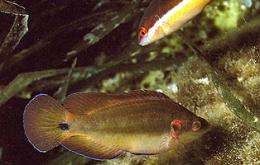
(PhysOrg.com) -- Evolutionary biology theory predicts that males usually won't invest a lot of time raising offspring when there is a good chance they are not the fathers. Yale University researchers have found a notable exception to this premise-a male fish in the Mediterranean, the ocellated wrasse, that is more likely to be paternal when there is grave doubt about the offsprings' parentage.

Theory also suggests females will look for cues in males that indicate they will make good fathers. However, results of the study — reported this week in the online edition of the journal Proceedings of the Royal Society of London — show female ocellated wrasse deposit more eggs into nests where the potentially nurturing “parental” males are surrounded by non-nesting “sneaker” males, who are also likely to father her young but spend no time raising them.

Parental male oscellated wrasse are more likely to care for offspring in this sperm-filled environment than in nests in which there is less sexual competition, said Suzanne H. Alonzo, assistant professor of ecology and and co-author of the study, along with Kellie L. Heckman, a postdoctoral fellow in the department.

Alonzo said that while these findings surprise some evolutionary biologists, they make sense from the perspective of the nesting male ocellated wrasse. While the individual nesting male has a greater chance of being cuckolded when sneaker males are present, he also has a better chance of raising more of his own offspring because females deposit more eggs in nests where there are already large numbers of offspring.

“While our simpler theories have trouble explaining the diversity of what we observe in nature, these patterns do have explanations,” Alonzo said. “The paper suggests we may have oversimplified the of how these things work.”

Provided by Yale University (news : web)

4.6 /5 (5 votes)  

Rank 4.6 /5 (5 votes)
Related Stories
Relevant PhysicsForums posts
  • Factors affecting beet root cell membrane
    createdFeb 12, 2012
  • Stem cell question.
    createdFeb 10, 2012
  • Protease cleavage
    createdFeb 10, 2012
  • Pertubance in a model
    createdFeb 10, 2012
  • Cancer drugs and Alzheimer's, Oh my!
    createdFeb 09, 2012
  • Squishing cells
    createdFeb 09, 2012
  • More from Physics Forums - Biology

More news stories

Plants use circadian rhythms to prepare for battle with insects

In a study of the molecular underpinnings of plants' pest resistance, Rice University biologists have shown that plants both anticipate daytime raids by hungry insects and make sophisticated preparations to ...

Biology / Cell & Microbiology

created 3 minutes ago | popularity 5 / 5 (1) | comments 0 | with audio podcast

Explosive evolution need not follow mass extinctions, says study of ancient zooplankton

Following one of Earth's five greatest mass extinctions, tiny marine organisms called graptoloids did not begin to rapidly develop new physical traits until about 2 million years after competing species became ...

Biology / Evolution

created 2 hours ago | popularity 5 / 5 (1) | comments 1 | with audio podcast

Study finds fish of Antarctica threatened by climate change

A Yale-led study of the evolutionary history of Antarctic fish and their "anti-freeze" proteins illustrates how tens of millions of years ago a lineage of fish adapted to newly formed polar conditions – ...

Biology / Ecology

created 2 hours ago | popularity 5 / 5 (2) | comments 0 | with audio podcast

Lens produces hours of scientific work in seconds

A new form of microscope which can produce results in seconds rather than hours – dramatically speeding up the process of drug development - is being developed by researchers at the University of Strathclyde ...

Biology / Other

created 6 hours ago | popularity 4.3 / 5 (6) | comments 1 | with audio podcast

New molecule has potential to help treat genetic diseases and HIV

(PhysOrg.com) -- Chemists at The University of Texas at Austin have created a molecule that's so good at tangling itself inside the double helix of a DNA sequence that it can stay there for up to 16 days before ...

Biology / Plants & Animals

created 11 hours ago | popularity 5 / 5 (3) | comments 0 | with audio podcast


Researchers illuminate link between sodium, calcium and heartbeat

Using the Canadian Light Source synchrotron, researchers from the University of British Columbia have revealed, for the first time, one of the molecular mechanisms that regulates the beating of heart cells by controlling ...

Music service gives Myspace second wind

Faded online social network Myspace said Monday it was getting a second wind due to the popularity of a freshly launched online music player.

Fetal exposure to radiation increases risk of testicular cancer

Male fetuses of mothers that are exposed to radiation during early pregnancy may have an increased chance of developing testicular cancer, according to a study in mice at The University of Texas MD Anderson Cancer Center. ...

Oxygen-deprived baby rats fare worse if kept warm

New study suggests that baby rats deprived of oxygen, but kept warm, had bigger swings in glucose and insulin, metabolic and physiologic effects that could increase the chances of brain damage. Findings could have implications ...

Challenges of identifying cognitive abilities in severely brain-injured patients

Only by employing complex machine-learning techniques to decipher repeated advanced brain scans were researchers at NewYork-Presbyterian/Weill Cornell able to provide evidence that a patient with a severe brain injury could, ...

Prolonged fructose intake not linked to rise in blood pressure

Eating fructose over an extended period of time does not lead to an increase in blood pressure, according to researchers at St. Michael's Hospital.