Researchers pave the way for effective liver treatments
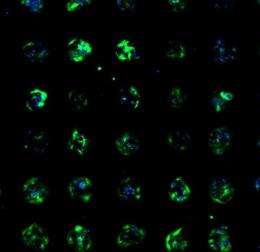
A combination of bioengineering and medical research at the University of California, San Diego has led to a new discovery that could pave the way for more effective treatments for liver disease.
In this work, the researchers have utilized an array system that can identify the biological components that can lead to or alleviate liver disease. The technology works by controlling the range of environments surrounding star-shaped liver cells called hepatic stellate cells (HSCs). HSCs are the major cell type involved in liver fibrosis, which is the formation of scar tissue in response to liver damage. The activated stellate cell is responsible for secreting collagen that produces a fibrous scar, which can lead to cirrhosis.
Current approaches to identify the factors affecting HSC biology typically focus on each factor individually, ignoring the complex cross-talk between the many components acting on the cells. The high-throughput cellular array technology developed by UCSD researchers systematically assesses and probes the complex relationships between hepatic stellate cells and components of their microenvironment. By doing this, they found that certain proteins are critical in regulating HSC activation and that the proteins influence one another's actions on the cells. The findings were published in a paper entitled "Investigating the role of the extracellular environment in modulating hepatic stellate cell biology with array combinatorial microenvironments" in the September 2009 issue of Integrative Biology.
"We can spot hundreds of combinations of proteins in the matrix surrounding the cell such as different kinds of collagen - you can spot them individually and in combination, so you can get hundreds of combinations with several proteins," said Shu Chien, co-author of the paper and bioengineering professor and director of the Institute of Engineering Medicine at UCSD. "We used a spotting pin that's normally used for microarray DNA spotting. But we spot proteins instead of DNA on theseslides.
"In one step we can look at the physical and chemical micro-environment of the cells," Chien added. "Now we can look at the optimum condition that is best for the cells to proliferate and differentiate."
The high-throughput cellular array technology used in this research was developed by Chien and his lab colleagues a few years ago mainly for stem cell research, but it has not been applied to this type of research before involving hepatic stellate cells.
"Our lab is interested in the cells that are responsible for laying down the fibrous scar in all types of chronic liver disease," said Dr. David Brenner, the dean of the UCSD School of Medicine and co-author of the paper. "In the course of 20 years, people have tried three or four matrixes to try to optimize their growth. Shu Chien mentioned this extracellular matrix array that his lab was using for stem cells, and I thought it would be an incredible opportunity to understand the effects of different matrixes in primary cell cultures.
"By looking at the array you get hundreds of different combinations of proteins and you can look at hundreds of cells at once," Brenner added. "This will give us new insights for the treatment for liver fibrosis, and it will give us the platform to test new treatments. This also allows us to do the critical experiments that will assess the ability of different drugs to work. There are really no effective therapies for liver fibrosis—there is only transplantation. Any less invasive therapy would be desirable. This is a big advance."
Chien said such medical advances are the result of the growing synergism between engineering and medicine. This study involves the dissertation work of David Brafman, who received his Ph.D. in bioengineering from UCSD under the joint advisorship of Chien and professor Karl Willert of the Department of Cellular and Molecular Medicine. Chien said the next step for this collaborative effort will be to develop a platform that allows scientists and researchers to differentiate cells into the kind they want. It's this type of work, Chien said, that gives the field of regenerative medicine a boost.
"Eventually we would like to help improve people's health," he said.
Source: University of California - San Diego (news : web)


