Moon crash: Public yawns, scientists celebrate
October 10, 2009 By SETH BORENSTEIN , AP Science Writer
Moon crash: Public yawns, scientists celebrate (AP)

Enlarge

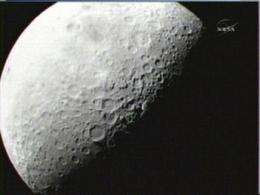
This image provided by NASA shows the first image taken of the moon from the Lunar Crater Observation and Sensing Satellite Friday morning Oct. 9, 2009. Two NASA spacecraft are barreling toward the moon at twice the speed of a bullet, about to crash into a lunar crater in a search for ice. (AP Photo/NASA)

(AP) -- NASA's great lunar fireworks finale fizzled. After gearing up for the space agency's much-hyped mission to hurl two spacecraft into the moon, the public turned away from the sky Friday anything but dazzled. Photos and video of the impact showed little more than a fuzzy white flash.

In social media and live television coverage, many people were disappointed at the lack of spectacle. One person even joked that someone hit the pause button in mission control.

Yet scientists involved in the project were downright gleeful. Sure, there were no immediate pictures of spewing plumes of that could contain water, but, they say, there was something more important: chemical signatures in light waves. That's the real bonanza, not pictures of geyser-like eruptions of debris, the scientists said.

The mission was executed for "a scientific purpose, not to put on a fireworks display for the public," said space consultant Alan Stern, a former associate administrator for science.

Scientists said the public expected too much. The public groused as if NASA delivered too little.

The divide was as big as a crater.

"We've been brainwashed by Hollywood to expect the money shot, like 'Deep Impact' or when Bruce Willis saves us from a comet," said physicist and television host Michio Kaku, who was not part of the mission. "Science is not done that way."

But Kaku and other experts also faulted NASA for overhyping the mission, not being honest with the public about the images being a longshot. "They should have put Steven Spielberg in charge," Kaku said.

NASA's mission - short for Observation and Sensing Satellite and pronounced L-Cross - had all the makings of a blockbuster. Its main goal was to look for some form of water on the - something that could still turn up in those light wave chemical signatures.

A preliminary review of data from the indicated no signs of water in the debris viewed from the blast, NASA said late Friday, but added that more study was needed.

And water on the moon could change NASA's troubled plans for space exploration. It would make revisiting and putting a base on the moon far cheaper because the moon's water could be used, Kaku said.

It was relatively cheap and last-minute by NASA standards: Just $79 million, in about three years. It was elegant in its simplicity. An empty rocket hull that would normally be space junk remained attached to the plucky little LCROSS until pulling away Thursday night. On Friday morning, it smashed into a crater near the moon's south pole.

Then the little satellite flew through what was supposed to be a six-mile plume of dust from the crash, taking pictures and measuring all sorts of stuff, mostly looking for water. Moments after the first crash, the smaller spacecraft itself hit the moon for a second impact.

The crashes created a man-made crater about one-fifth the size of a football field, Brown University geologist and LCROSS scientist Peter Schultz told The Associated Press.

It all worked perfectly, according to NASA. But there were no pictures of a plume. There may not have been a plume at all, or maybe it was just hidden or too small, said LCROSS scientist Anthony Colaprete.

The spacecraft, instead of spewing six miles of dust straight out, could have compacted the lunar soil - sort of like a rock sinking quickly in water instead of making a massive splash.

"We saw a crater; we saw a flash, so something had to happen in between," Colaprete said. The crater was the aftermath of the crash, and the flash was the impact itself.

The key is not in photographs but in squiggly lines that show those complicated light waves, Colaprete said. Once they are analyzed - a task that may take weeks - the light waves will show whether water was present at the crash site.

"It wasn't a dud. We got a gold mine of data," said Kaku, a professor at the City College of New York and host of "Sci Q Sundays" on the Science Channel. If those squiggly lines show there is ice just under the surface of the moon, it would make the lack of pictures worth it, he said.

"Ice is more valuable than gold on the moon," Kaku said.

For about a decade, scientists have speculated about buried ice below the moon's poles. Then surprising new research last month indicated that there seem to be tiny amounts of water mixed into the lunar soil all over the moon, making the moon once again a more interesting target for scientists.

But a discovery of ice later this month would not be quite the same as seeing promised flashes through a telescope.

People who got up before dawn to look for the crash at Los Angeles' Griffith Observatory threw confused looks at each other instead. They tried to watch on TV because the skies were not clear enough, but that proved disappointing, too.

Telescope demonstrator Jim Mahon called the celestial show "anticlimactic."

"I was hoping we'd see a flash or a flare, evidence of a plume," he said.

---

On the Net:

NASA's LCROSS site: http://www.nasa.gov/lcross

©2009 The Associated Press. All rights reserved. This material may not be published, broadcast, rewritten or redistributed.

3.9 /5 (19 votes)  

Filter


Move the slider to adjust rank threshold, so that you can hide some of the comments.


Display comments: newest first

Bob_Kob
Oct 10, 2009

Rank: 4 / 5 (4)
Capture the publics attention: Test nuclear weapons on the moon. I'd pay to see that.
Doug_Huffman
Oct 10, 2009

Rank: 4.2 / 5 (5)
The conspiracy of ignorance masquerades as common sense.
Sean_W
Oct 10, 2009

Rank: 5 / 5 (1)
I love the reaction to the reaction. They basically call us all slack-jawed yokles for wanting a big show but they also kind of, sort of admit that they kind of sort of promised everyone a big show. If we are all so simple maybe they should have saved all the flashy animation for after and told us it was the real mission.
fixer
Oct 10, 2009

Rank: 3 / 5 (2)
I suppose it's one way to get rid of trash, throw it into the neighbors garden or onto a vacant lot.
Nothing really changes, does it.
LuckyBrandon
Oct 10, 2009

Rank: not rated yet
sean w-then the conspiracy theories would be thrown abound ;)
Roj
Oct 11, 2009

Rank: not rated yet
"We've been brainwashed by Hollywood to expect the money shot.."
Ya, we also recall Governors and stuff Hollywood action figures in their place.

Overwhelming numbers of young California voters elected their favorite action hero, who hasn't picked up a single weapon, or blown up anything. Another dud, which ultimately offered very little excitement besides falling off his motorcycle once.
conklin
Oct 11, 2009

Rank: 3 / 5 (2)
NASA'S MOON-ICE PROBE BOONDOGGLE

The anticipated "Violent Impact" and "huge cloud of lunar dust and ice crystals" was not observed on a 30-foot TV display by the gullible masses.

Is NASA aware that there is no atmosphere on the Moon? A particle of Moon dust will fall back to the Moon's surface with the same acceleration as a bowling ball. Reference: High school physics.

NASA spokesmen have stated that the importance of finding ice on the Moon is that water could provide hydrogen for fuel and oxygen to breathe.

Is NASA aware that far more energy is required to disassociate H2O into H2 and O2 than can be recovered by the recombination of H2 and O2 to produce useful work such as rocket propulsion? Reference: Engineering chemistry and thermodynamics.

Is NASA aware that the absurdities of men mining polar Moon-ice crystals for any useful purpose are too numerous to enumerate?

In engineering terms...NASA is jerking-off in the bathroom.

James T. Conklin
DrJim
Oct 12, 2009

Rank: 5 / 5 (2)
>Is NASA aware that there is no atmosphere on the >Moon? A particle of Moon dust will fall back to >the Moon's surface with the same acceleration as >a bowling ball. Reference: High school physics.

Unless the small particles are tribo-charged. Reference: University phsyics.

>Is NASA aware that far more energy is required to >disassociate H2O into H2 and O2 than can be >recovered by the recombination of H2 and O2 to >produce useful work such as rocket propulsion? >Reference: Engineering chemistry and >thermodynamics.

Are you aware that electrical energy is cheap on the moon (photovoltaics or heat engine), but can not be stored for transportation purposes without chemical intermediaries? Reference: elementary school science

>Is NASA aware that the absurdities of men mining >polar Moon-ice crystals for any useful purpose >are too numerous to enumerate?

Are you aware of how comical you sound? Reference Saturday Night Live
Truth
Oct 12, 2009

Rank: not rated yet
I wonder if this "bombing" of the moon might serve another less obvious purpose...Recently, China and other nations are gearing up to land their own people on the moon....Dropping a massive object with pin-point precision down on a moon target might be a way of sending a not so subtle message to them....
abhishekbt
Oct 13, 2009

Rank: not rated yet
Comment by Truth makes me wonder though, can it be another still less obvious fact?

Though there was no blast nor an explosion(nuclear!), I think NASA would have definitely tried to measure any changes in the Moon's orbit even by a minuscule amount.
Those two satellites may have lacked TNT but they definitely had a tremendous amount of K.Energy. I see NASA getting ready for the Space Defense Program! Anyone asteroids calling?
antialias_physorg
Oct 17, 2009

Rank: not rated yet
I think NASA would have definitely tried to measure any changes in the Moon's orbit even by a minuscule amount.

Hardly. Spitting in the ocean does not produce measurable results. The orders of magnitude between the kinetic energy of that piece of (basically hollow) space debris and the (very solid) moon are just too staggering for anyone to measure a change in orbit (remember that every day a lot more mass is collected by the moon from space debris which impacts it. Since we don't know how much that is we couldn't calculate the change due to the NASA impact even if we had the instruments to measure it.)
Rank 3.9 /5 (19 votes)
Related Stories
Relevant PhysicsForums posts
  • Is Venus Slowing Down?
    created11 hours ago
  • Never ending outer space.....
    createdFeb 11, 2012
  • Neutron Star fragments?
    createdFeb 11, 2012
  • stationary or not?
    createdFeb 11, 2012
  • Flash Scale of the Universe
    createdFeb 10, 2012
  • Titan's lack of impact craters
    createdFeb 09, 2012
  • More from Physics Forums - General Astronomy

More news stories

Time of year important in projections of climate change effects on ecosystems

(PhysOrg.com) -- Does it matter whether long periods of hot weather, such as last year's heat wave that gripped the U.S. Midwest, happen in June or July, August or September?

Space & Earth / Environment

created 43 minutes ago | popularity 5 / 5 (1) | comments 0 | with audio podcast

Scientists discover reason for Mt. Hood's non-explosive nature

(PhysOrg.com) -- For a half-million years, Mount Hood has towered over the landscape, but unlike some of its cousins in Oregon’s Cascade Mountains and many other volcanoes around the Pacific “Rim ...

Space & Earth / Earth Sciences

created 1 hour ago | popularity 5 / 5 (1) | comments 0 | with audio podcast

Missing dark matter located: Intergalactic space is filled with dark matter

Researchers at the University of Tokyo’s Institute for the Physics and Mathematics of the Universe (IPMU) and Nagoya University used large-scale computer simulations and recent observational data of gravitational ...

Space & Earth / Astronomy

created 1 hour ago | popularity 4.2 / 5 (5) | comments 6 | with audio podcast

Planck mission steps closer to the cosmic blueprint

(PhysOrg.com) -- ESA's Planck mission has revealed that our Galaxy contains previously undiscovered islands of cold gas and a mysterious haze of microwaves. These results give scientists new treasure to mine ...

Space & Earth / Astronomy

created 10 hours ago | popularity 5 / 5 (8) | comments 2 | with audio podcast

Scientists say Obama Mars cuts to hit research (Update)

The United States will scale back Mars exploration under a proposed budget by President Barack Obama released Monday that has some scientists fuming over the risk of a NASA brain-drain.

Space & Earth / Space Exploration

created 7 hours ago | popularity 5 / 5 (3) | comments 23


First-of-its-kind stem cell study re-grows healthy heart muscle in heart attack patients

Results from a Cedars-Sinai Heart Institute clinical trial show that treating heart attack patients with an infusion of their own heart-derived cells helps damaged hearts re-grow healthy muscle.

Discovery paves way for salmonella vaccine

(Medical Xpress) -- An international research team led by a University of California, Davis, immunologist has taken an important step toward an effective vaccine against salmonella, a group of increasingly antibiotic-resistant ...

Smoking bans lead to less, not more, smoking at home: study

Smoking bans in public/workplaces don't drive smokers to light up more at home, suggests a study of four European countries with smoke free legislation, published online in Tobacco Control.

Ovarian cancer arises in fallopian tube of knockout mice

(Medical Xpress) -- The most deadly form of "ovarian" cancer arises in the fallopian tubes – not the ovaries – of knockout mice that lack two genes associated with the disease, said researchers led by Baylor College ...

UK cases of progressive sight loss condition set to rise a third by 2020

New cases of the progressive sight loss condition, known as age-related macular degeneration, or AMD for short, are set to rise by a third in the UK over the next decade, reveals research published online in the British Jo ...

Medical school link to wide variations in pass rate for specialist exam

Wide variations in doctors' pass rates, for a professional exam that is essential for one type of specialty training, seem to be linked to the particular medical school where the student graduated, indicates research published ...