Taiwan scientists identify flood-tolerant gene in rice
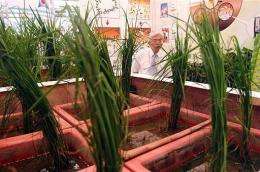
October 11, 2009 This photos shows rice growing from bio-engineered soil aimed at enhancing its productivity at a trade show in July 2009

Enlarge

This photos shows rice growing from bio-engineered soil aimed at enhancing its productivity at a trade show in Taipei in July 2009. A Taiwanese scientist has said her research team has found the gene that allows rice to grow under water and believes the breakthrough could help develop other flood-resistant crops.

A Taiwanese scientist has said her research team has found the gene that allows rice to grow under water and believes the breakthrough could help develop other flood-resistant crops.

The gene, named CIPK15, a type of enzyme, "allows seedlings to survive and continue to grow even when submerged in water," said Yu Su-mei, a research fellow at the Institute of Molecular Biology at Taiwan's Academia Sinica.

Yu said she believed the discovery would help breeders generate new rice varieties with greater seedling growth under flood-water, which would save on labour and use of pesticides, potentially benefiting the environment.

The study was published in the current issue of the Washington-based journal Science Signaling.

(c) 2009 AFP


print this article email this article download pdf blog this article bookmark this article     Stumble it Digg this share on Facebook retweet share on Reddit add to delicious
Rate this story - 4.7 /5 (3 votes)


October 11, 2009 all stories

Comments: 0

4.7 /5 (3 votes)
  • Stumble this up

  • Digg this

  • share this

  • hide
  • Related Stories

  • Scientists develop high-yield deep water rice
    created Aug 20, 2009 | popularity not rated yet | comments 0
  • New flood-tolerant rice offers relief for world's poorest farmers
    created Aug 09, 2006 | popularity not rated yet | comments 0
  • Scientists unlock mystery of aromatic rice
    created Mar 25, 2008 | popularity not rated yet | comments 0
  • Water-stingy agriculture reduces arsenic in rice markedly
    created Jul 28, 2008 | popularity not rated yet | comments 0
  • Gene's past could improve the future of rice
    created Jan 23, 2009 | popularity not rated yet | comments 0


  • hide
  • Relevant PhysicsForums posts

  • What is transpulmonary pressure?
    created Nov 24, 2009
  • Is there a gay gene?
    created Nov 23, 2009
  • Super quick question about Starling forces?
    created Nov 22, 2009
  • Questions about diffusion
    created Nov 22, 2009
  • More from Physics Forums - Biology

Other News

'Safety valve' protects photosynthesis from too much light

Biology / Cell & Microbiology

created 47 minutes ago | popularity not rated yet | comments 0

Photosynthetic organisms need to cope with a wide range of light intensities, which can change over timescales of seconds to minutes. Too much light can damage the photosynthetic machinery and cause cell death. Scientists ...


Cells defend themselves from viruses, bacteria with armor of protein errors

Biology / Cell & Microbiology

created 1hour ago | popularity not rated yet | comments 0

When cells are confronted with an invading virus or bacteria or exposed to an irritating chemical, they protect themselves by going off their DNA recipe and inserting the wrong amino acid into new proteins to defend them ...


Researchers discover biological basis of 'bacterial immune system'

Biology / Cell & Microbiology

created 1hour ago | popularity 4 / 5 (1) | comments 0

Bacteria don't have easy lives. In addition to mammalian immune systems that besiege the bugs, they have natural enemies called bacteriophages, viruses that kill half the bacteria on Earth every two days.


Redback spiders were first spotted in Japan in 1995

Venomous Aussie redback spiders invading Japan

Biology / Ecology

created 8 hours ago | popularity 5 / 5 (2) | comments 0

Australia's venomous redback spiders are on the march in Japan, where they are believed to have arrived years ago as stowaways on cargo ships, a wildlife expert warned Wednesday.


Study explores violent world of raptors

Biology / Plants & Animals

created 8 hours ago | popularity not rated yet | comments 0

A journey that started with a box of bird feet carried three Montana State University graduate students into the gruesome world of raptors and led to their findings being published in a prominent journal.